My Child May Have ADHD: Which Montessori Activities Help with Focus and Calm?
Published on: October 31, 2026
My Child May Have ADHD: Which Montessori Activities Help with Focus and Calm?
I have two children: one is 3 years old and the other is 6 years old. The older child shows some traits that may suggest ADHD, but the diagnosis has not yet been confirmed. I would especially like to learn about Montessori activities suited to their ages, as well as ideas to support focus, independence, and emotional regulation, particularly for a child who may have ADHD.
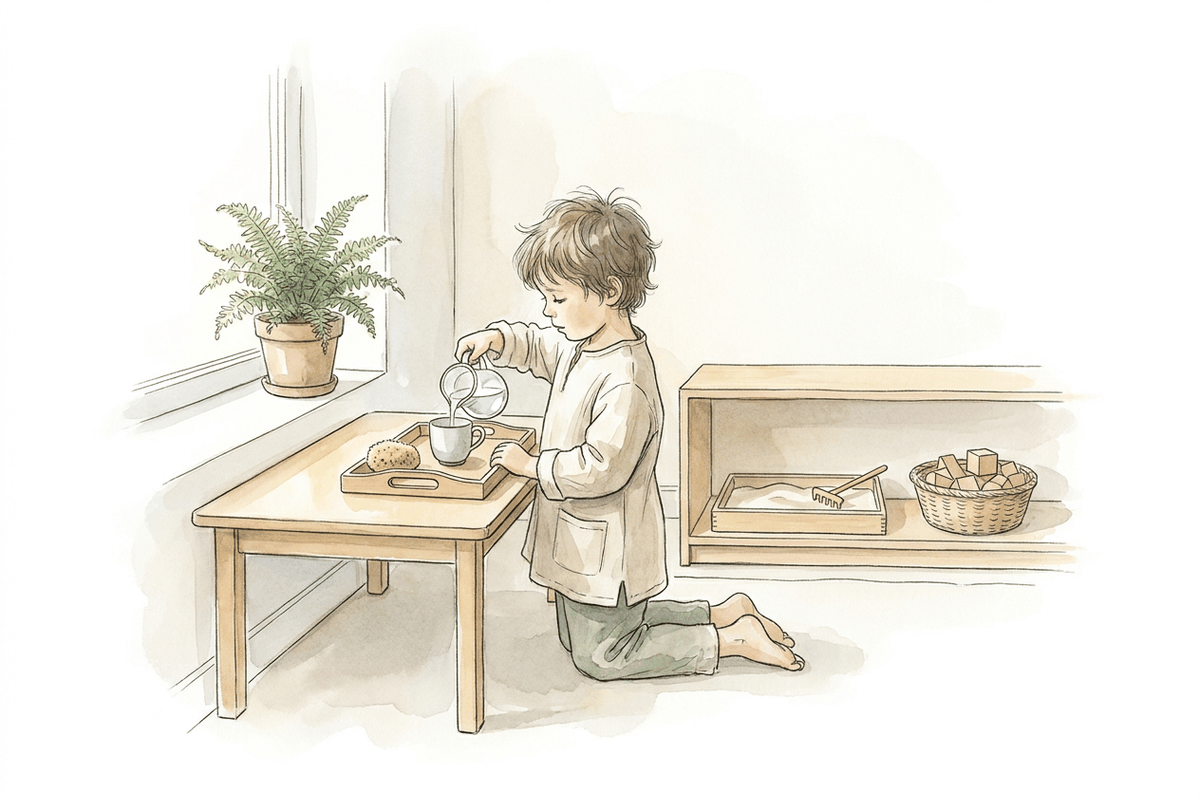
Thank you so much for writing, and for telling me about your two. Three and six is a lovely pair of ages, and almost everything below works for both of them, side by side.
First, the most important thing: your doctor is the right person for the ADHD question. I am not a doctor, and nothing here takes the place of their advice. But these activities help any busy child, whatever a diagnosis does or does not say, and they work well alongside whatever you learn there.
I like to think of a busy child as a curious child, not a distracted one. That child has a lot of energy, and our job is not to stop it. Our job is to give it somewhere good to go.
Start with Free Play, Then Add Structure a Little at a Time
This is the most important idea in this whole letter. For a child with ADHD, especially between three and six, something very structured, like a puzzle or a careful pouring exercise, usually will not work at first. It asks for too much stillness and precision too soon, and it can end in frustration for both of you.
So begin with lots of free play: digging in the sand, splashing and pouring at the water table, building, running, climbing. Let your child explore with no rules about how it should be done. Then, a little at a time, bring in one short, structured activity. Show it once, keep it brief, and stop while it is still going well. Over weeks and months, as your child is ready, the structured work can grow. Everything below is written with that in mind: start loose, and add structure slowly.
Give the Hands Real Work
Again and again, Montessori teachers notice the same thing: a child who cannot sit still for a worksheet will settle when their hands have a real job to do. In Montessori we call this practical life. Start with the loosest version of each job, like free water play at the sink or scrubbing a big table, and bring in the more careful versions later, one at a time.
- Water play first, then pouring. Let your child pour and splash freely at the sink or in a tub. Later, when they are ready, show the careful pouring exercise from one small pitcher to another.
- Spooning and transferring beans from one bowl to another.
- Table washing, with a bucket, a brush, soap and a sponge. Many children will happily scrub for twenty minutes.
- Washing up real dishes at a low basin.
For your three-year-old, these practical life activities for toddlers are just the right size. Your six-year-old can learn the same work and then show the little one how to do it. Older children love to teach, and being the helper is wonderful for confidence.
Maria Montessori first saw how deep a young child's concentration can go when she watched a three-year-old girl work with the knobbed cylinders. The girl took the cylinders out and put them back more than forty times, so absorbed that she did not notice the room around her. Repetition is how concentration grows, so when your child wants to do the same work again and again, let them.
Heavy Work Before Sitting Work
Occupational therapists use the term "heavy work" for anything that makes the muscles push, pull or carry. It helps many children feel settled in their bodies, especially just before a task that needs focus. At home, heavy work can be:
- carrying a basket of books or a watering can from room to room;
- watering the plants or digging in the garden (try growing sprouts together);
- sweeping the floor, or pushing a laundry basket down the hall;
- carrying the groceries in from the car.
Five minutes of this before a quieter activity can make a real difference.
Sand and Water Play, with a Purpose
Sand and water are calming for almost every child, and they are the perfect free play. At first, just let your child dig, pour, scoop and splash, with no rules at all. Much later, once your child is happy and settled with them, you can add a small purpose now and then:
- Hide a few shells in a tray of sand, and sift to find them all.
- Fill a cup up to a line drawn on the side. This one asks for a lot of control, so save it until your child is ready.
- Trace letters or numbers in a thin layer of sand on a tray, just like sandpaper letters without the sandpaper.
- Make sand candles together.
Building with Blocks and Lego
Building is wonderful hand work, and it lets a child make a plan and carry it out. Blocks are perfect for your three-year-old. Lego is a great fit for your six-year-old, as are the constructive triangles. One tip: offer a small set at a time, in one basket, rather than the whole bin. Too many pieces can be as hard on concentration as too few.
Short Movement Breaks Between Activities
I know an elementary teacher who would let her children take a short recess between activities: go outside, run around and play for a few minutes, then come back in. It helped a great deal. The children came back ready to work.
You can do the same at home. Between one activity and the next, go outside and run to the fence and back, jump, or play chase for five minutes. Indoors, try walking the line: walking slowly along a line of tape, heel to toe, perhaps carrying a little bell without letting it ring. It turns movement into the work instead of the problem.
Then, to bring the energy back down, the silence game is a gentle first step toward calm. Keep it short at first, even ten seconds, and let it grow.
A Calm, Simple Space
The room itself can help or hurt. A few ideas:
- Fewer things on the shelf. Six or eight activities are plenty. Put the rest away and swap a few each week.
- Everything in its place. Each activity on its own tray or in its own basket, always on the same shelf.
- Long, unhurried work time. When your child is concentrating, do not interrupt, not even to praise. Wait until they finish.
- A steady rhythm to the day. When a child knows what comes next, they do not have to spend energy wondering. Our Montessori routines at home article has ideas.
Helping with Big Feelings
Emotional regulation grows the same way concentration does: with practice, in calm moments. Grace and courtesy lessons let you role-play what to do when we are upset, before it is needed: "When I feel angry, I can take three slow breaths," or "I can say, 'I need a break.'" A cozy peace corner, a small spot with a cushion and a calm-down jar, gives a child somewhere to go to settle. I wrote more about this, and about Montessori for children with ADD and ADHD, in My Child is Out of Control, What Can I Do?
One Small Step to Start
You do not need to do all of this at once. This week, give both children plenty of free play with sand, water and building, add one short movement break between activities, and try one small real job. Then watch what happens. Observation is the heart of Montessori, and your children will show you what helps them most.