My Child is out of Control, what can I do?
Published on: June 30, 2007
Sometimes parents ask, “Why does my child hit and push other children?” In fact often, my child won’t share or even take turns. They wonder if their child might even be a bully. If you’re feeling this way, please know that you are not alone — and the fact that you’re seeking answers shows just how deeply you care about your child’s well-being and development.
Children who exhibit this behavior are often strong-willed leaders who like to push limits. They are testing boundaries, exploring their power in the world, and trying to understand how relationships work. You can’t do much to change your child’s personality — and truthfully, you wouldn’t want to. That boldness and determination will serve them well in life. But you can do a few things to help them live and thrive within the norms of society, channeling that fierce energy in positive and constructive directions.
Understanding What’s Behind the Behavior
In Montessori education, we look at challenging behavior not as something to punish, but as a form of communication. When your child pushes, hits, or refuses to share, they are often telling you something important: they may be overwhelmed, understimulated, seeking control, or simply lacking the vocabulary to express big emotions. Rather than labeling the behavior as “bad,” try to observe what is happening just before the outburst. Is your child tired? Hungry? Transitioning between activities? Understanding the root cause allows you to address the real need.
In Montessori, we talk about the concept of normalization — the process by which a child, through meaningful and engaging work, develops deep concentration, self-discipline, and a sense of inner peace. A child who is acting out is often a child who has not yet found that deep engagement. When children are given purposeful activities that match their developmental needs, their behavior naturally begins to shift.
Montessori Strategies for Handling Aggressive or Defiant Behavior
Any activity that gives your child constructive freedom to lead and make choices will help channel that energy positively. Here are some Montessori-inspired strategies you can begin using at home:
- Offer meaningful choices: Instead of telling your child what to do, give them two acceptable options. “Would you like to set the table or pour the water into the pitcher?” This satisfies their need for control while keeping them within appropriate boundaries.
- Teach Grace and Courtesy lessons: In Montessori classrooms, we role-play social interactions — how to ask for a turn, how to say “excuse me,” how to express frustration with words instead of hands. Practice these scenarios at home during calm moments, not in the heat of conflict.
- Create a peace corner: Designate a small, cozy area in your home where your child can go to calm down. Stock it with comforting items like a soft cushion, a calm-down jar, breathing cards, and a feelings chart. A peace corner kit can give you everything you need to set up this important space.
- Use observation before intervention: Before stepping in, pause and watch. Sometimes children resolve conflicts on their own when given a moment.
- Avoid excessive praise or shaming: Both can actually intensify defiant behavior. Learn more in Praise in the Montessori Classroom.
Practical Activities to Try at Home
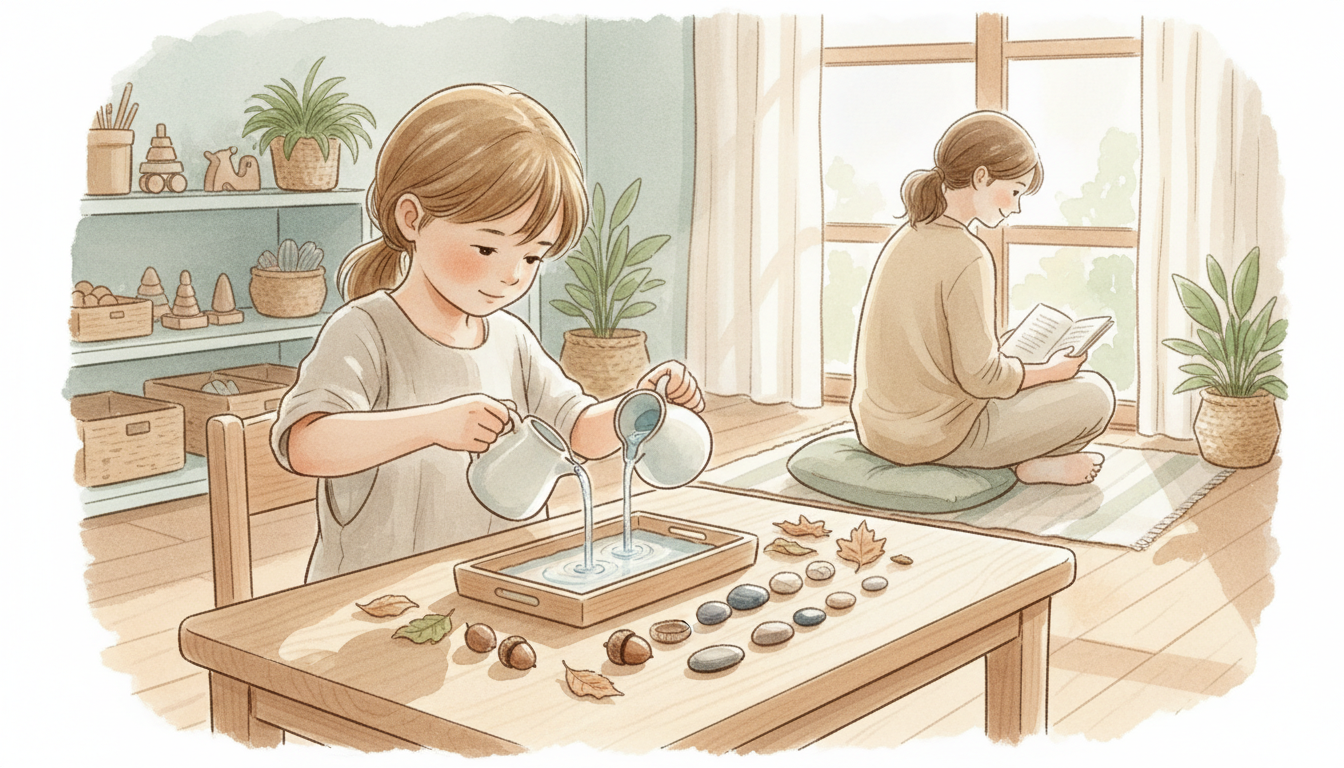
One of the most powerful ways to help a strong-willed child is through Practical Life activities. These are real, purposeful tasks — pouring, sweeping, washing dishes, folding cloths, slicing bananas — that give your child a sense of competence and contribution. A practical life tray set is a wonderful way to introduce these activities in an organized, inviting way.
When presenting materials to your child, remember to move slowly, use minimal words, and let your hands do the teaching. Children who push limits often respond beautifully to this kind of calm, deliberate modeling.
Other activities that work particularly well for strong-willed children include:
- Gardening and outdoor work: Digging, watering, and carrying heavy items provides a physical outlet for intense energy.
- Cooking together: Measuring, stirring, and kneading dough require focus and offer a satisfying sense of accomplishment.
- Building projects: Let your child plan and create something — a fort, a birdhouse, a block tower.
- Care of others: Feeding a pet, watering plants, or helping prepare a snack for a sibling gives your child a healthy way to exercise responsibility.
Be Gentle with Yourself, Too
Parenting a strong-willed child is exhausting. There will be hard days. That’s okay. Your child’s behavior is not a reflection of your failure as a parent. If you’re feeling stretched thin, take a look at how to reduce stress in your family for some practical self-care strategies.
Remember, the goal is not to break your child’s spirit. It is to help them understand how to use their incredible power in ways that uplift rather than harm. With patience, consistency, and the right environment, your bold little leader will find their way — and you’ll be amazed at the compassionate, capable person they become.