Lesson of the Day 102: The Baric Tablets — Montessori's Sensorial Lesson in Weight (Heavy and Light)
Published on: June 11, 2026
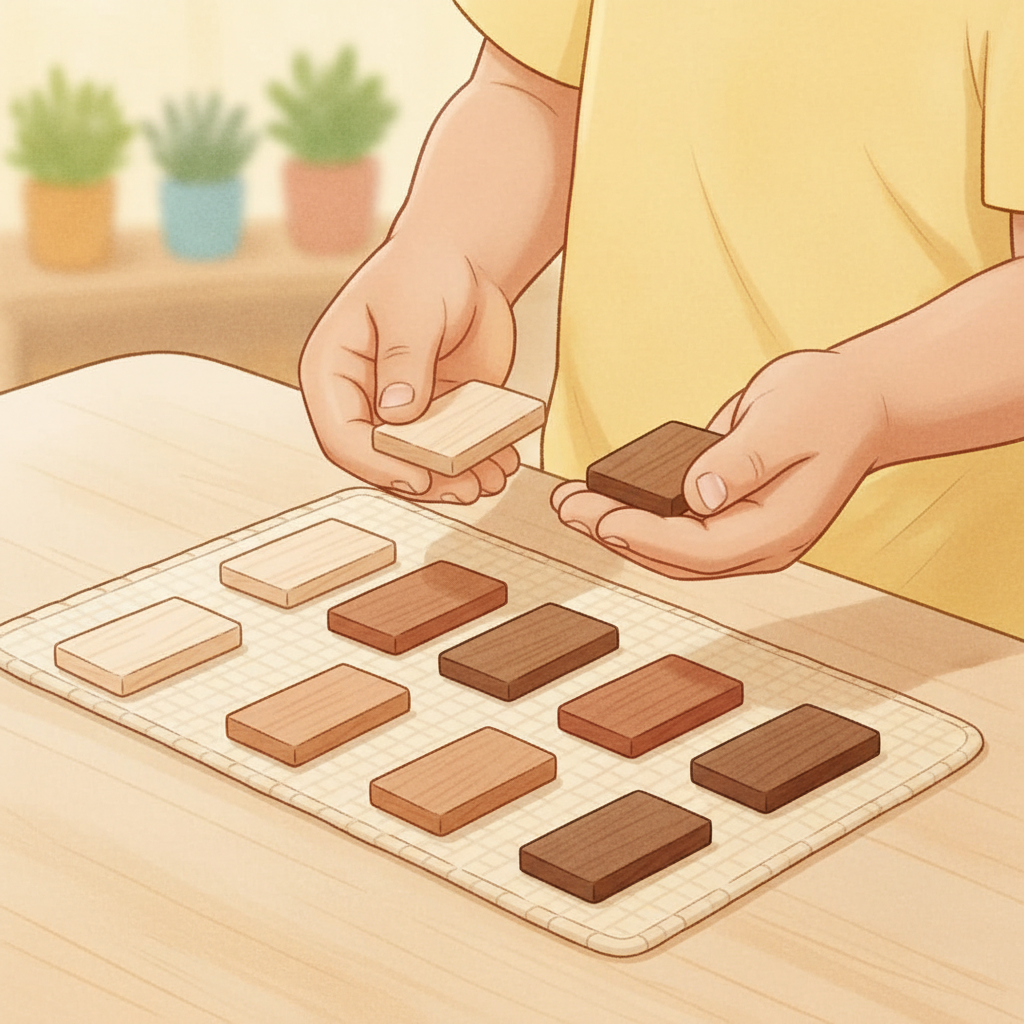
Montessori Lesson of the Day #102 — Welcome back to our daily Montessori journey! Today we turn to a quietly remarkable material that asks the child to close their eyes and listen, not with their ears, but with their hands: the Baric Tablets. If your child has already enjoyed the Brown Stair and the Touch Tablets, the Baric Tablets are a wonderful next step that isolates a brand-new quality for the child to discover — weight.
What Are the Baric Tablets?
The Baric Tablets are a set of small, smooth wooden tablets that are identical in size, shape, and surface texture — but differ in one quality alone: their weight. Traditionally the set is made from three different kinds of wood, each of a different density, so the tablets fall into three groups: the lightest, the medium, and the heaviest.
Because the tablets look exactly the same, the child cannot tell them apart by sight. The only way to discover the difference is to pick them up, one in each hand, and feel which is heavier and which is lighter. This is what Maria Montessori called the "isolation of one quality." Where the Brown Stair isolates thickness and the Color Tablets isolate hue, the Baric Tablets isolate the baric sense — the perception of weight.
The word "baric" comes from the Greek baros, meaning weight (the same root as "barometer"). By keeping everything else constant, the material draws the child's whole attention to this single, surprisingly subtle sensation.
Ages
The Baric Tablets are typically introduced to children around 3 to 4 years old and up, usually after the child has had some experience with the earlier visual Sensorial materials such as the Pink Tower and the Red Rods. Discriminating weight is a refined skill, so most children come to the Baric Tablets once their hands and minds have already been prepared by simpler work.
Older children in the 4-to-6 range love returning to the tablets for the added challenge of working blindfolded or with eyes closed — a step that deepens concentration and makes the weight discrimination even more precise.
Purpose and Aims of the Baric Tablets
Direct Aims
- Discrimination of weight: The child learns to perceive and compare differences in weight using the baric (muscular) sense of the hands and arms
- Refinement of the baric sense: By isolating weight from all other qualities, the material sharpens the child's ability to feel and judge "heavy" and "light"
- Sorting and grading: The child learns to group the tablets into sets — lightest, medium, and heaviest — building an understanding of ordered comparison
Indirect Aims
- Development of concentration: Judging weight by feel alone requires quiet, sustained attention
- Preparation for later learning: The experience of comparing and grading lays groundwork the child will later meet in measurement, mathematics, and the sciences
- Refinement of the stereognostic sense: Working with eyes closed strengthens the child's ability to know objects through touch and muscular feeling alone
- Coordination and control of movement: Holding the tablets gently and steadily to register their weight develops fine motor control and a calm, deliberate hand
- Independence and self-correction: When the tablets are matched by their wood, the child can check their own work without an adult correcting them
Materials Needed
To present this lesson at home, you'll need a set of Baric Tablets and, ideally, a small blindfold for later extensions. Like the Touch Tablets and the Thermic Tablets, the Baric Tablets are a tactile material best presented at a quiet table where the child can focus fully on the sensation in their hands.
Baric Tablet Sets
- Adena Montessori Baric Tablets with Box — a complete three-set graded weight tablet material in a wooden storage box. This is the classroom-standard material, with three different woods giving clear, distinct differences in weight that are perfect for a child's first experience of the baric sense
- Montessori Sensory Weight Plate Material (Baric Tablets with Box) — a budget-friendly home set of graded wooden tablets. A lovely, affordable option for families just beginning to build a home Sensorial shelf, teaching exactly the same concept of heavy and light
You'll also want:
- A clean, uncluttered table where the child can work without distraction
- A small blindfold or simple eye-cover for later, eyes-closed work
Presenting the Baric Tablets: The Three Period Lesson
Begin with just two contrasting groups — the lightest tablets and the heaviest. Sit beside your child and take one tablet from each group, one in each hand. Show your child how to hold each tablet flat on the fingertips, moving the hands gently up and down to "weigh" them. Make your movements slow and deliberate so the child sees that this is careful, attentive work.
Encourage your child to close their eyes (or simply look away) and feel the difference. Then sort the tablets into two piles: the heavy ones here, the light ones there. Because the tablets within each group are the same wood, the child can later check their sorting by looking at the wood grain — a gentle built-in control of error.
Once your child can sort confidently, introduce the vocabulary with a Three Period Lesson, just as you would with the Knobbed Cylinders: First, naming — "This one is heavy. This one is light." Second, recognition — "Show me the heavy one. Show me the light one." Third, recall — holding one up and asking, "What is this one?" When your child is ready, add the third (medium) group and introduce the comparatives and superlatives: heavier and lighter, heaviest and lightest.
Extensions and Variations
- Work blindfolded: Once your child is familiar with the tablets, a blindfold removes the visual sense entirely and lets the baric sense shine. This is a favorite challenge for older children
- Add the third group: Begin with only the lightest and heaviest tablets, then introduce the medium group to make the discrimination finer and more demanding
- Matching pairs: Mix the tablets and ask the child to find two that feel exactly the same weight
- Weight hunt around the home: Extend the concept into daily life — comparing a feather and a stone, an empty cup and a full one — naming heavy and light as you go
- Combine the senses: Pair this work with the Thermic Tablets for warm and cool, helping your child appreciate how many different qualities the hands can perceive
Why Children Love the Baric Tablets
There is something almost magical about discovering a difference you cannot see. Children are delighted to find that two identical-looking tablets feel completely different in the hand — it feels like a secret only their fingers can unlock.
Like all the Sensorial materials, the Baric Tablets do not pour new impressions into the child — they help the child organize and classify impressions already gathered from the world. Your child has been lifting, carrying, and dropping objects since infancy, building a rich (if unnamed) sense of heavy and light. The Baric Tablets give those impressions a name, an order, and a system. When you see your child weighing a tablet with closed eyes and quiet concentration, then breaking into a delighted smile as they sort it correctly, you are witnessing the deep satisfaction of a sense made precise.
Summary and What Comes Next
The Baric Tablets are far more than a box of look-alike wooden pieces. They are your child's formal exploration of weight as an isolated quality — heavy and light, heavier and lighter, heaviest and lightest. They refine the hand, sharpen concentration, and awaken the muscular sense to subtle differences the eye can never catch.
Key takeaways from today's lesson:
- The Baric Tablets are identical in size, shape, and texture, differing only in weight — usually through three different woods of increasing density
- The child discriminates weight by holding the tablets, often with eyes closed or blindfolded, isolating the baric sense
- They are introduced around ages 3 to 4 and up, after early visual Sensorial work like the Pink Tower
- Matching tablets by their wood gives a gentle, built-in control of error
- The Three Period Lesson introduces the vocabulary of heavy/light and their comparative and superlative forms
What comes next in our Montessori Lesson of the Day series? Having explored size, length, and thickness with the visual materials, and now weight with the Baric Tablets, your child is ready to refine still more of the senses. You might revisit color discrimination with the Color Tablets, deepen tactile work with the Touch Tablets, or return to visual grading with the Knobless Cylinders. Every lesson builds on the last, and every material connects to the whole — that's the genius of Montessori.
Enjoy watching your child weigh and wonder today. That quiet, eyes-closed concentration — feeling for a difference no one can see — is the work of a mind growing ever more precise and attentive. What a privilege it is to witness.
Happy teaching, Montessori families! 🌟