Lesson of the Day 89: The Pink Tower
Published on: May 22, 2026
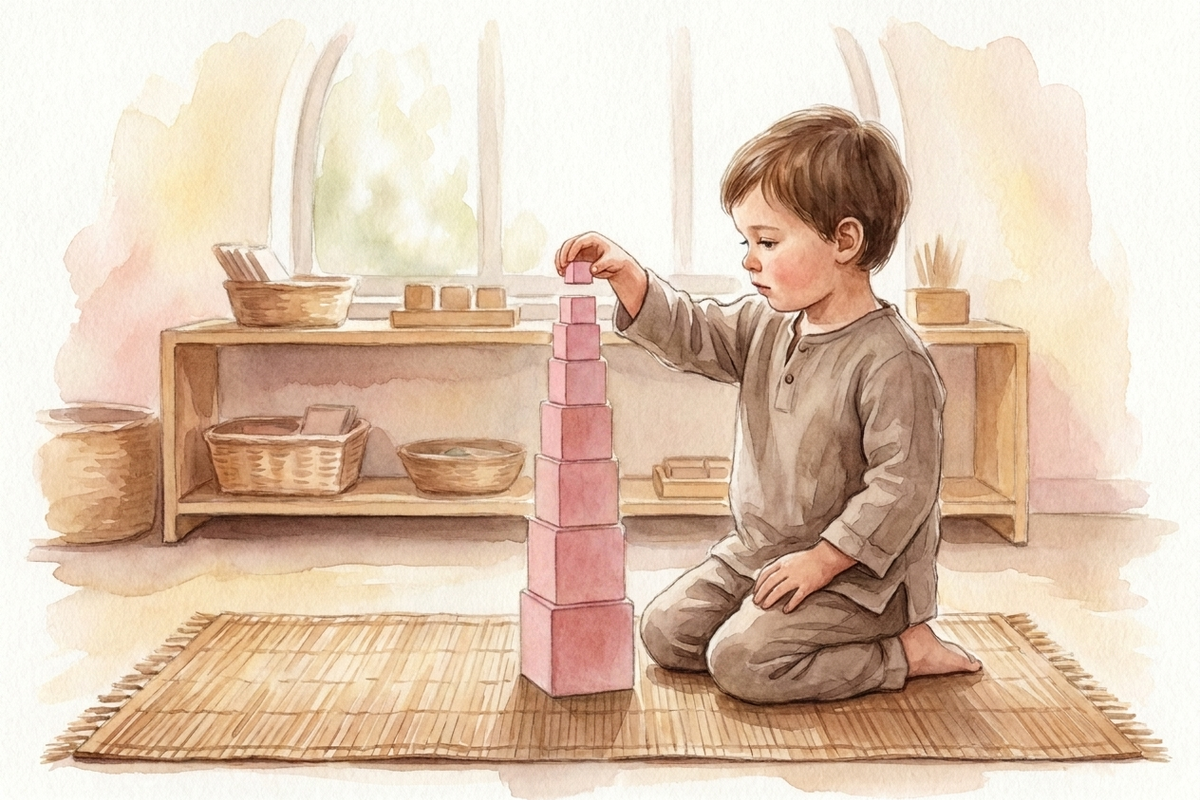
Of all the materials in the Montessori classroom, none is quite as iconic — or as instantly recognizable — as the Pink Tower. Ten rosy wooden cubes, graduated from a tiny one-centimeter cube that sits on a child's fingertip to a substantial ten-centimeter cube that requires two small hands to lift, stacked into a graceful tower on a floor mat. It is the image that appears on Montessori brochures, school websites, and Instagram feeds the world over. And yet, like so many Montessori materials, its elegant simplicity conceals a depth of purpose that can take your breath away once you truly understand it. The Pink Tower is not a stacking toy. It is not a block puzzle. It is a precisely engineered instrument for refining visual perception, building mathematical understanding, developing coordinated movement, and cultivating the deep, self-directed concentration that Maria Montessori considered the cornerstone of all learning.
In Lesson of the Day #89, we continue our Sensorial mini-series — picking up right where we left off with LOTD #88: The Knobbed Cylinders. If you've been following along since our Practical Life mini-series (Pouring Exercises, Spooning & Transferring, Polishing, Walking the Line, and Table Washing), you've already watched your child develop the concentration, coordination, and sense of order that are the essential prerequisites for Sensorial work. The Knobbed Cylinders introduced your child to the art of visual discrimination — noticing differences in height, diameter, or both — through a self-correcting puzzle. Now the Pink Tower takes that visual discrimination into three dimensions, asks the child to work with a graded series out in the open without the scaffolding of fitted sockets, and quietly lays the foundation for the entire decimal system. Whether you're a Montessori teacher deepening your understanding, a homeschooling parent setting up a Sensorial shelf, or simply a curious mom or dad who wants to know why your child is so fascinated by those pink cubes at school, this deep dive will give you everything you need.
What Is the Pink Tower?
The Pink Tower is a set of ten solid wooden cubes, each painted a uniform pink, graduated in size from 1 cm × 1 cm × 1 cm to 10 cm × 10 cm × 10 cm. Each cube increases by exactly one centimeter in each of its three dimensions — making the progression perfectly regular and mathematically precise. The smallest cube is a tiny, delicate thing that a child can balance on a fingertip. The largest is a hefty block that weighs noticeably more and requires two hands to carry. All ten cubes are the same color, the same material, the same finish — the only thing that varies is their size in all three dimensions.
This is a critical design principle. In the Knobbed Cylinders, we saw how each block isolates a single dimensional variable — height alone, diameter alone, or both together. The Pink Tower isolates the concept of size in three dimensions simultaneously. Because every cube is the same color and the same shape, there is nothing to distract the child from the one quality that matters: the graduated difference in size. This is what Montessori educators mean by isolation of quality — stripping away every irrelevant variable so the child's attention can focus like a laser on the one concept being explored.
The cubes are typically made from smooth, solid hardwood — beechwood is common — and their weight varies dramatically as a natural consequence of their size. The smallest cube weighs just a gram or two. The largest cube weighs roughly a kilogram (about 2.2 pounds). This means the Pink Tower engages not only the child's visual sense but also their muscular sense — what Montessori called the baric sense. When a child carries the large cube across the room and then picks up the small one, they don't just see the difference in size; they feel it in their muscles, their hands, their whole body. This multi-sensory engagement is what makes the learning so deep and lasting.
"The hands are the instruments of man's intelligence." — Maria Montessori, The Absorbent Mind
Why Pink? Why a Tower?
Parents often ask why the cubes are pink. The answer, like many things in Montessori, is both practical and purposeful. The uniform pink color ensures that the child is not distracted by color variations — there is only one quality to attend to, and that is size. But why pink specifically, rather than blue or green or natural wood? Maria Montessori chose pink because it is a warm, inviting, aesthetically pleasing color that appeals to young children. The material is meant to attract — to call out to the child from the shelf and say, in its quiet, beautiful way, "Come work with me." The pink also makes the tower visually distinctive in the classroom, ensuring it is immediately recognizable and doesn't get confused with other materials.
As for the tower shape — the act of stacking the cubes from largest to smallest, building upward, is deeply satisfying to young children. There is a natural human pleasure in construction, in building something that rises, in seeing order emerge from scattered pieces. The tower form also provides a dramatic control of error: if a cube is out of sequence, the tower will look visibly wrong, will lean to one side, or — most dramatically — will topple over entirely. The child doesn't need an adult to tell them they made a mistake. The material tells them. And this, as we discussed in our Knobbed Cylinders lesson, is one of the most powerful features of Montessori design: the child teaches themselves.
The Age and the Readiness
The Pink Tower is typically introduced to children between 2½ and 4 years old — making it one of the earliest Sensorial materials a child encounters. In the traditional Montessori classroom sequence, it is often presented shortly after or alongside the Knobbed Cylinders, and before the Brown Stair and Red Rods. However, "age" is only a rough guide. What matters more than the number on the birthday cake is whether the child is ready — and readiness for the Pink Tower looks something like this:
- The child can carry objects carefully across a room without dropping them
- The child can sit or kneel at a work mat and sustain attention for several minutes
- The child shows interest in building, stacking, or ordering objects by size
- The child has some experience with Practical Life activities and has developed a reasonable degree of coordination and concentration
- The child is beginning to show interest in the Sensorial shelf
If your child has been working with pouring exercises, spooning and transferring, and other Practical Life activities, they have likely already developed the concentration, fine motor control, and sense of order that prepare them beautifully for the Pink Tower.
The Direct and Indirect Aims
Every Montessori material serves both direct aims — the immediate, observable skills the child is developing — and indirect aims — the deeper, longer-term preparations that won't become fully apparent until months or even years later. The Pink Tower is particularly rich in both.
Direct Aims
- Visual discrimination of size in three dimensions: The child learns to perceive and compare differences in volume — not just height, not just width, but all three dimensions simultaneously. This is a more complex perceptual task than the Knobbed Cylinders, which typically isolate one or two dimensions at a time.
- Seriation: The child learns to arrange objects in a graded series from largest to smallest (or smallest to largest). Seriation is a fundamental cognitive skill — it underlies the ability to count, to understand number sequence, and to grasp concepts like "more than" and "less than."
- Coordination of movement: Carrying the cubes one at a time from the shelf to the mat, grasping each cube with the appropriate grip, and placing each cube carefully on top of the preceding one all require precise, controlled movement.
- Concentration: The entire exercise — from carrying the cubes to building the tower to dismantling it and returning it to the shelf — requires sustained, focused attention. This is the kind of deep concentration that Montessori considered the wellspring of all development.
Indirect Aims
- Mathematical preparation — the decimal system: This is perhaps the most profound indirect aim. The ten cubes represent the numbers 1 through 10 in three-dimensional, concrete form. The smallest cube has a volume of 1 cubic centimeter. The second smallest has a volume of 8 cubic centimeters (2 × 2 × 2). The third has a volume of 27 cubic centimeters (3 × 3 × 3). The largest has a volume of 1,000 cubic centimeters (10 × 10 × 10). The child is, without knowing it, holding cube numbers in their hands. They are experiencing the relationship between linear measurement and volume. They are building an intuitive foundation for the concepts of cubing, cube roots, and the base-ten number system — years before they will encounter those ideas in abstract form.
- Preparation for geometry: Working with cubes — three-dimensional shapes with equal faces — builds intuitive familiarity with geometric forms. This prepares the child for later work with the Geometric Solids and the Geometric Cabinet.
- Language development: The Pink Tower provides the concrete foundation for a rich vocabulary of comparison: large, small, larger, smaller, largest, smallest, big, little, heavy, light. The three-period lesson (which we'll discuss in detail below) is the vehicle for introducing this language.
- Muscular perception of weight: Because the cubes vary so dramatically in weight as well as size, the child's muscular sense is engaged alongside the visual sense. This prepares the child for later work with the Baric Tablets, which isolate the sense of weight specifically.
- Preparation for writing and reading: The left-to-right, bottom-to-top ordering involved in building the tower, and the systematic, sequential nature of the activity, contribute to the kind of ordered thinking that underlies literacy.
"The child who concentrates is immensely happy." — Maria Montessori, The Absorbent Mind
How the Pink Tower Connects to the Knobbed Cylinders
If you've just read our deep dive into the Knobbed Cylinders, you might be wondering: how does the Pink Tower differ? After all, both materials involve visual discrimination of size. Both involve graded series. Both are made of beautiful, natural wood. The difference is significant, and understanding it helps you appreciate the careful sequencing of the Montessori Sensorial curriculum.
With the Knobbed Cylinders, the child works with a built-in control of error — each cylinder fits into exactly one socket, and if the child makes a mistake, a cylinder will be left over at the end that doesn't fit. The sockets literally guide the child's discrimination. With the Pink Tower, there are no sockets. The child must rely entirely on their own visual judgment to determine which cube is next in the series. There is no frame, no container, no fitted hole to confirm the choice. The control of error is still present — the tower will look wrong or topple if a cube is misplaced — but it is less immediate and less forgiving than the Knobbed Cylinders' sockets.
Additionally, the Knobbed Cylinders isolate one or two dimensions at a time (height, diameter, or both). The Pink Tower varies in all three dimensions simultaneously — each cube is larger or smaller in height, width, and depth. This makes the perceptual task more complex. The child must judge overall volume rather than a single linear measurement.
Finally, the Pink Tower introduces the element of construction. The child isn't fitting pieces into a puzzle — they are building something. This creative, constructive aspect adds a dimension of satisfaction and purpose that is different from the Knobbed Cylinders' puzzle-solving experience.
In the Montessori sequence, the two materials complement each other beautifully. The Knobbed Cylinders refine the child's visual discrimination with generous scaffolding; the Pink Tower asks the child to apply that refined perception independently, in three dimensions, while building something beautiful.
Presenting the Pink Tower: A Step-by-Step Guide
The presentation of the Pink Tower is a lesson in economy, precision, and respect for the child. Like all Montessori presentations, it is done slowly, deliberately, and with minimal words — the material does the teaching, not the adult. Here is how to present it, whether you are a classroom teacher or a parent at home.
Before the Presentation
The Pink Tower should be stored on a low shelf in the Sensorial area, with the cubes arranged from largest (on the bottom) to smallest (on top), forming a tower on the shelf itself. This is both aesthetically pleasing and practical — it allows the child to see the material, to be drawn to it, and to understand at a glance how the pieces relate to each other.
Choose a time when the child is calm, alert, and interested. Invite the child warmly: "I'd like to show you something. Would you like to come see the Pink Tower?" If the child declines, accept the refusal gracefully and try again another day. Montessori education never forces.
Step 1: Spread the Mat
Unroll a work mat or rug on the floor, in a space with plenty of room around it. Maria Montessori used a green carpet in her first Casa dei Bambini in Rome — the contrast between the pink cubes and the green surface made the cubes visually pop and helped the child focus. If you have a green mat, wonderful. If not, any solid-colored mat that provides contrast with the pink cubes will do. Avoid busy patterns that could distract the eye.
The mat defines the workspace. It tells the child: "This is where we work with this material." This is a principle carried over from Practical Life — the mat creates order, establishes boundaries, and helps the child focus.
Step 2: Carry the Cubes One at a Time
This step is critical, and it is one that is often rushed or skipped by well-meaning adults. Each cube should be carried individually from the shelf to the mat. Beginning with the largest cube, carry it with both hands to the mat and place it down. Then return to the shelf for the next largest cube. Carry it with one hand if possible — grasping the cube with the whole hand, fingers wrapped around it, so the child gets a muscular impression of the size. Continue until all ten cubes have been carried to the mat.
Why carry them one at a time? Several reasons:
- It extends the activity, building patience and sustained effort
- It requires multiple trips, developing gross motor coordination and grace of movement
- It gives the child a muscular experience of each cube's size and weight, one at a time — the hands are measuring for the mind
- It models care and respect for the material
- It subtly introduces the concept of seriation before the building even begins — the child handles the cubes in order from large to small
The largest cube (10 cm) is too large for most 2½-year-old hands to grasp in one hand, and that is perfectly fine — the child uses both hands for that one. But the remaining nine cubes should each be grasped with one hand. Watch how the child's hand adjusts its grip for each successively smaller cube — this is the muscular sense at work, absorbing the graded difference in size.
Step 3: Scatter the Cubes on the Mat
Once all ten cubes are on the mat, scatter them randomly — not in a neat row, not in order, but mixed up across the mat. This is important because it means the child must choose each cube from the scattered collection, using visual judgment to find the largest remaining cube each time. If the cubes were already in order, there would be no discrimination task — the child would simply pick up the next one in line.
Step 4: Build the Tower
Now, slowly and deliberately, build the tower. Scan the scattered cubes with your eyes — let the child see you looking, comparing, choosing. Pick up the largest cube and place it in the center of the mat. Then scan again and choose the next largest. Place it centered on top of the first cube. Continue, cube by cube, always choosing the largest remaining cube, always placing it carefully centered on top of the growing tower.
Move slowly. This is not a race. The slowness is the lesson — it communicates care, precision, and the value of deliberation. Each placement is an act of judgment: "Is this centered? Is this the right cube?" The child watches and absorbs not just what you are doing but how you are doing it.
When the tower is complete — ten cubes stacked from largest to smallest, rising from the mat like a rosy staircase to the sky — pause. Let the child look. Let them appreciate what has been built. The visual impression of the completed tower is powerful: a perfect graduation of size, an embodiment of order, a thing of real beauty.
Step 5: Dismantle and Invite
Carefully take the tower apart, removing cubes from the top one at a time and scattering them on the mat again. Then invite the child: "Now you try." Step back. Resist the urge to help. Resist the urge to correct. The child's job is to build. Your job is to observe.
Step 6: Returning the Material
When the child is finished, they carry the cubes back to the shelf one at a time, rebuilding the tower on the shelf in its proper form. This closing step is just as important as the building — it teaches responsibility, care for the environment, and the satisfaction of completing a full cycle of work. It also reinforces the seriation one more time, in reverse.
The Three-Period Lesson with the Pink Tower
The Pink Tower provides a beautiful opportunity for the three-period lesson — Montessori's elegant technique for introducing new vocabulary. Once the child has had several experiences building the tower and is comfortable with the material, you can use the three-period lesson to introduce the language of comparison.
First Period: Naming ("This is…")
Choose the largest cube and the smallest cube. Place them side by side. Point to the largest and say clearly: "This is the large cube." Point to the smallest: "This is the small cube." Repeat once or twice, touching each cube as you name it. Keep it simple — two contrasting cubes, two clear labels.
Second Period: Recognition ("Show me…")
Now ask the child to identify: "Show me the large cube." "Show me the small cube." "Can you put your hand on the large cube?" "Can you pick up the small cube?" This period should be playful and extended — ask the child to do many different things with the cubes to reinforce the vocabulary. "Put the large cube on the mat." "Carry the small cube to the table and bring it back." "Place the large cube on my hand." The second period is where the real learning happens, and you can spend as much time here as the child enjoys.
Third Period: Recall ("What is this?")
Hold up a cube and ask: "What is this one? Is this the large cube or the small cube?" Only move to this period when you are confident the child will succeed — the third period is a test, and Montessori pedagogy always sets children up for success, not failure.
Extending the Vocabulary
Once the child has mastered large and small, you can introduce the comparative and superlative forms: large, larger, largest and small, smaller, smallest. Use three cubes now — a large one, a medium one, and a small one. "This one is large. This one is larger. This one is the largest." These degrees of comparison are essential language concepts and also critical mathematical vocabulary. Understanding "larger than" and "smaller than" is the verbal foundation for understanding "greater than" and "less than" in mathematics.
You can also introduce the vocabulary of heavy and light, since the cubes vary so dramatically in weight. Hold the smallest cube in one hand and the largest in the other: "This one is light. This one is heavy." This connects the Pink Tower to the Baric Tablets and enriches the child's sensory vocabulary.
Counting with the Pink Tower: The First Mathematics Material
Here is where the Pink Tower begins to reveal its deeper mathematical genius. Maria Montessori designed the Pink Tower not merely as a Sensorial exercise but as the first piece of mathematics equipment in the classroom. The ten cubes represent the numbers 1 through 10 in concrete, three-dimensional form — and working with them gives the child a physical, tangible experience of quantity and value that no amount of rote counting can replicate.
Counting Forward: 1 to 10
When your child is ready — after they have mastered building the tower and are comfortable with the language of large and small — you can introduce counting. Begin with the smallest cube. "This is one." Set it aside. Pick up the next smallest. "This is two." Continue through all ten cubes: "Three. Four. Five. Six. Seven. Eight. Nine. Ten."
What makes this counting experience so powerful is that the child can see and feel that each number is bigger than the last. "Two" is noticeably larger and heavier than "one." "Five" is visibly larger than "four." "Ten" is dramatically, unmistakably larger than "one." Most preschool children can recite numbers like memorizing a rhyme — "one, two, three, four, five" rolls off the tongue like a song. But reciting is not understanding. Using the Pink Tower, the child experiences that each number represents a larger quantity than the one before it. The abstract concept of "more" becomes concrete, visible, holdable.
This is the foundation for all later mathematical work — from the Number Rods and Golden Bead Material to the Stamp Game and beyond. The Pink Tower gives the child their first concrete experience of the number system, and it does so through the body — through the hands, the eyes, the muscles — rather than through abstract symbols.
Counting Backward: 10 to 1
Later, when your child is comfortable counting forward, introduce counting backward. Start with the largest cube: "Ten." Pick up the next one: "Nine." Continue down to "One." Counting backward is a much more difficult cognitive task than counting forward, and many young children struggle with it when it's presented abstractly. But with the Pink Tower, they can see the numbers getting smaller. They can hold the shrinking quantity. The visual and muscular experience of the decreasing cubes supports the verbal sequence in a way that makes backward counting intuitive rather than confusing.
This backward counting is also the sensory foundation for subtraction. When a child counts backward with the Pink Tower, they are experiencing what it means for a quantity to decrease — to get less, to shrink, to reduce. Years later, when they encounter the abstract operation of subtraction, they will have this embodied memory to draw upon.
The Advanced Exercise: Corner Alignment and the Smallest Cube as Measure
Once your child can build the standard tower easily and consistently, it's time for the advanced exercise — and this is where the Pink Tower's mathematical elegance truly shines.
Building with One Corner Aligned
Instead of centering each cube on the one below it (which is the standard presentation), have the child build the tower with one corner of every cube precisely aligned along a single vertical edge. In other words, all ten cubes share one common corner point, with two edges of each cube flush against two edges of the cube below.
When built this way, the tower creates a beautiful stepped effect along the two exposed sides. Each step — each ledge — represents the exact dimensional difference between one cube and the next. And here is the beautiful part: the smallest cube fits perfectly on each ledge.
Give the child the smallest cube (or a spare small cube, if you have one) and invite them to place it on each step. It fits. Perfectly. Every time. On every level. This is because each cube differs from the next by exactly one centimeter in each dimension — and the smallest cube is exactly one centimeter in each dimension. The child is experiencing, in the most concrete possible way, that the difference between consecutive cubes is constant — that the progression is regular — that the graduation is uniform. These are foundational mathematical concepts: constant difference, regular progression, uniform gradation.
Cube Numbers and Cube Roots
For the Montessori teacher or the mathematically curious parent, the Pink Tower holds an even deeper mathematical secret. Because each cube is a true cube — equal in all three dimensions — the volume of each piece is a perfect cube number:
- Cube 1: 1 × 1 × 1 = 1 cubic centimeter
- Cube 2: 2 × 2 × 2 = 8 cubic centimeters
- Cube 3: 3 × 3 × 3 = 27 cubic centimeters
- Cube 4: 4 × 4 × 4 = 64 cubic centimeters
- Cube 5: 5 × 5 × 5 = 125 cubic centimeters
- Cube 6: 6 × 6 × 6 = 216 cubic centimeters
- Cube 7: 7 × 7 × 7 = 343 cubic centimeters
- Cube 8: 8 × 8 × 8 = 512 cubic centimeters
- Cube 9: 9 × 9 × 9 = 729 cubic centimeters
- Cube 10: 10 × 10 × 10 = 1,000 cubic centimeters
The largest cube is made up of exactly 1,000 of the smallest cubes. A child holding the 10-centimeter cube in their two hands is holding one thousand. They are holding the concept of "a thousand" in concrete form — years before they will encounter that number in a math workbook. And when they later work with the Golden Bead Material, where the "thousand cube" is literally a cube made of 1,000 unit beads, the connection will be there, waiting, already formed in the muscles and the eyes.
This is what Montessori meant when she spoke of indirect preparation. The child working with the Pink Tower at age three has no idea they are learning about cube numbers and the decimal system. They are simply building a beautiful tower. But the mathematical relationships are real, embedded in the material itself, and the child's senses are absorbing them. Years later, when the abstract concepts are introduced, the child will have a reservoir of concrete experience to draw upon — and the abstractions will feel not foreign but familiar, not difficult but natural.
"What the hand does, the mind remembers." — Maria Montessori
Extensions and Variations
One of the hallmarks of a great Montessori material is that it invites extension — the child can return to it again and again, finding new challenges, new discoveries, new connections. The Pink Tower is exceptionally rich in extensions.
Combining with the Brown Stair
The Brown Stair (also called the Broad Stair) is a set of ten brown prisms that vary in two dimensions (width and height) while remaining constant in the third (length — all prisms are 20 cm long). When combined with the Pink Tower, the child can explore the relationships between the two materials. The width of each Brown Stair prism corresponds to the dimensions of the corresponding Pink Tower cube — the thickest prism has the same cross-section as the largest cube, the thinnest prism has the same cross-section as the smallest cube.
Children can create elaborate patterns and constructions by combining the two materials — building walls, staircases, cities, mazes. These combinations develop spatial reasoning, creative thinking, and the ability to perceive relationships between different materials. They also reinforce the common mathematical principle shared by both materials: regular, graduated progression.
Combining with the Red Rods
The Red Rods vary in one dimension only — length — while remaining constant in height and width. The shortest rod (10 cm) is the same length as the largest Pink Tower cube. This provides yet another connection point. Children who combine the Pink Tower, Brown Stair, and Red Rods are experiencing the same mathematical principle (graduated size) isolated in one dimension (Red Rods), two dimensions (Brown Stair), and three dimensions (Pink Tower). This is a profound lesson in dimensional thinking — and the child absorbs it through play, through construction, through the joy of making beautiful things with beautiful materials.
Building Horizontally
Instead of building a vertical tower, the child can arrange the cubes in a horizontal line — from largest to smallest, left to right. This variation changes the visual experience and requires a different kind of spatial planning. It also naturally reinforces the left-to-right directionality that prepares for reading and writing.
Building with Eyes Closed
For the child who has mastered the standard tower, building with eyes closed (or with a blindfold) is a thrilling challenge. The child must rely entirely on their stereognostic sense — the ability to perceive shape, size, and dimension through touch alone — to find the correct cube and place it accurately. This extension connects to work with the Mystery Bag and develops the same sense-training from a different angle.
Distance Game
Place the cubes on one side of the room and the mat on the other. The child must carry each cube across the room, one at a time, and build the tower from memory — without being able to compare the remaining cubes directly. This requires the child to hold a mental image of the series and make judgments based on remembered comparisons rather than immediate visual comparison. It's a wonderful exercise in visual memory and deepens the child's internal representation of the graded series.
Pink Tower Cards and Printable Extensions
Printable Pink Tower cards can extend the material in wonderful ways. English number name cards, counting cards, and even cards in other languages (Spanish, French) can be matched with the cubes, connecting the Sensorial experience to language and literacy. If you're homeschooling, these printable extensions are a simple, cost-effective way to get more mileage from the material. Check our free downloadable Pink Tower cards for English, Spanish, and French number names, as well as counting cards for sequencing practice.
Art and Tracing
Children can trace the faces of the cubes on paper, creating a series of nested squares that beautifully illustrate the graduated sizes. They can color the squares pink, cut them out, and arrange them — a two-dimensional representation of the three-dimensional material. This is an early exercise in abstraction: moving from the concrete material to a symbolic representation.
Control of Error: The Material as Teacher
The Pink Tower's control of error is elegantly simple: if the tower is built incorrectly, it will look wrong, lean, or topple. A cube placed out of sequence creates a visible irregularity — the graduation is disrupted, and the child can see that something isn't right. In the most dramatic cases, the tower will actually fall over, providing unmistakable physical feedback.
This built-in control of error is fundamental to the Montessori philosophy. The child does not need an adult to say "That's wrong" or "Try again." The material communicates the error directly to the child, preserving their dignity and autonomy. The child can self-correct without shame, without external judgment, without any loss of confidence. This experience of finding and fixing their own mistakes builds internal motivation, problem-solving skills, and a healthy, resilient relationship with error — all of which will serve them throughout their lives.
It's worth noting that the Pink Tower's control of error is less forgiving than the Knobbed Cylinders'. With the Cylinders, every mistake is immediately apparent because a cylinder is left over that doesn't fit. With the Pink Tower, a small error (swapping two adjacent cubes, for example) might not cause the tower to topple — it might simply create a subtle visual irregularity that the child may or may not notice. This is developmentally appropriate: the child who has already worked with the Knobbed Cylinders has refined their perception enough to begin working with a less scaffolded control of error. The progression from more support to less support mirrors the child's growing independence and perceptual skill.
Helpful Hints for Parents and Caregivers
If you're introducing the Pink Tower at home, here are some practical tips drawn from decades of Montessori classroom experience:
Start with Fewer Cubes if Needed
If the full ten-cube tower is too challenging at first, give your child every other cube — five cubes with more dramatic size differences. The child can build a smaller tower with more obvious gradation, building confidence and developing their eye. Once they've mastered the five-cube tower, add the remaining cubes. This is not "dumbing down" the material — it's meeting the child where they are, which is the heart of Montessori pedagogy.
Resist the Urge to Correct
When your child builds the tower incorrectly, do not fix it for them. Do not point out the error. Do not say "That one goes over there." The material will provide the feedback. If the child doesn't notice the error, that's fine — it means they aren't ready to perceive that level of difference yet, and they will develop that perception through repeated experience. Your job is to observe, not to correct.
If the child is consistently struggling and becoming frustrated, it may mean they need more time with the Knobbed Cylinders or more experience with Practical Life activities before returning to the Pink Tower. Trust the child's readiness.
Allow Repetition
Your child may want to build the tower five times in a row. Or ten times. Or every day for a week. This repetition is not boredom — it is mastery. Maria Montessori observed that children repeat activities far beyond the point where adults would consider the task "learned." This repetition is the child's way of deepening their understanding, refining their perception, and strengthening the neural pathways that underlie the skill. Embrace the repetition. Celebrate it. It is the surest sign that the material is serving its purpose.
"Repetition is the secret of perfection." — Maria Montessori, The Discovery of the Child
Model Careful Carrying
The process of carrying each cube from the shelf to the mat is just as important as building the tower. Model it carefully: hold the cube with both hands (for the largest) or one hand (for the smaller ones), walk slowly, place it gently on the mat. This carrying ritual develops grace of movement, spatial awareness, and respect for materials. It also extends the activity, giving the child more time with each individual cube and more opportunity to experience its size and weight.
Keep the Work Space Uncluttered
The mat should have nothing on it but the Pink Tower cubes. No other toys, no books, no snacks. This clean, uncluttered workspace helps the child focus and communicates that this is meaningful work deserving of their full attention. This principle of the prepared environment is central to Sensorial education and, indeed, to the entire Montessori approach.
Don't Rush the Language
Resist the temptation to introduce vocabulary (large, small, larger, smaller) during the first few presentations. Let the child simply build. Let them have the sensory experience first — the seeing, the touching, the lifting, the placing. The language should come only after the child has had multiple experiences with the material and is clearly comfortable with the activity. Montessori always gave the concrete experience first and the language second: the hand before the word.
The Pink Tower in the Broader Sensorial Curriculum
The Pink Tower is one of several materials in the Montessori Sensorial curriculum that train the visual sense through graded series. Understanding where it fits in the larger picture helps you appreciate both its unique role and its connections to other materials.
The Visual Sense Materials
The Sensorial curriculum organizes materials by the sense they primarily train. The visual sense materials include:
- Knobbed Cylinders: Four blocks, each isolating a different dimensional variation (height, diameter, both, or inverse). Self-correcting through fitted sockets. Typically the first Sensorial material presented.
- Pink Tower: Ten cubes varying in all three dimensions. Isolates the concept of size. Self-correcting through visual irregularity or toppling.
- Brown Stair: Ten prisms varying in two dimensions (width and height) while remaining constant in length. Isolates the concept of thick and thin.
- Red Rods: Ten rods varying in one dimension (length) while remaining constant in width and height. Isolates the concept of long and short.
- Knobless Cylinders: Four sets of ten colored cylinders (matching the four Knobbed Cylinder block variations) that can be used independently or in combination. An extension and review of the Knobbed Cylinder work.
- Color Tablets: Three boxes of colored tablets for matching and grading colors. Isolate the sense of chromatic perception.
Notice the beautiful progression: the Knobbed Cylinders introduce dimensional discrimination with maximum scaffolding. The Pink Tower, Brown Stair, and Red Rods each isolate a different dimensional quality (three dimensions, two dimensions, one dimension) with less scaffolding. The Knobless Cylinders combine all the dimensional variations in a more complex, multi-variable format. And the Color Tablets move the visual sense training from dimension to color. Each material builds on what came before and prepares for what comes after.
The Connection to Mathematics
The Pink Tower's role as a bridge between Sensorial and Mathematics is one of its most important functions. In a Montessori classroom, the child's mathematical journey typically flows through these stages:
- Sensorial foundations: Pink Tower, Brown Stair, Red Rods (understanding size, quantity, gradation)
- Number Rods: The Red and Blue Number Rods introduce counting and the concept of quantity with one-dimensional measurement
- Sandpaper Numbers: The Sandpaper symbols for each number connect the concrete quantity to the abstract symbol
- Spindle Boxes, Cards and Counters: Further reinforcement of number-quantity correspondence (see LOTD #81: Number Cards and Counters)
- Golden Bead Material: The decimal system introduced through units, tens, hundreds, and thousands
- Operations: Addition, subtraction, multiplication, and division with concrete materials
The Pink Tower sits right at the beginning of this journey, giving the child their first concrete experience of numbered quantities (1 through 10) and their first embodied understanding that the decimal system is based on groups of ten. When the child later encounters the Golden Bead thousand cube — a large cube made up of 1,000 small unit beads — they will have already held "a thousand" in their hands, in the form of the Pink Tower's largest cube. The connection is immediate and powerful.
Common Questions from Parents
"My child just wants to knock the tower over. Is that okay?"
This is perhaps the most common question parents ask about the Pink Tower, and the answer requires nuance. Building the tower and then gleefully smashing it is developmentally normal for very young children — it's a cause-and-effect experiment, and it's fun. However, in a Montessori context, we want to gently guide the child toward purposeful work with the material. If a very young child (say, 2 or 2½) is in a knocking-over phase, it may mean they aren't quite ready for the formal presentation. Give them more time with early Practical Life activities and try again in a few weeks. If an older child who has been shown the proper use is choosing to knock the tower over, it may indicate that they have already mastered the standard exercise and are ready for extensions — or it may indicate that they need a gentle redirection: "I see you'd like to build it again! Let's try building it with the corners lined up this time."
"Do I need the 'real' Montessori Pink Tower, or will any stacking cube set work?"
The precision of the material matters. A true Montessori Pink Tower has cubes that increase by exactly one centimeter in each dimension, are made of solid wood (for the correct weight gradation), and are all the same shade of pink. Many inexpensive "stacking cube" sets have irregular size differences, are made of lightweight plastic or hollow wood, and come in multiple colors. These sets may be fine as toys, but they won't serve the same educational purpose as the authentic material. The precise, regular gradation — the mathematical gradation — is the whole point. If you're investing in a Pink Tower for home use, invest in one that meets the Montessori standard.
Two good options for home classrooms:
- Adena Montessori Pink Tower — Full-Size 10-Piece Set — Solid wood cubes graduated from 1 cm to 10 cm, the classroom standard
- Kid Advance Montessori Pink Tower — Another quality option with proper dimensions for home use
"How long should my child work with the Pink Tower before moving on?"
There is no set timeline. Some children are fascinated by the Pink Tower for months. Others master it relatively quickly and are ready to move on to the Brown Stair within a few weeks. The key indicator of readiness to move on is not speed but ease and precision: Can the child build the tower consistently, without errors, with smooth and coordinated movements? Can they do the advanced corner-alignment exercise? Do they show interest in the next material? Trust the child's pace. In Montessori education, we follow the child — not the curriculum calendar.
"Can I combine the Pink Tower with other activities?"
Absolutely — once the child has mastered the standard exercise. Combining the Pink Tower with the Brown Stair, Red Rods, or Knobless Cylinders is a rich and rewarding extension. You can also combine it with language activities (matching number name cards to cubes), counting activities (see our Pink Tower and Counting page), and art activities (tracing the cube faces). The Pink Tower is one of the most versatile materials in the Montessori classroom, and its potential for extension is nearly limitless.
The Pink Tower and Montessori's Vision of Education
To truly understand the Pink Tower, it helps to understand Maria Montessori's vision of how children learn. Montessori believed that children — especially children under six — learn not through instruction but through experience. Not through being told but through doing. Not through abstract symbols but through concrete materials that they can see, touch, lift, carry, and manipulate. She believed that the senses are the gateway to the intellect — that all knowledge enters the mind through the senses — and that by refining and training the senses, we give the child the tools to perceive, understand, and interact with the world more fully.
The Pink Tower embodies this philosophy perfectly. A child working with the Pink Tower is not being "taught" about size, or numbers, or the decimal system. They are experiencing these things. They are holding them. They are building with them. The knowledge enters through the hands, the eyes, the muscles — and it is stored not as memorized information but as lived understanding. This is why Montessori called the child's mind the "absorbent mind" — it doesn't learn in the conventional sense; it absorbs, it constructs, it becomes.
"Education is a natural process carried out by the child and is not acquired by listening to words but by experiences in the environment." — Maria Montessori
The Pink Tower also embodies Montessori's deep respect for the child. It is not a teaching tool in the traditional sense — the adult does not "use" it to teach the child. Rather, it is a development tool — the child uses it to teach themselves. The adult's role is to present it, to step back, and to trust. Trust the material. Trust the child. Trust the process. This can be difficult for parents who are accustomed to more directive educational approaches, but it is one of the most liberating and rewarding shifts in perspective that Montessori offers.
A Day in the Life: The Pink Tower at Work
Picture this: A three-year-old girl arrives at school, hangs up her coat, and scans the Sensorial shelf. Her eyes land on the Pink Tower — those ten rosy cubes stacked neatly, waiting. She carries a mat to an open spot on the floor and unrolls it. Then she returns to the shelf and begins carrying the cubes, one by one, the largest first. She holds the big cube with both hands, walks carefully, places it on the mat. Back for the next one. And the next. Ten trips. Ten cubes. She takes her time.
Now she kneels at the mat, surrounded by scattered pink cubes. She looks. She reaches for one — pauses — reaches for a different one. Places it in the center. Scans again. Picks up the next. Places it on top. Her movements are deliberate, unhurried. Her face is calm, focused, absorbed. She is not playing. She is working. And in that work, she is refining her visual perception, exercising her muscles, developing her concentration, absorbing mathematical relationships, and building the kind of quiet, confident independence that will serve her for the rest of her life.
The tower grows. Eight cubes. Nine. She places the tiny top cube and sits back on her heels, looking at what she's built. A smile. Not a triumphant grin — something quieter, more internal. The deep satisfaction of completed work. She touches the tower gently, then takes it apart, cube by cube, and carries each one back to the shelf.
This entire cycle — from choosing the work to returning it to the shelf — might take fifteen minutes. And in those fifteen minutes, that child has done more meaningful developmental work than an hour of worksheets could ever accomplish.
The Pink Tower and Writing: An Unexpected Connection
While the Knobbed Cylinders are more commonly credited with preparing the hand for writing (through the pincer grip on the knobs), the Pink Tower contributes to writing readiness in its own way. The act of grasping each cube — wrapping the hand around a large cube, then a slightly smaller one, then a still smaller one — develops the muscular flexibility of the hand. The hand must constantly adjust its grip to accommodate the changing size of the cubes. This adaptability is exactly what the hand needs for writing, where the fingers must make tiny, precisely controlled movements while the hand maintains a relaxed, flexible grip on the pencil.
Additionally, the Pink Tower develops visual-motor coordination — the ability to use visual information to guide hand movements. Placing each cube precisely centered (or corner-aligned) on the one below it requires the child to coordinate what their eyes see with what their hands do. This same visual-motor coordination is essential for forming letters, staying on a line, and controlling the spacing and size of written words. It connects beautifully to later work with the Sandpaper Letters and the Moveable Alphabet.
Montessori's Own Words on the Pink Tower
Maria Montessori described the Pink Tower and related Sensorial materials in several of her books, including The Montessori Method, The Discovery of the Child, and The Absorbent Mind. In her writings, she emphasized that the purpose of these materials was not to teach specific facts but to refine the senses and develop the capacity for observation. She wrote about watching children work with the tower with an almost reverent attention — observing their concentration, their self-correction, their satisfaction.
Montessori was particularly interested in the way children returned to the material again and again, repeating the exercise far beyond what an adult would consider necessary. She saw in this repetition not boredom but the work of self-construction — the child building their own intelligence, their own perception, their own will, through their own freely chosen activity. The Pink Tower, for Montessori, was not just an educational material. It was evidence of the child's extraordinary capacity for self-development — evidence that, given the right environment and the right tools, children will educate themselves.
"The child is both a hope and a promise for mankind." — Maria Montessori, Education and Peace
Setting Up the Pink Tower at Home
If you're creating a Montessori environment at home, the Pink Tower is one of the first Sensorial materials worth investing in. Here are some practical considerations:
Placement
Place the Pink Tower on a low, accessible shelf in your Sensorial area — or, if you have a general Montessori shelf, in the Sensorial section. The cubes should be stacked in tower form on the shelf, largest on the bottom, smallest on top. The shelf should be at the child's height, so they can see and reach the material independently.
Floor Space
The Pink Tower is a floor work. You need an open area large enough for a work mat plus room for the child to move around the mat comfortably. Clear the area of furniture and other materials that might be distracting or create obstacles during the carrying process.
Work Mat
A solid-colored work mat — ideally green, for contrast with the pink cubes, following Montessori's original practice — makes a big difference. The mat defines the workspace, provides visual contrast, and protects the cubes from hard floors. You can use a simple green felt mat, a yoga mat cut to size, or any flat, solid-colored surface.
Quality of Material
As discussed above, the precision of the cubes matters. Look for a set made from solid wood (not hollow), with cubes that increase by exactly 1 cm in each dimension, all painted the same shade of pink. The cubes should be smooth, well-finished, and free of splinters or rough edges. A good Pink Tower is an investment, but it's one that will last for years and serve multiple children. The two options linked above — Adena Montessori and Kid Advance — are both solid choices for home use.
Companion Materials
While the Pink Tower can stand alone beautifully, its potential is amplified when paired with other Sensorial materials. If you can afford to add the Brown Stair and Red Rods, the three materials together create a powerful, interconnected system for dimensional exploration. But don't feel you need to buy everything at once — the Pink Tower is a wonderful starting point, and many families find that it alone provides months of engaged, purposeful work.
Observing Your Child: What to Look For
When your child works with the Pink Tower, take the opportunity to observe. Montessori observation is a skill in itself — and the Pink Tower provides a perfect window into your child's development. Here are some things to watch for:
- Concentration: How long does the child sustain attention? Does their focus deepen over time with repeated use?
- Self-correction: Does the child notice and correct errors on their own, or do they need the tower to topple before they realize something is wrong? Increasing ability to self-correct indicates refining visual discrimination.
- Precision of movement: Are the child's movements becoming smoother and more controlled over time? Are they centering the cubes more accurately?
- Independence: Does the child set up and clean up independently? Do they choose the work on their own?
- Repetition: How many times does the child build the tower in a single work session? Increased repetition often indicates deepening engagement.
- Emotional state: Does the child appear calm, focused, and satisfied during and after the work? This is what Montessori called "normalization" — the state of deep, peaceful concentration that she considered the hallmark of healthy development.
- Language: Is the child beginning to use comparative language spontaneously? "This one is bigger!" "That's the tiny one!" Spontaneous use of vocabulary indicates genuine internalization of the concepts.
What you observe during Pink Tower work will tell you volumes about your child's development and readiness for the next step. It will also teach you something about yourself — about your own capacity for patience, trust, and the art of stepping back.
Where the Pink Tower Leads
The Pink Tower is a beginning, not an end. The perceptions refined through this material ripple forward through the entire Montessori curriculum in ways both obvious and subtle:
- The visual discrimination of size prepares for the Brown Stair and Red Rods, which isolate additional dimensional qualities
- The seriation work prepares for the Number Rods, where the child counts graduated lengths
- The embodied experience of cube numbers prepares for the Golden Bead Material and the decimal system
- The concentration and independence developed through Pink Tower work prepare for every subsequent material across all curriculum areas
- The vocabulary of comparison (large, small, larger, smallest) prepares for mathematical language and logical thinking
- The three-dimensional spatial reasoning prepares for the Geometric Solids and later geometry work
Nothing in a Montessori classroom exists in isolation. Every material is a thread in a carefully woven tapestry, and the Pink Tower is one of the most beautiful and foundational threads. It connects backward to the Knobbed Cylinders and forward to the Brown Stair, the Red Rods, the Number Rods, and the entire mathematical curriculum. It is, in its quiet, rosy way, a cornerstone.
A Note on Trust and Beauty
If you're new to Montessori, the Pink Tower can be a revelation — not just for your child, but for you. Here is a material with no batteries, no screens, no flashing lights, no cartoon characters. Just ten wooden cubes, painted pink, varying in size. And yet it captivates children. They return to it again and again. They work with it in deep, absorbed silence. They build and rebuild and rebuild, each tower a little more precise, a little more confident, a little more theirs.
This is the Montessori promise: that children don't need entertainment; they need meaningful work. They don't need stimulation; they need concentration. They don't need to be taught; they need the freedom and the tools to teach themselves. The Pink Tower is one of those tools — perhaps the most beautiful and iconic of them all.
When your child sits on the floor, pink cubes scattered around them, eyes scanning carefully for the next one in the series, small hands lifting and placing with growing precision — you are witnessing something remarkable. You are witnessing a human being constructing their own intelligence. And your job, in that moment, is the most difficult and most rewarding job a parent can have: simply to watch, to trust, and to marvel.
Ten pink cubes. One child. A mat on the floor. And in that simple configuration, the entire Montessori philosophy in miniature — beauty, order, precision, independence, self-construction, and the deep, quiet joy of meaningful work.
Free Printouts
Download these free Pink Tower printable activities:
- Pink Tower English Cards — Cards with English number names for matching with each cube
- Pink Tower Counting Cards — Counting cards from largest to smallest for sequencing practice
- Pink Tower Spanish Cards — Cards with Spanish number names for bilingual learning
- Pink Tower French Cards — Cards with French number names for bilingual learning
Explore more Pink Tower activities:
- Pink Tower and Counting — A math and reading activity using the Pink Tower
- Big and Small — Size comparison concepts using the Pink Tower
For a broader overview of the Sensorial area and how the Pink Tower connects to the full range of sense-training materials, visit our What Is Sensorial Education? guide. To continue exploring the Sensorial materials, revisit our previous lesson on the Knobbed Cylinders, or explore our individual pages on the Brown Stair, Red Rods, Knobless Cylinders.