Practical Life
Published on: March 18, 2026
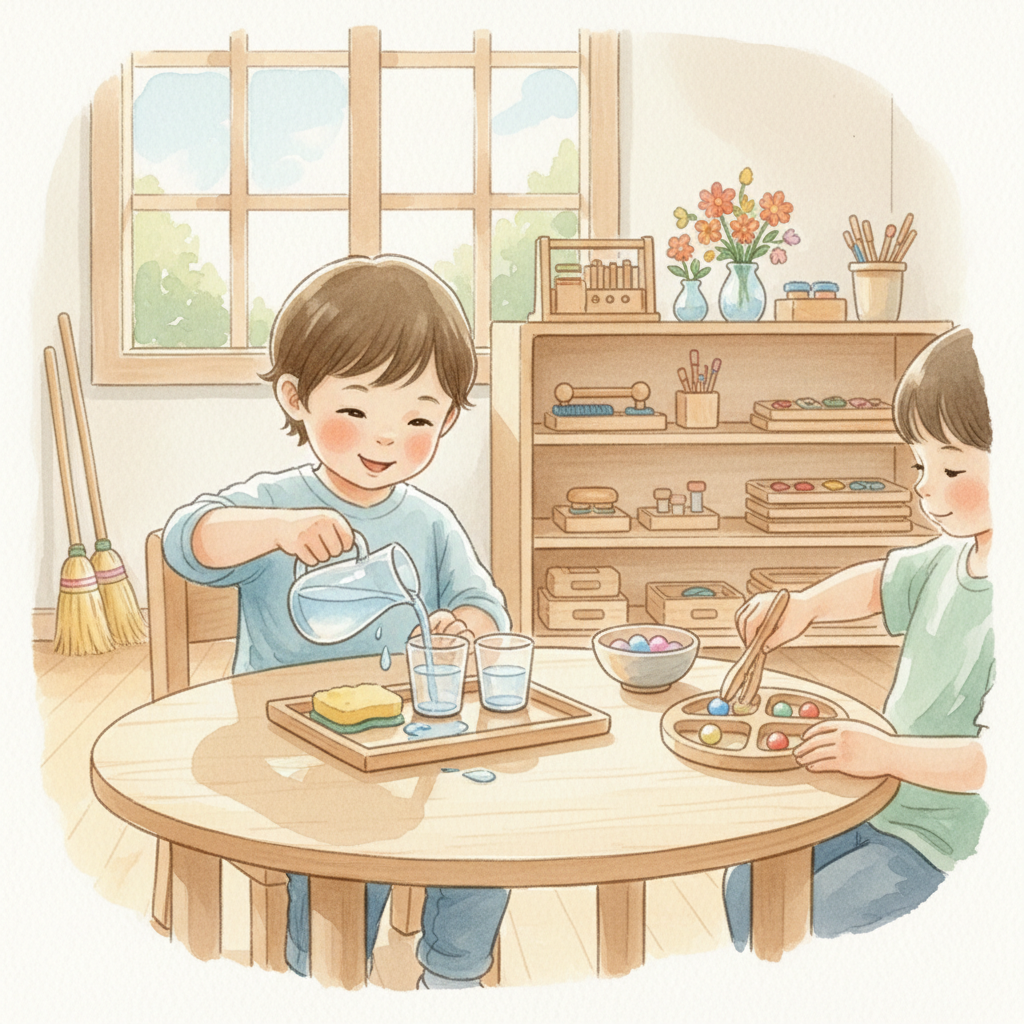
Practical Life for Life
My favorite age of preschool development, believe it or not, is the (not so) terrible twos. In fact, I love the terrific twos. The twos are just made for Montessori practical life skills, exemplified by the "I can do it myself!" attitude of most two-year-old children.
What Is Practical Life?
Basically, it is any physical activity that helps a child grow in motor skills, cognitive development, self-confidence, and most of all, independence. Any controlled movement of hands, arms, legs, feet, and eyes helps your child achieve independence and mastery of his or her environment. Sitting up, crawling, walking, and grasping a toy are practical life skills for infants.
Soon, your toddler is ready for new areas to conquer — dressing, brushing teeth, washing face and hands, eating properly, manners, and so on. Being able to take care of yourself gives not only self-confidence and freedom, but helps with concentration in the mastery of concrete learning that eventually leads to abstract learning, such as reading and math.
How long are parents required to help their children achieve practical skills? I recently taught my 16-year-old son how to drive in a very methodical Montessori approach — slowly, step by step: how to start the car, use the brake, shift gears, center the car, hold the steering wheel. I had to remember to be patient and most of all, not talk too much! It seems like practical life skills are something we continually develop during our lives.
Getting Started with Practical Life Materials
Here are some materials to help set up practical life activities at home:
- Montessori Sensory Bin Tools with Wooden Box — Includes tongs, containers, and transfer tools for fine motor skill development.
- Metal Bucket and Bowl Set for Hand Washing Activities — Perfect for practicing pouring water and washing hands independently.
Practical Life Activities
Here are practical life ideas that help develop motor skills, eye-hand coordination, order, sequence, concentration, and independence. Most importantly, a child who can control his or her environment is a happy, well-adjusted child. Use these ideas when cleaning, cooking, and getting ready for the day — just use any situation to let your child help become a real part of the family routine.
Care of Self
- Dressing oneself
- Knowing parts of the body
- Putting on jacket and zipping it
- Hanging jacket on a low hook
- Putting clean clothes in a drawer
- Washing hands and drying with a paper towel
- Blowing nose and throwing away tissue properly
- Learning home address and phone number
Care of Environment
- Setting the dinner table
- Cleaning up spills with a sponge
- Polishing shoes
- Dusting and polishing exercises
- Sweeping with a small broom and dust pan
- Flower arranging
- Caring for plants and animals
- Putting materials, books, and toys away on shelves
- Working carefully and neatly
Fine Motor Skills
- Fastening clothes on a line with clothespins
- Using scissors with skill
- Pouring beans, rice, or sugar without spilling
- Pouring liquids without spilling
- Use of tweezers, tongs, eyedroppers, and locks
- Spooning exercises
- Simple use of needle and thread
- Weaving and bead stringing
- Sorting beads by color, size, or shape
- Small hammer and nails for wood projects
Gross Motor Skills & Grace and Courtesy
- Walking on the line — a foundational exercise for balance, posture, and concentration
- Sitting on or next to the line
- Carrying objects without dropping them
- Carrying liquids without spilling
- Walking without knocking into furniture or people
- Dancing without knocking into furniture or people
- Table manners
- Folding napkins, towels, and own clothing
Purpose
Practical life activities build independence, concentration, coordination, and a sense of order. They prepare children for more advanced academic work by giving them the confidence and self-discipline that comes from mastering real-world tasks. Every child who can take care of themselves and their environment is better prepared for the joys of learning.
See also: Walking the Line — one of the most important Montessori gross motor exercises for developing balance, coordination, and fluid movement.