Lesson of the Day 96: Color Tablets — Montessori Visual Discrimination of Color with Boxes 1, 2, and 3
Published on: May 26, 2026
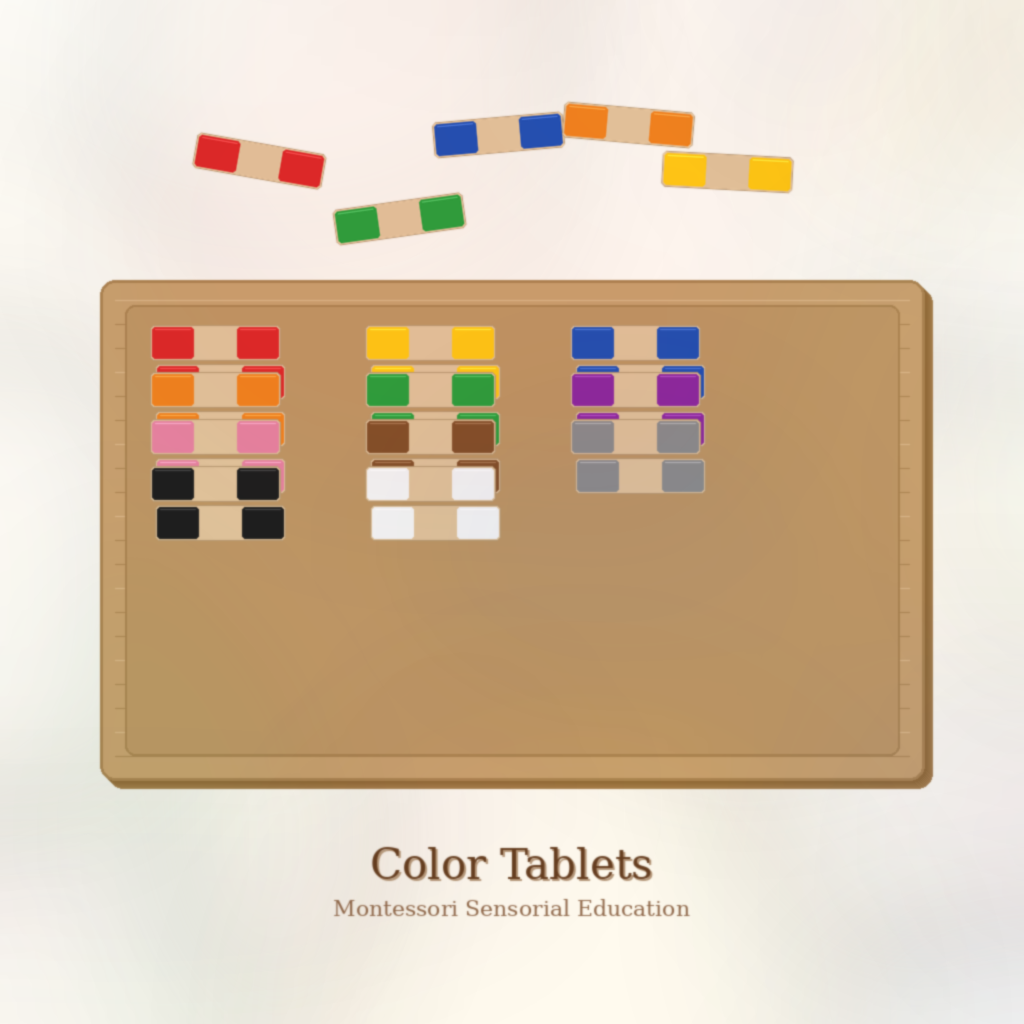
"The senses, being explorers of the world, open the way to knowledge." — Maria Montessori
Of all the beautiful materials in the Montessori Sensorial area, the Color Tablets may be the most visually stunning. Imagine a child quietly arranging sixty-three tablets into nine perfect gradients — from the deepest, richest hue to the palest whisper of color — with the focus and precision of an artist mixing paints on a palette. This is not a craft project. This is the profound, methodical education of the eye.
The Color Tablets come in three boxes, each building upon the last. They guide children from the simplest act of matching primary colors to the extraordinarily refined skill of discriminating between seven shades of a single hue. In today's Lesson of the Day, we'll walk through all three boxes — their purpose, their presentation, and the many extensions that turn this material into a gateway for art, language, and a lifelong sensitivity to the world of color.
🎨 Why Color Education Matters
Maria Montessori understood that children don't just see — they must be taught to observe. A child who has worked with the Color Tablets doesn't just see "blue" in a sunset. She sees cerulean fading to powder blue, edged with violet and rose. This refined perception enriches every experience — from appreciating art in a museum to noticing the subtle shift of seasons in the garden.
The Color Tablets isolate the single quality of color for the child to explore. The tablets are identical in size, shape, weight, and texture. Only the color varies. This isolation of a single sense quality is the hallmark of Montessori Sensorial education — and it's what makes this material so powerful.
🎒 Materials You'll Need
- Color Tablet Box 1 — 3 pairs of primary colors (red, blue, yellow) for ages 2.5–3
- Color Tablet Box 2 — 11 pairs including primary, secondary, and tertiary colors for ages 3–3.5
- Color Tablet Box 3 — 9 color families × 7 graded shades = 63 tablets for ages 3.5–5
- A clean, uncluttered work mat or table
- A blindfold (optional, for advanced extensions)
- Colored pencils, watercolor paints, or crayons for art extensions
- 👉 Montessori Color Tablets Sets on Amazon
- 👉 Color Box 3 (63 Tablets) on Amazon
- 👉 Children's Watercolor Paint Set on Amazon
A note on handling: Show your child to hold each tablet by its white border (the wooden or plastic edges on the sides), not by the colored center. This teaches care of materials and keeps the colored surfaces clean — a small detail that reinforces the Montessori principle of respect for one's tools.
📦 Box 1: The Primary Colors (Ages 2.5–3)
Purpose
Box 1 introduces the concept of matching by color. It contains just 6 tablets — one pair each of red, blue, and yellow. The simplicity is intentional. The young child is learning the fundamental skill: these two are the same.
Presentation
- Invite the child to the lesson. Carry the box carefully to the table together.
- Open the box and place the six tablets randomly on the table.
- Pick up one tablet (e.g., red). Look at it with genuine interest. Place it on the left side of the table.
- Scan the remaining tablets. Pick up each one, compare it to the first, and either set it aside or — when you find its match — place it beside the first with a small smile of satisfaction.
- Repeat with the remaining two pairs.
- When finished, name the colors using the Three-Period Lesson:
- Period 1 (Naming): "This is red. This is blue. This is yellow."
- Period 2 (Recognition): "Can you show me red? Where is yellow?"
- Period 3 (Recall): Point to a tablet and ask, "What color is this?"
- Invite the child to try. Return the tablets to the box together.
For more about how the Three-Period Lesson works across Montessori Sensorial materials, see our article on Sensorial Impressions vs. Education.
📦 Box 2: Expanding the Palette (Ages 3–3.5)
Purpose
Box 2 contains 11 pairs (22 tablets): the three primary colors (red, blue, yellow), three secondary colors (orange, green, purple), and additional hues such as pink, brown, black, white, and gray. The child now matches a much wider range of colors and begins to learn a richer vocabulary.
Presentation
- Place all 22 tablets in a scattered arrangement on the mat.
- Select one tablet and place it to the left. Search through the remaining tablets to find its match, comparing each one carefully before placing it beside or setting it aside.
- Continue until all 11 pairs are matched, arranged in a column of pairs.
- Introduce the new color names using the Three-Period Lesson — but only two or three new names per session. Don't overwhelm!
- Invite the child to mix the tablets and try independently.
Key observation: Watch how your child searches. Does she scan quickly or examine each tablet closely? Does she hold tablets side by side to compare? These are signs of developing visual discrimination — the very same skill she'll use later for reading (distinguishing between similar letters) and math (comparing quantities).
📦 Box 3: The Grading Challenge (Ages 3.5–5)
Purpose
Box 3 is the crown jewel. It contains 63 tablets organized into 9 color families: red, blue, yellow, orange, green, purple, pink, brown, and gray. Each family has 7 shades grading from darkest to lightest. The child learns to perceive and arrange subtle differences in saturation and value — a remarkably refined skill.
Presentation (One Color Family First)
- Begin with a single color family — red is traditional. Remove the 7 red tablets and set the rest of the box aside.
- Place all 7 tablets randomly on the mat.
- Scan all the tablets. Select the darkest shade and place it at the top (or far left).
- From the remaining tablets, again find the darkest and place it next in line.
- Continue until all 7 are arranged from darkest to lightest in a smooth gradient.
- Run your finger along the gradient and say: "Dark… darker… darkest" and "Light… lighter… lightest."
- Mix the tablets and invite the child to try.
Building Up to the Full Display
Once the child can confidently grade one color family, introduce a second, then a third. Eventually — and this is a breathtaking moment — the child will lay out all 63 tablets in a magnificent sun-ray pattern or grid: 9 rows of 7, each perfectly graded. Children often return to this work again and again, drawn by its beauty and the deep concentration it requires.
🔑 Points of Interest and Error Control
- Control of error is built into the material itself. In Box 1 and Box 2, mismatched tablets are visually obvious. In Box 3, a tablet out of order disrupts the smooth gradient — the child's own eyes tell them something isn't right.
- Point of interest: The moment of comparison — holding two tablets side by side and deciding "same" or "different" — is where the real learning happens.
- Encourage your child to work slowly. Speed is never the goal. Precision and attention are.
🌈 Extensions and Variations
The Color Tablets open the door to an astonishing range of extensions:
- Color Scavenger Hunt: Give your child a tablet and ask them to find something in the room (or outdoors!) that matches. This bridges the material to the real world.
- Memory Game: Place one tablet on a tray. Let the child study it, then cover it. Can they find the matching shade from a selection of similar tablets?
- Distance Game: Place one set of tablets on a table and the matching set across the room. The child carries one tablet at a time, holding the color in memory as they walk to find its match.
- Color Mixing with Paint: After working with Box 3, invite your child to mix watercolors to create their own gradient of 7 shades. This is deeply satisfying and connects Sensorial work to art.
- Nature Walk: Take a few tablets outside and match them to flowers, leaves, stones, and sky. Children are amazed at how many colors exist in nature.
- Color Vocabulary: Introduce rich language — crimson, scarlet, burgundy, maroon, rose, coral, blush — all for the "red" family. This builds vocabulary while honoring the child's refined perception.
- Blindfold Sorting (Advanced): Can the child sort tablets by color family using only touch? (Some wooden tablets have subtle texture differences — this challenges the stereognostic sense.)
🔗 Connecting to Other Sensorial Materials
The Color Tablets are part of the larger Montessori Sensorial curriculum, which systematically educates every sense. If your child has enjoyed this material, explore these related lessons:
- The Knobbed Cylinders — visual discrimination of size (height and diameter)
- The Pink Tower — visual discrimination of three-dimensional size
- The Brown Stair — visual discrimination of width
- The Geometric Cabinet — visual discrimination of form
- Thermic Tablets — discrimination through the sense of touch (temperature)
- Our complete Color Tablets guide for additional information and printable resources
📚 Recommended Books and Resources
- 👉 Montessori Sensorial Materials on Amazon
- 👉 Mouse Paint by Ellen Stoll Walsh — a charming picture book about color mixing, perfect as a companion to this lesson
- 👉 Pantone: Colors Board Book — beautiful color reference for young children
- 👉 Watercolor Set for Kids on Amazon
💭 A Closing Reflection
There is something quietly profound about watching a child arrange 63 color tablets into perfect gradients. It is not just an exercise in sorting. It is the cultivation of an aesthetic sense — a capacity to notice, appreciate, and respond to beauty in the world.
Montessori wrote that the Sensorial materials give children "the keys to the universe." The Color Tablets offer one of those keys: the ability to truly see. A child who has graded nine families of color from darkest to lightest will never look at a sunset, a garden, or a painting in quite the same way again. The world becomes richer, more detailed, more alive.
Set out the box. Let your child's hands and eyes do the work. And don't be surprised if you, too, begin to notice shades you never saw before.
Keep following the child — one color, one shade, one beautiful lesson at a time. 🌈