Sensorial Impressions vs Sensorial Education
Published on: June 30, 2007
"Thought is his human birthright, all education aims at helping the individual to think clearly about them instead of half-knowing things all in a muddle."
— Phoebe Child
What Is Sensorial Education?
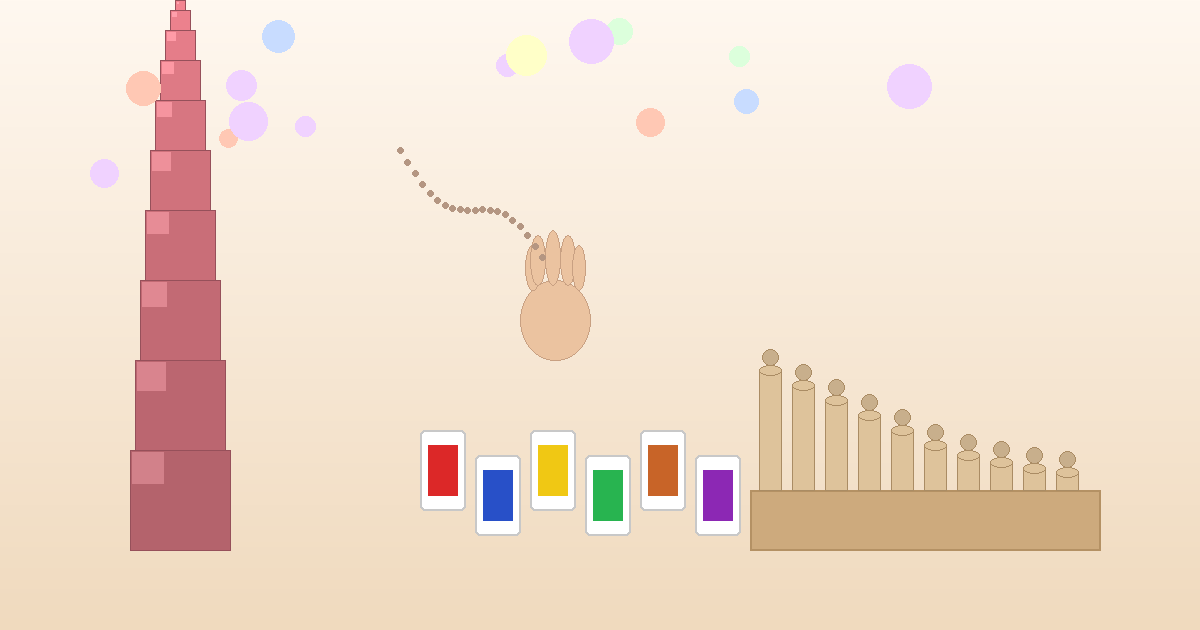
Sensorial education helps develop a child's intellect. Whether you believe intelligence is genetic or shaped by environment, it can be furthered through education. Intelligence is built upon experiences and thought processes. The Montessori materials for ages 18 months to 6 are designed to help a child's mind develop the necessary skills for later intellectual learning.
Sensorial Impressions vs. Sensorial Education
Sensorial impressions of a child's environment are not the same as sensorial education. Impressions are feelings — not intellectual building blocks. The mind needs information to discriminate and appreciate culture, art, music, poetry, reading, and all aspects of the environment. Dr. Montessori designed early sensorial educational materials for exactly this purpose.
The sensorial apparatus provides a particular purpose and focus. It includes using the child's hands, senses, and spontaneous activity. When a young child sees something new and exciting, he or she will want to touch the object. Young children will grab a new kitten and hold it immediately — they want to feel the reality of the object.
From Contrast to Gradation: How Sensorial Concepts Are Taught
This education is not an exercise to sharpen the senses, but to allow a child to use his or her senses to understand what he or she sees. The first lessons present contrasted sensory materials, and then graded materials. This teaches concepts of comparing and contrasting.
For example, the first colors introduced are the primary colors, which are the most distinct on the color chart. Red, blue, and yellow are introduced first. Then shades and combinations are introduced later so the child can learn to grade by shade using materials like colored tablets.
"This is the beginning of the development of the intellect and it is brought about by the intelligence working in a concentrated way on the impressions given by the senses."
— Phoebe Child
Unlocking Absorbed Knowledge
Sensorial education taps the young child's mind of absorbed information from the first three years of life. The information at this point is a sea of impressions in the unconscious mind. As a child works further, the young mind becomes aware of concepts of size, color, weight, quantity, and so on. This is the beginning of sensorial education.
When the differences are clear, the names are introduced to describe these concepts — often through the three period lesson. Montessori builds concept upon concept. Nothing is left to chance learning. There is an order and sequence to the materials presented. Montessori's sensorial approach helps a child categorize and use his vast amount of subconscious knowledge about his or her surroundings. It is a key that unlocks the door of the mind.
Hands-On, Three-Dimensional Learning
Montessori understood that this intellectual activity was a manual, active approach. It came from observing her own students and is contrary to adult methods of teaching and learning. The materials are three-dimensional and real. Montessori at this stage did not use pictures for teaching sensorial concepts — she believed that children wanted to see and feel real objects.
Concentration is a byproduct of a child learning with his or her hands. During the ages of 3 to 6, the "hands are the busiest of all." The equipment provides an intellectual education that will help a child eventually acquire his or her culture. This hands-on approach lays the groundwork for later work in practical life and academic subjects.
How Are Sensorial Exercises Introduced?
Usually, the Pink Tower is introduced at age 3. After the child has successfully completed the tower, he or she has learned several things:
- Differences in size and weight
- How to hold his or her fingers precisely with the small cubes
- How to grasp the largest cube
- Controlling arms and fingers so the tower doesn't fall
- The good feeling of completing the task
Muscular skill, intellectual growth, and character development combine as a whole for the child when using Montessori sensorial education.
More activities, such as the Brown Stair and the long rods, are introduced after the Pink Tower. A much more complicated exercise is that of the cylinders. A quality set of Montessori Cylinder Blocks — or a child-sized set of knobbed cylinders — provides children with opportunities to discriminate differences in dimension through repeated, self-correcting activity. You can also download free cylinder cards to extend this work. Then the geometric shapes are introduced. All of these activities use three-dimensional objects that develop eye-hand coordination and provide a concrete understanding of size and shape for later learning, including sensorial math experiences.
All sensorial activities include use of the senses. Everything is moveable and a real object. Visual aids alone are not used in sensorial education.
The Marriage of Hand and Mind
"They cannot see properly without their hands."
— Phoebe Child
The marriage of the hand and mind is the cornerstone of sensorial education. With it, the child unlocks his or her world in a concrete way. This foundation built through touch, movement, and careful observation prepares the child for everything that follows — from sandpaper letters and early literacy to the golden bead material and the decimal system.
By honoring the child's natural drive to explore through the senses, Montessori sensorial education transforms fleeting impressions into lasting knowledge.