The Cylinders and Solid Insets
Published on: April 25, 2026
Knobbed Cylinders (Cylinder Blocks) & Solid Insets
Age: 2½ to 5 years
Materials
4 wooden blocks, each containing 10 knobbed cylinders. These beautifully crafted blocks are one of the first sensorial materials your child will work with, and they remain a favorite for years!
Recommended materials:
- Knobbed Cylinder Blocks (Set of 4) on Amazon
- Montessori Cylinder Blocks on Amazon — well-made and sized correctly for little hands
Free Printout
📄 Cylinder Cards (PDF) — print these on cardstock, cut them out, and your child can match them to the cylinders or arrange them in order by size. A wonderful extension activity!
Block Descriptions
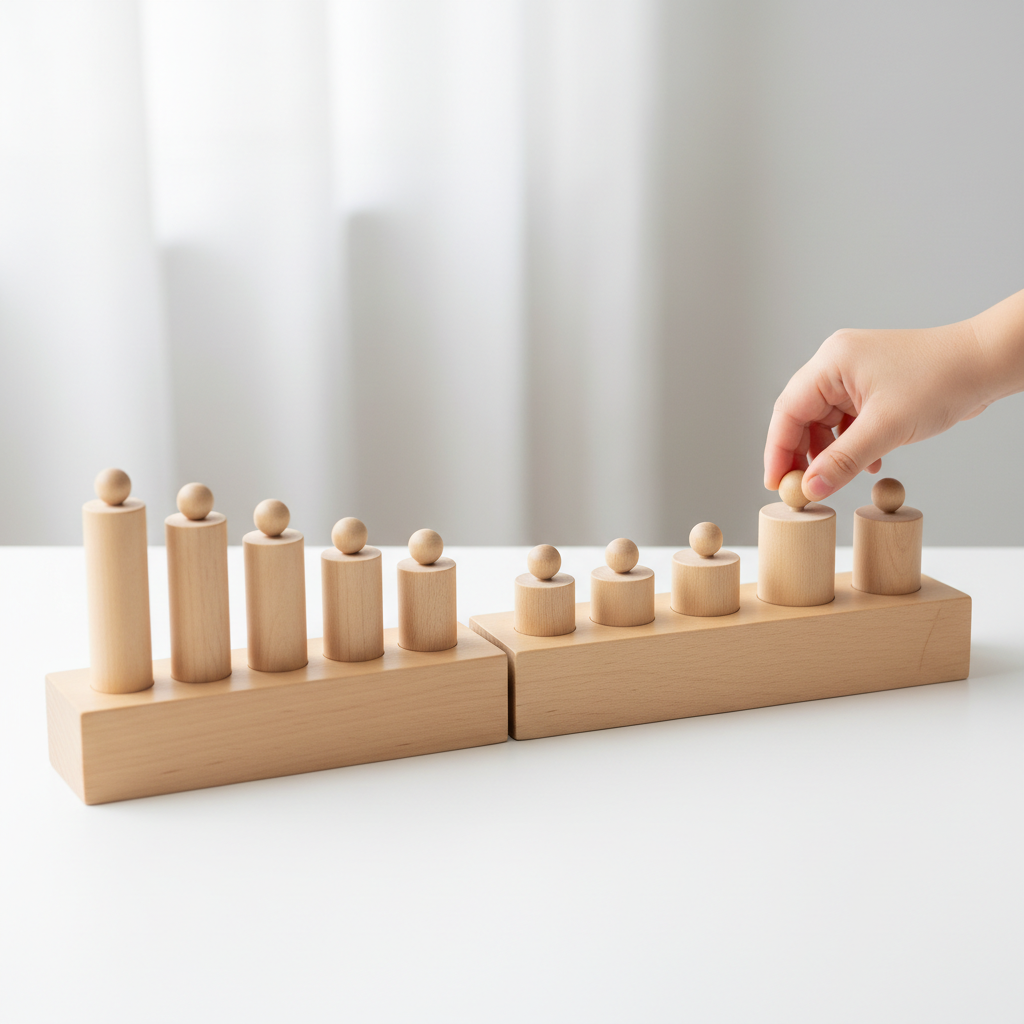
Block One: The cylinders vary in all three dimensions. Each cylinder increases or decreases by ½ cm in height, width, and depth from the preceding cylinder. The tallest cylinder is the thickest.
Block Two: The cylinders vary the same as Block One, only the tallest cylinder is the thinnest and the shortest cylinder is the widest.
Block Three: The cylinders vary in two dimensions — width and depth. All cylinders are the same height. They increase and decrease by ½ cm in both width and depth from the preceding cylinder.
Block Four: The cylinders vary in one dimension only — height. Each cylinder increases or decreases in height by ½ cm from the preceding one.
Blocks One and Two are the easiest because they vary in three dimensions. Block Four is the most difficult because it only varies in one dimension, and the control of error is not absolute the way it is for Blocks One, Two, and Three.
Presentation
You can do this on a table or on a rug. Sit next to your child and place the block of cylinders between you. Take out the cylinders, holding the knob of each between the thumb and the first two fingers. (This grasp helps prepare your child for holding a pencil properly!) Mix the cylinders on the table or rug in front of the block. After a short pause, replace the cylinders in their correct sockets, choosing them carefully in order of size. Some children will want to put the cylinders in themselves — which is great!
Watch a video of the presentation here.
Exercise
I usually ask my child, "Would you like to do this now?" Your child can use any of the sets without any further instruction. The cylinders are a wonderful self-teaching apparatus that a child can figure out all by him or herself. It's such a joy to watch them concentrate and work through the challenge on their own!
Advanced Exercise
When your child has mastered working with a single block, he or she can be shown how to use two sets together. I like to place the wooden blocks in a "<" shape. Mix the cylinders from both blocks and replace them correctly. Later your child can take three blocks, arrange them in a triangle, mix the cylinders, and then put them back. When using all four, make a square with the blocks and proceed to mix and replace.
Once your child is comfortable with the knobbed cylinders, you might also introduce the Knobless Cylinders for an exciting new challenge. You can also explore the Cylinder Cards for extended matching activities.
What Your Child Develops
- Visual perception of depth and dimension
- Keener observation of surroundings with a greater understanding of height, length, width, and depth
- Fine motor skills
- Writing readiness — the fingers and thumb naturally form the pencil grip
The knobbed cylinders are a cornerstone of Montessori sensorial education. They pair beautifully with other dimension-focused materials such as The Pink Tower, The Brown Stair, and The Red Rods. Together, these materials build a rich foundation for early math experiences and a lifelong love of learning.