The Brown Stair (Broad Stair)
Published on: February 24, 2026
The Brown Stair (Broad Stair)
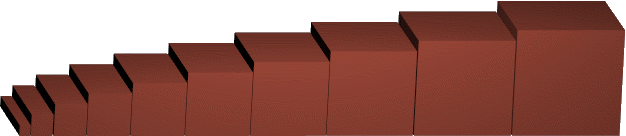
Ages
2½ to 5 years old
Material
10 brown wooden prisms, all the same length (20 centimeters), varying in height and width from 1 centimeter square to 10 centimeters square. Unlike the Red Rods, which vary in only one dimension, the Brown Stair prisms vary in two dimensions — height and width — while length stays constant.
Presentation
Spread a mat or rug on the floor. Mix the prisms on the mat. Arrange them in order from largest to smallest to form a stair. Make sure both sides of the stair are even. As you move each prism into place, stretch your hand across its thickness to measure it — this gives the child a muscular impression of the difference in size between each piece.
Exercise
Your child builds the stair as demonstrated. Encourage your child to use two hands for the largest prisms and one hand for the smaller ones — this naturally reinforces the sensorial experience of weight and dimension. Once the stair is built, show your child that the smallest prism fits exactly on top of each step of the stair, measuring the difference between one level and the next.
Purpose
- Visual perception and muscular awareness of differences in size
- Understanding and awareness of two-dimensional change (height and width)
- Math readiness — emphasis on the quantities 1 through 10
- Introduction to the relationship of square numbers: 4 of the smallest prisms make up the second stair, 9 make up the third stair, and 100 make up the largest stair
- Sequence, order, and concentration
Control of Error
The child can usually find any mistakes by feeling the stair with their hands. A prism out of order will break the smooth, even progression of the steps, and the child can detect this both visually and through touch.
Helpful Hint
Count the stairs together from 1 to 10. As your child grows more confident, you can begin with every other prism until the full set of 10 is mastered.
Advanced Exercise
Your child can place the Pink Tower cubes next to the Brown Stair as a visual comparison — the smallest cube of the Pink Tower matches the smallest prism of the Brown Stair. Combining the Pink Tower, Brown Stair, and Red Rods together is a wonderful extension that deepens understanding of how dimension changes in one, two, and three directions.
Free Printouts
Download this free Brown Stair printable activity:
- Brown Stair Printout — A printable version of the Brown Stair for practice and coloring
Recommended Materials
If you're adding the Brown Stair to your home classroom, here are two good options:
- Adena Montessori Brown Stair — Full Classroom Size — 10 solid wooden prisms graduated from 1cm to 10cm square, the standard classroom material
- Kghios Montessori Brown Stair — Compact Set — A smaller version ideal for home use with limited space