The Knobless Cylinders
Published on: April 25, 2026
The Knobless Cylinders
Ages
3 to 5 years old
Material
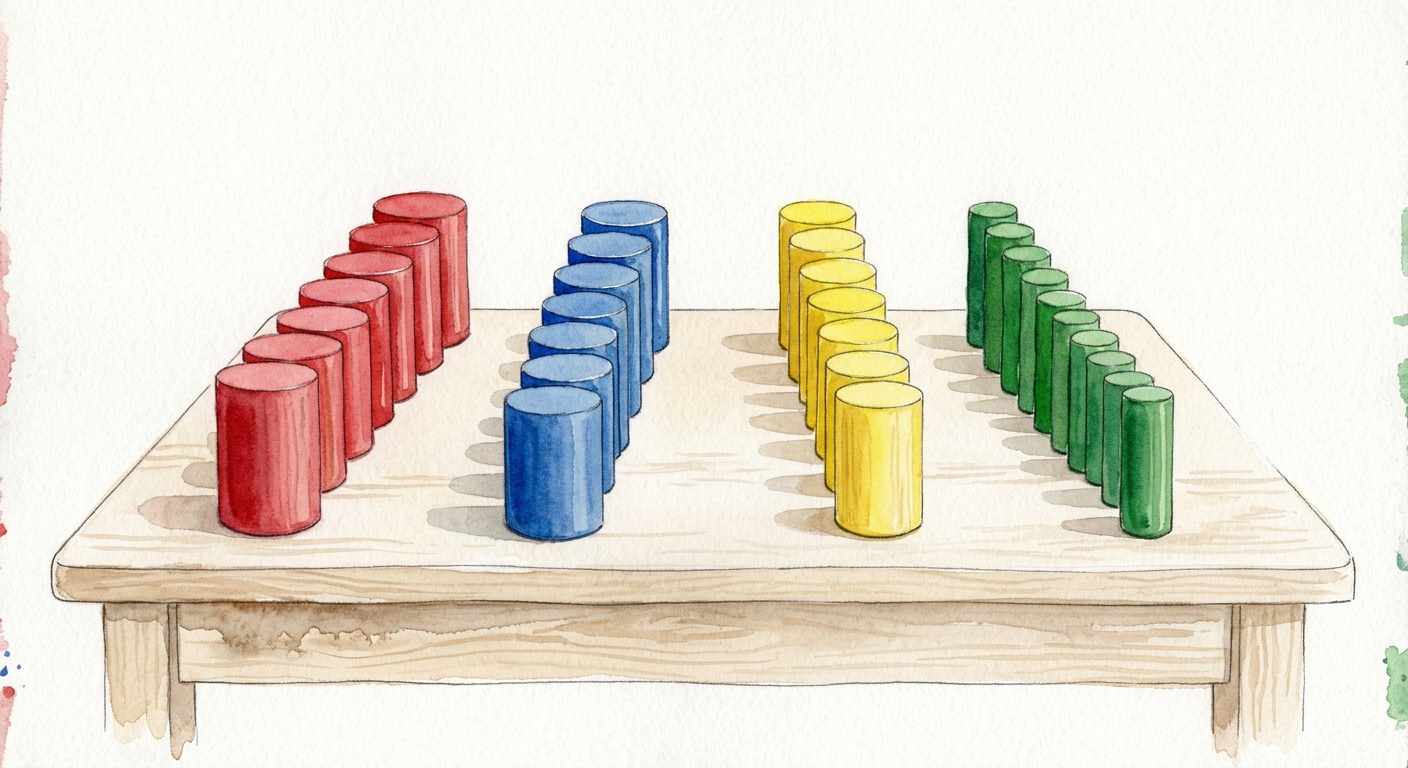
Four sets of 10 solid wooden cylinders, each set painted a different color. The knobless cylinders match the dimensions of the four sets of knobbed cylinders, but without knobs — the child must handle them freely, which adds a new level of challenge and sensorial awareness.
- Set 1 (Yellow): Cylinders vary in all three dimensions — height, width, and depth. The tallest cylinder is also the thickest, and they decrease proportionally. (Matches knobbed cylinder block 1.)
- Set 2 (Green): Cylinders also vary in all three dimensions, but the tallest cylinder is the thinnest and the shortest is the thickest. (Matches knobbed cylinder block 2.)
- Set 3 (Red): Cylinders vary in width and depth only — all cylinders are the same height. (Matches knobbed cylinder block 3.)
- Set 4 (Blue): Cylinders vary in height only — all cylinders are the same width. (Matches knobbed cylinder block 4.)
Presentation
Begin with a single set. Spread a mat on the floor or use a table. Remove the cylinders and mix them on the mat. Show your child how to arrange them in order from largest to smallest (or smallest to largest) in a line, or build them into a tower. Encourage your child to feel each cylinder as it is placed — wrapping their fingers around the width or running a hand along the height — so they gain a muscular impression of the dimensional differences.
Exercise
Your child builds the arrangement as demonstrated, working with one set at a time. Once your child has mastered ordering a single set confidently, introduce two sets together. The child can then begin to compare and contrast the cylinders across sets — noticing, for example, that a yellow cylinder and a blue cylinder may share the same height but differ in width. Eventually, all four sets can be combined in a single exercise, creating a rich and complex sorting and grading challenge.
Purpose
- Refine visual discrimination of differences in similar solid geometric shapes
- Develop spatial awareness — the child must discern similarities and differences across multiple dimensions
- Strengthen eye-to-hand coordination and fine motor skills
- Deepen understanding of gradation: tall–short, large–small, wide–narrow, thick–thin
- Preparation for mathematics through sequencing and seriation
- Build concentration and independent problem-solving
Control of Error
When cylinders are arranged in a graduated series, any piece out of order breaks the smooth visual progression. The child can detect the error by sight or by running their fingers along the tops or sides of the line. When building a tower, an incorrectly placed cylinder will cause the tower to lean or topple — providing an immediate, self-correcting feedback.
Language
Use the knobless cylinders as an opportunity to introduce and reinforce vocabulary for gradation. Talk about the series using comparative language: small, smaller, smallest; tall, taller, tallest; wide, wider, widest; thick, thin, narrow, and so on. The three-period lesson works beautifully here.
Advanced Exercise
Once your child is comfortable with all four sets of knobless cylinders, try combining them with the knobbed cylinders. Your child can place each knobless cylinder on top of its matching knobbed cylinder — matching the yellow set to knobbed block 1, the green set to block 2, and so on. Most children will eventually discover that the knobless cylinders also fit directly into the holes of the knobbed cylinder blocks, which is a wonderful moment of self-discovery!
For further extensions, encourage your child to explore how the knobless cylinders relate to other sensorial materials. The Pink Tower, Brown Stair, and Red Rods each isolate different dimensional changes, and combining them with the knobless cylinders deepens the child's understanding of how size varies in one, two, and three dimensions.
Free Printouts
Download this free printable activity to use alongside the knobless cylinders:
- Cylinder Cards Printout — Printable cards for matching and grading cylinder exercises
Recommended Materials
If you're adding the knobless cylinders to your home classroom, here are two good options:
- Montessori Knobless Cylinders — Complete Set of 4 — Four color-coded sets of 10 solid wooden cylinders matching the standard knobbed cylinder dimensions
- Montessori Knobbed Cylinder Blocks — The complementary knobbed cylinder blocks, perfect for pairing with the knobless cylinders in advanced exercises