The Knobbed Cylinders (Cylinder Blocks)
Published on: March 06, 2026
The Knobbed Cylinders (Cylinder Blocks)
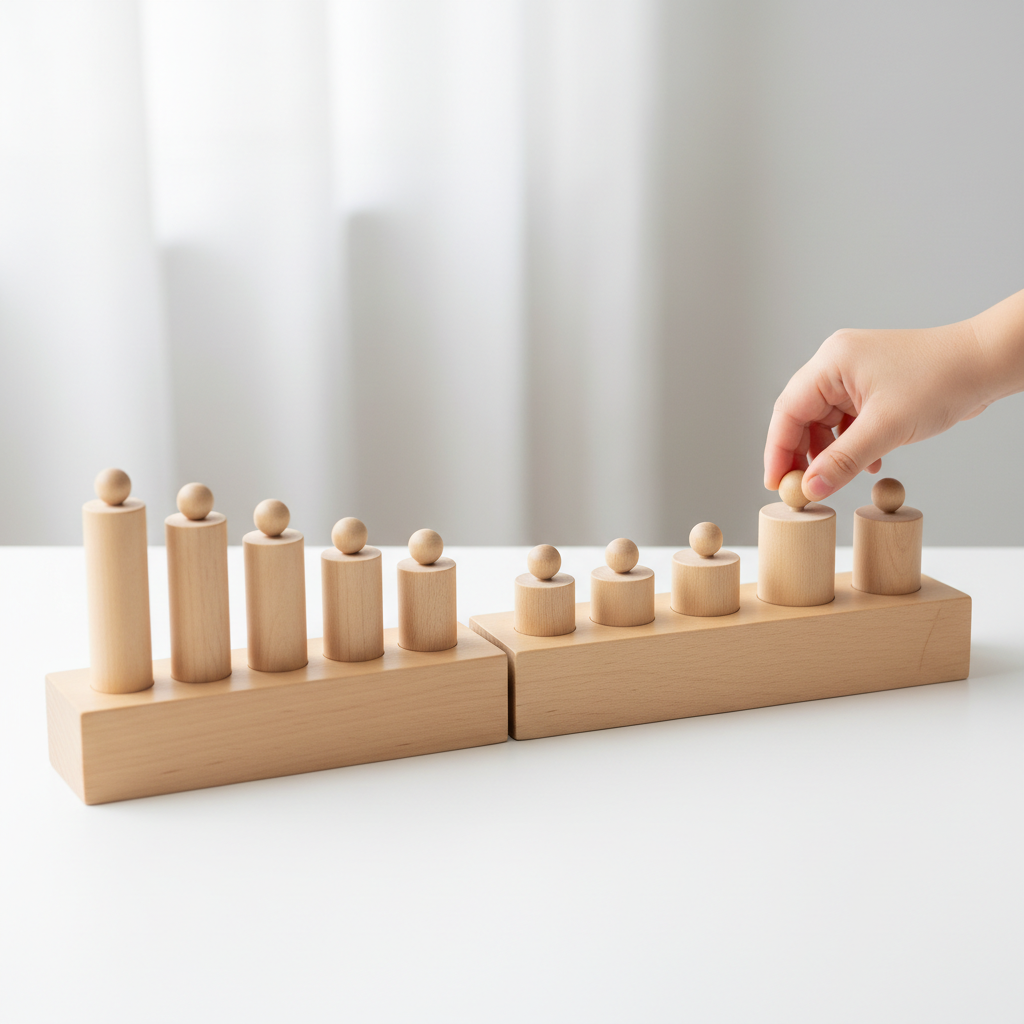
Ages
2½ to 5 years old
Material
Four wooden blocks, each containing 10 cylinders with small knobs on top. The cylinders fit snugly into sockets carved into the blocks. Each block varies the cylinders in a different way:
- Block 1: Cylinders vary in all three dimensions (height, width, and depth). Each cylinder increases or decreases by ½ cm in all dimensions. The tallest cylinder is the thickest.
- Block 2: Same as Block 1, but reversed — the tallest cylinder is the thinnest and the shortest is the widest.
- Block 3: Cylinders vary in two dimensions (width and depth) but are all the same height. They increase and decrease by ½ cm in width and depth.
- Block 4: Cylinders vary in one dimension only — height. Each cylinder increases or decreases in height by ½ cm. This is the most difficult block because the control of error is less obvious.
Presentation
Work on a table or a rug on the floor. Sit next to your child and place one block of cylinders between you. Remove the cylinders one at a time, holding each knob between the thumb and the first two fingers — this is the same grip your child will later use to hold a pencil. Mix the cylinders on the table or rug in front of the block. After a short pause, carefully replace the cylinders in their correct sockets, choosing them in order of size.
Many children will want to put the cylinders in themselves right away — and that's wonderful! This is exactly the kind of self-directed learning Montessori is built on.
Exercise
Invite your child: "Would you like to try this?" Your child can work with any of the four blocks without further instruction. The knobbed cylinders are a beautifully self-teaching material — the sockets provide a built-in control of error that lets your child figure out the correct placement independently.
Start with Block 1 or Block 2, which are the easiest because the cylinders vary in all three dimensions. Move to Block 3 (two dimensions), and finally Block 4 (one dimension) as your child's skills develop.
Purpose
- Visual perception of depth and dimension
- Observing surroundings with greater awareness of height, length, width, and depth
- Fine motor skills development
- Writing readiness — the pincer grip on the knobs prepares the hand for holding a pencil
- Concentration and independent problem-solving
- Preparation for mathematics — understanding graduated differences
Control of Error
Blocks 1, 2, and 3 have absolute control of error — if a cylinder is in the wrong socket, another cylinder simply won't fit. Block 4 has less obvious control of error since the cylinders are all the same width, making it a more challenging exercise for the child.
Advanced Exercises
When your child has mastered working with one block at a time:
- Two blocks: Place the wooden blocks in a V shape. Mix the cylinders from both blocks and replace them correctly.
- Three blocks: Arrange the blocks in a triangle. Mix all the cylinders together and replace.
- Four blocks: Make a square with all four blocks. Mix all 40 cylinders and sort them back into the correct sockets — a wonderful challenge!
Free Printouts
Download these free cylinder printable activities:
- Cylinder Cards Printout — Printable cylinder matching cards for hands-on practice
Recommended Materials
If you're adding knobbed cylinders to your home classroom, here are some good options:
- Montessori Knobbed Cylinder Blocks — Full 4-Block Set — Classic wooden set with 4 blocks and 40 cylinders, includes a personalized storage bag
- Adena Montessori Small Cylinders Block Set — Compact version ideal for home use, with four graduated blocks