Lesson of the Day 54: The Knobless Cylinders — Building Visual Discrimination Through Hands-On Grading
Published on: June 04, 2026
Materials Needed
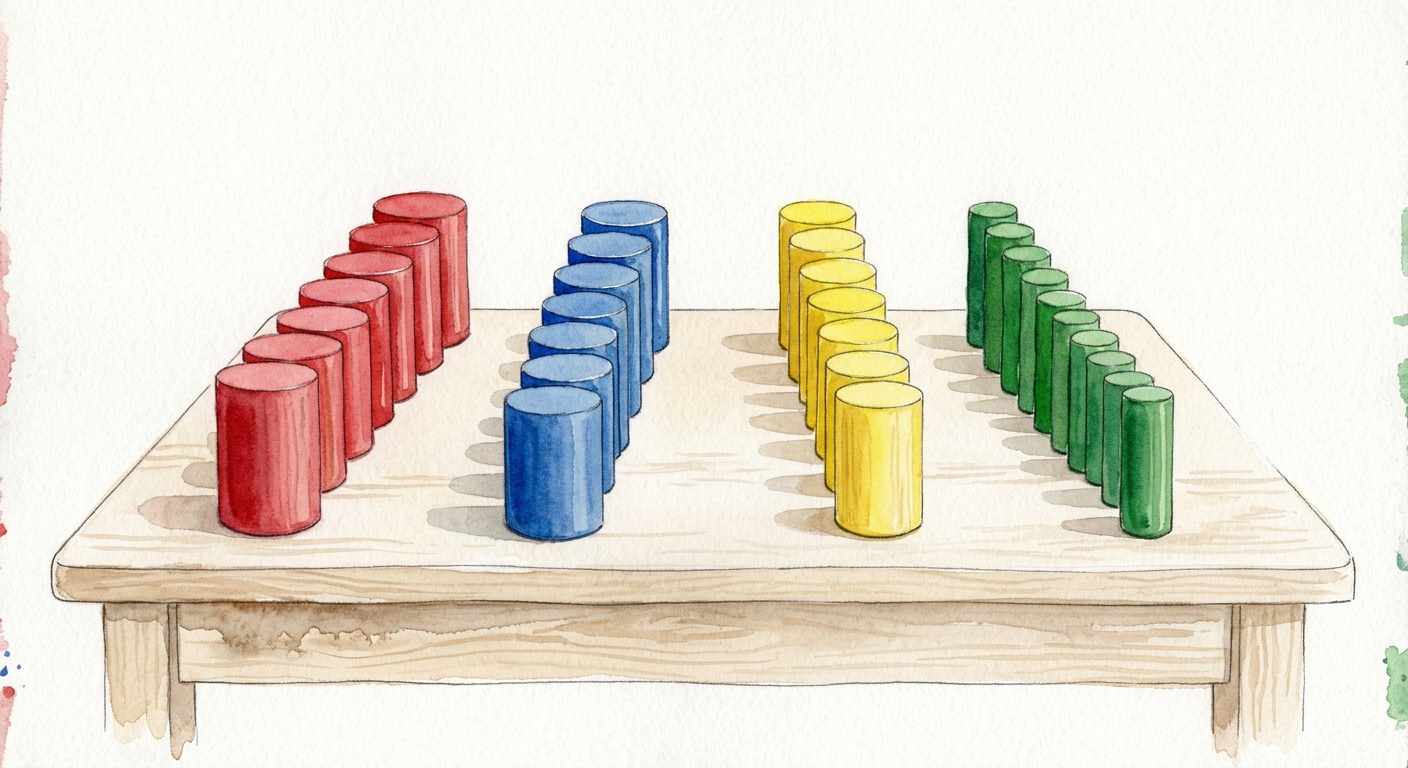
- Knobless Cylinders — Complete Set of 4 Boxes — Four color-coded sets (yellow, green, red, blue) of 10 solid wooden cylinders each. Hidoggy Montessori Knobless Cylinders (Set of 4) or Montessori Wooden Knobless Color Cylinder Blocks
- Knobbed Cylinder Blocks (optional, for advanced pairing exercise) — The four corresponding knobbed cylinder blocks that the knobless cylinders are designed to match
- A floor mat or large work rug
- Optional: Pink Tower, Brown Stair, or Red Rods for cross-material extensions
Free Printouts
Download this free printable to extend the knobless cylinder lesson:
- Cylinder Cards Printout — Printable cards for matching and grading cylinder exercises. These cards show graduated sequences that your child can use as visual guides or matching work.
See our full collection of sensorial resources for additional printouts and guides related to dimensional materials.
Age Range
3 to 6 years. Most children are introduced to the knobless cylinders after they have gained confidence with the knobbed cylinders (typically around age 3 to 3.5). The single-set exercises are appropriate for younger children, while combining two, three, or all four sets together offers challenge well into the kindergarten years.
Purpose
The Knobless Cylinders are a foundational material in the Montessori sensorial curriculum. They refine the child's ability to perceive and discriminate differences in size across multiple dimensions — height, width, and depth — using only the sense of sight and touch. Without the knobs that guided the earlier knobbed cylinder work, the child must now handle each cylinder freely, relying on visual judgment and muscular memory to arrange them in precise graduated sequences.
This material serves several interconnected purposes:
- Visual discrimination: The child learns to perceive subtle differences among similar three-dimensional objects, training the eye to notice gradation in one, two, or three dimensions simultaneously.
- Spatial reasoning: Working across multiple sets, the child begins to understand how dimensions relate to one another — that two cylinders can share the same height but differ in width, or vice versa.
- Fine motor coordination: Handling the cylinders without knobs requires a different, more refined grip. The child wraps fingers around each piece, gaining a muscular impression of its size.
- Mathematical preparation: Seriation (arranging objects in a graduated order) is a pre-mathematical skill that lays the groundwork for understanding number sequences, measurement, and comparison.
- Concentration and problem-solving: Especially when multiple sets are combined, the knobless cylinders offer a rich intellectual challenge that builds sustained attention and independent thinking.
Maria Montessori designed the sensorial materials so that each isolates a particular quality for the child's focused exploration. The knobless cylinders beautifully complement other dimensional materials like the Pink Tower (which varies in three dimensions), the Brown Stair (two dimensions), and the Red Rods (one dimension). Together, these materials give the child a complete and concrete understanding of how size changes in the physical world.
Understanding the Four Sets
Before presenting the knobless cylinders, it helps to understand exactly what makes each set unique. Each set of 10 cylinders is painted a different color and varies in specific dimensions, matching the four blocks of knobbed cylinders:
- Yellow Set (Set 1): Cylinders vary in all three dimensions — height, width, and depth. The largest cylinder is both the tallest and the thickest; the smallest is both the shortest and the thinnest. They decrease proportionally. This matches knobbed cylinder block 1.
- Green Set (Set 2): Cylinders also vary in all three dimensions, but in the opposite relationship — the tallest cylinder is the thinnest, and the shortest is the thickest. This inverse relationship makes the green set particularly interesting and challenging. It matches knobbed cylinder block 2.
- Red Set (Set 3): Cylinders vary in width and depth only — all ten cylinders are the same height. The child grades them from thickest to thinnest (or thinnest to thickest). This matches knobbed cylinder block 3.
- Blue Set (Set 4): Cylinders vary in height only — all ten cylinders are the same width. The child grades them from tallest to shortest (or shortest to tallest). This matches knobbed cylinder block 4.
The color coding is not arbitrary — it helps the child (and the adult) quickly identify which set isolates which dimensional change. This becomes especially important when multiple sets are combined in advanced exercises.
Presentation 1: A Single Set
Always begin with a single set. Many guides suggest starting with the yellow set (which varies in all three dimensions and offers the most obvious visual differences), though the red set (same height, varying width) is also a clear starting point. Choose whichever set you feel will best engage your child.
- Invite your child to the lesson: "I'd like to show you something new today. Would you like to come work with me?"
- Together, carry the box of cylinders to the mat. Walk carefully and slowly — modeling respect for the material.
- Sit beside your child (on their dominant side so they have a clear view of your hands).
- Open the box and gently remove each cylinder one at a time, placing them in a scattered, random arrangement on the mat. Take your time. Let your child see that you handle each piece with care.
- Pause and look at the scattered cylinders. Then pick up the largest cylinder. Wrap your fingers around it so you can feel its full width. Place it at the left side of the mat.
- Scan the remaining cylinders. Pick up the next largest and place it to the right of the first, touching it so the two sit side by side.
- Continue selecting the next largest each time, building a graduated line from left to right (largest to smallest).
- When the line is complete, slowly run your hand along the tops of the cylinders — if the set varies in height (yellow, green, or blue), your hand will glide along a smooth slope. If working with the red set, run your fingers along the sides to feel the gradual narrowing.
- Pause and admire the completed work. Then say, "Would you like to try?"
- Mix the cylinders again and invite your child to build the sequence independently.
Key presentation tips:
- Use slow, deliberate movements. The child absorbs not just what you do but how you do it.
- Keep language minimal during the presentation itself. Let the material speak.
- If your child places a cylinder out of order, do not correct immediately. The control of error is built into the material — an out-of-order piece will break the smooth visual progression, and most children will notice on their own.
Presentation 2: Combining Two Sets
Once your child can confidently and independently grade a single set, introduce a second set alongside the first. A natural pairing is the yellow set with the green set, because both vary in all three dimensions but with opposite relationships (in the yellow set, tall equals thick; in the green set, tall equals thin). This contrast is fascinating for children.
- Carry both boxes to the mat. Remove all cylinders from both sets and mix them together on the mat.
- First, invite your child to sort the cylinders by color — yellow cylinders in one group, green in another. (This step reinforces classification skills.)
- Then, grade each color group in order, side by side on the mat.
- Once both sequences are complete, invite your child to notice: "Look at how these are the same height" (pointing to a yellow and green cylinder that share a dimension) "but this one is wider."
- Allow your child to explore the comparisons freely.
Other effective two-set pairings include:
- Red + Blue: The red set has uniform height with varying width; the blue set has uniform width with varying height. Placing them side by side makes these contrasting qualities beautifully visible.
- Yellow + Red: Both include width variation, but the yellow set adds height changes.
Presentation 3: All Four Sets Combined
When your child is thoroughly comfortable with two-set exercises, you can introduce all four sets at once. This is one of the richest and most challenging sensorial activities in the entire Montessori curriculum. With 40 cylinders spread across the mat, the child must sort, classify, and grade across multiple dimensions simultaneously.
- Remove all 40 cylinders and scatter them on a large mat.
- The child first sorts by color (four groups of ten).
- Then grades each group in sequence.
- Finally, the child may explore cross-set comparisons — finding cylinders from different sets that share the same height, or the same width, or neither.
Some children will spontaneously begin creating patterns and designs with the combined sets — towers, staircases, circular arrangements, or symmetrical layouts. This creative exploration is wonderful and should be encouraged. It reflects a deep internalization of the dimensional relationships.
Control of Error
The knobless cylinders are self-correcting in several ways:
- Visual check: When cylinders are arranged in a graduated series, any piece out of order breaks the smooth visual progression. The child can see that something "doesn't look right."
- Tactile check: Running a hand along the tops (for height-varying sets) or sides (for width-varying sets) of the completed sequence reveals any bump or irregularity where a cylinder is misplaced.
- Tower building: When cylinders are stacked into a tower (a popular variation), an incorrectly placed piece will cause the tower to lean or topple — immediate, unmistakable feedback.
- Matching with knobbed cylinders: In the advanced exercise described below, each knobless cylinder should fit perfectly into a corresponding hole in the knobbed cylinder block. A mismatch is immediately apparent.
These built-in controls mean you never need to point out errors. The child discovers mistakes independently, which builds confidence, self-reliance, and genuine understanding.
The Three-Period Lesson: Language for Gradation
The knobless cylinders provide a perfect opportunity to introduce and refine vocabulary for comparison and gradation. Use the three-period lesson to teach these terms:
For height-varying sets (Yellow, Green, Blue):
- Tall, taller, tallest
- Short, shorter, shortest
For width-varying sets (Yellow, Green, Red):
- Thick, thicker, thickest
- Thin, thinner, thinnest
- Wide, wider, widest
- Narrow, narrower, narrowest
General terms:
- Large, larger, largest
- Small, smaller, smallest
Here is how the three-period lesson works with this material:
- Period 1 (Naming): Select three contrasting cylinders from one set (e.g., the thickest, a middle one, and the thinnest from the red set). Point to each: "This is thick. This is thin. This is thinner."
- Period 2 (Recognition): "Show me the thick one. Show me the thin one. Can you point to the thinner one?"
- Period 3 (Recall): Point to one cylinder: "What is this one?"
Introduce only two or three terms at a time. Once your child has mastered the basic comparative forms, you can add superlatives (thickest, thinnest, tallest, shortest) in a later session.
Advanced Exercise: Pairing with the Knobbed Cylinders
This is one of the most satisfying extensions of the knobless cylinder work. Once your child is comfortable with all four sets, bring out the corresponding knobbed cylinder blocks.
- Place the four knobbed cylinder blocks on the mat with the cylinders seated in their holes.
- Set the four boxes of knobless cylinders nearby.
- Show your child how to match each knobless cylinder to its corresponding knobbed cylinder by placing the knobless cylinder on top of the knobbed one: yellow knobless cylinders match block 1, green matches block 2, red matches block 3, and blue matches block 4.
- Your child may also discover — often with great delight — that the knobless cylinders fit directly into the holes of the knobbed cylinder blocks when the knobbed cylinders are removed. This moment of self-discovery is deeply satisfying and reinforces the child's understanding of dimensional correspondence.
If you don't yet have the knobbed cylinders in your home environment, you can read more about them in our Lesson of the Day 88: The Knobbed Cylinders or our Knobbed Cylinders guide.
Extensions and Variations
The knobless cylinders lend themselves to many creative extensions. Here are several to try as your child's mastery grows:
Tower Building
Invite your child to stack the cylinders of one set into a tower, placing the largest at the bottom and the smallest on top. This requires careful hand control and an understanding of stability — if a larger cylinder is placed above a smaller one, the tower will topple. The blue set (same width, varying height) creates an especially dramatic tall tower, while the red set (same height, varying width) creates a wide, pyramid-like structure.
Blindfold Exercise
Once the child is very familiar with a set, introduce a blindfold or simply ask the child to close their eyes. Can they arrange the cylinders in order using only their sense of touch? This exercise transfers the work from the visual sense to the stereognostic (muscular) sense and deepens the child's understanding of dimensional differences.
Pattern Cards
Use the free cylinder cards printout to give your child visual patterns to replicate. Place a card on the mat and have your child match the arrangement shown, selecting the correct cylinders and positioning them accordingly.
Cross-Material Exploration
Encourage your child to explore how the knobless cylinders relate to other sensorial materials:
- The Pink Tower cubes vary in all three dimensions (like the yellow knobless cylinders). Can your child find a pink cube and a yellow cylinder that are "about the same size"?
- The Brown Stair prisms vary in two dimensions (width and depth) while maintaining the same length — similar to the red knobless cylinders maintaining the same height.
- The Red Rods vary in one dimension only (length), just as the blue knobless cylinders vary in one dimension (height).
These cross-material comparisons help the child build a rich, interconnected understanding of how dimensional change works in the physical world. This kind of exploration is at the heart of sensorial education.
Connection to Geometric Solids
As your child advances, you might also draw a connection between the knobless cylinders and the Geometric Solids. The cylinder is one of the geometric solids, and working with the knobless cylinders gives the child an embodied understanding of this shape long before they encounter it in formal geometry. You can read more in our Lesson of the Day 56: Geometric Solids.
Observation Tips for Parents
As you watch your child work with the knobless cylinders, here are some things to notice:
- Does the child work systematically? A child who scans all the remaining cylinders before selecting the next one is demonstrating careful visual comparison. A child who grabs at random may need more time with the material or might benefit from a quieter re-presentation.
- Does the child self-correct? Watch for moments when the child pauses, notices an error in the sequence, and fixes it independently. This is the material working exactly as Montessori intended.
- How does the child handle the cylinders? Wrapping the whole hand around each piece (rather than pinching with two fingers) gives a fuller muscular impression of its size. If the child is only using a pincer grasp, gently model the full-hand grip.
- Is the child ready for more challenge? Signs of readiness include completing a single set quickly and accurately, expressing boredom, or spontaneously combining sets. These are invitations to introduce the next level.
- Does the child explore creatively? Building towers, creating patterns, or inventing games with the cylinders shows that the child has internalized the dimensional relationships and is now applying that understanding in new contexts. Celebrate this!
Common Questions
Should I introduce the knobless cylinders before or after the knobbed cylinders?
In the traditional Montessori sequence, the knobbed cylinders come first. The knobs provide a built-in guide (the cylinder fits into a specific hole), which gives the child a structured introduction to dimensional grading. The knobless cylinders remove that scaffolding, requiring the child to rely entirely on visual and tactile judgment. However, if your child is already comfortable with grading activities and shows strong visual discrimination, you can introduce the knobless cylinders even without prior knobbed cylinder experience.
My child just wants to build towers and doesn't want to grade them. Is that okay?
Absolutely. Tower building is a legitimate and valuable exercise with this material. The child is still exploring dimensional relationships — they're learning about stability, balance, and the consequences of size differences. The grading work can be re-presented gently at another time. Follow your child's interest.
How long should my child work with a single set before I introduce more?
There is no fixed timeline. Watch for consistent, accurate, and independent work with one set — the child should be able to grade the cylinders without hesitation and with evident satisfaction. This might take a few days for some children or several weeks for others. Never rush the progression. The depth of understanding matters far more than the speed.
Can I make DIY knobless cylinders?
While the precision of manufactured Montessori materials is part of what makes them effective (the dimensional differences are mathematically proportional), you can create a simplified version using wooden dowels cut to graduated lengths or widths. Paint each set a different color. The experience won't be identical to the standard material, but it can still offer meaningful sensorial exploration.
Where This Fits in the Montessori Sequence
The knobless cylinders sit within the sensorial area of the Montessori classroom, part of a carefully designed progression of dimensional materials. Here is the typical sequence:
- Knobbed Cylinders — The child's first dimensional grading work, with self-correcting sockets.
- Pink Tower — Ten pink cubes graded in three dimensions.
- Brown Stair — Ten brown prisms graded in two dimensions.
- Red Rods — Ten red rods graded in one dimension (length).
- Knobless Cylinders — Four sets grading in various dimensional combinations, deepening and consolidating all previous work.
The knobless cylinders are sometimes described as the "culmination" of the dimensional sensorial materials because they bring together all the concepts explored in the earlier works. A child who has mastered all four sets — and especially a child who can combine them and relate them back to the knobbed cylinders — has developed a remarkably refined capacity for visual discrimination and spatial reasoning.
In yesterday's Lesson of the Day 53: Color Tablets, we explored how the sensorial materials refine the chromatic sense. Today's knobless cylinders refine the dimensional sense. Together, these materials build a child's ability to observe the world with precision, clarity, and wonder.
Further Reading
Explore these related resources on our site to deepen your understanding of Montessori sensorial materials:
- The Knobless Cylinders — Our comprehensive standalone guide
- Cylinders and Solid Insets — Understanding the full cylinder family
- What is Sensorial Education? — The philosophy behind these materials
- The Pink Tower — Three-dimensional grading
- The Brown Stair — Two-dimensional grading
- The Red Rods — One-dimensional grading
- Geometric Solids — Exploring three-dimensional shapes