Geometric Solids
Published on: May 12, 2026
Geometric Solids
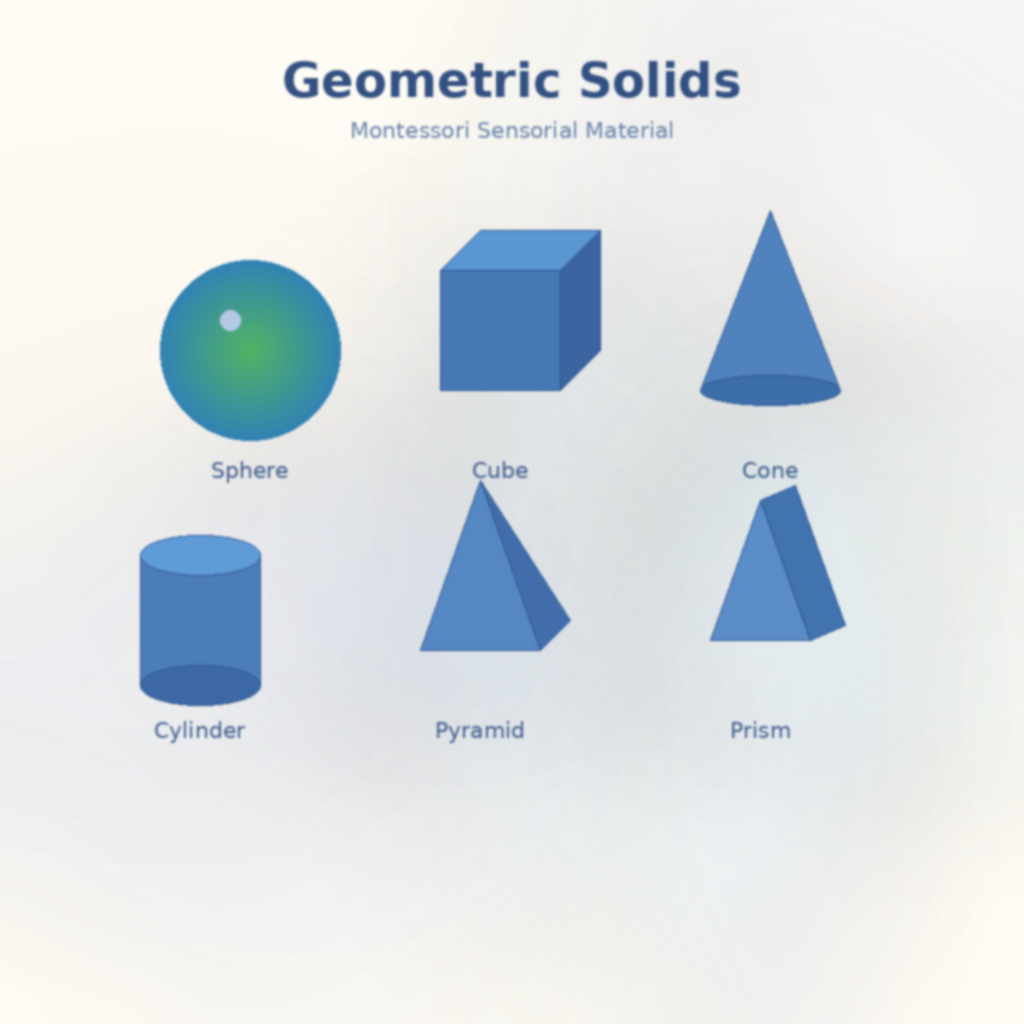
The Geometric Solids are one of the most beautiful and engaging materials in the Montessori sensorial curriculum. This set of ten blue-painted wooden shapes invites children to explore three-dimensional geometry through touch, sight, and language — building a concrete understanding of form that lays the groundwork for abstract geometry years later.
Ages
3 to 6 years old
Material
A set of ten blue-painted wooden geometric solids, each approximately 8–10 cm in its largest dimension:
- Sphere — a perfectly round ball that rolls in every direction
- Ellipsoid — an egg-like oval, elongated along one axis
- Ovoid — similar to the ellipsoid but narrower at one end (like an egg)
- Cube — six equal square faces, all edges the same length
- Rectangular Prism — a box shape with three pairs of rectangular faces
- Triangular Prism — two triangular ends joined by three rectangular faces
- Cylinder — a tube with two circular, flat ends
- Cone — a circular base tapering to a single point (apex)
- Square-Based Pyramid — a square base with four triangular faces meeting at a point
- Triangular Pyramid (Tetrahedron) — four triangular faces, the simplest Platonic solid
The set also includes three wooden stands (bases) for the shapes that roll — sphere, ellipsoid, and ovoid — and a blindfold or sleep mask for the stereognostic exercise.
Presentation
First Presentation — Three Contrasting Solids
- Invite the child to the lesson. Place three strongly contrasting solids on a mat — the sphere, cube, and cone work well.
- Pick up the sphere. Roll it slowly in your hands, feeling every part of the surface. Say: "This is a sphere."
- Offer it to the child. Let them roll it, hold it, and explore it with both hands.
- Pick up the cube. Run your fingers deliberately along each flat face and sharp edge. Say: "This is a cube."
- Let the child feel the faces, edges, and vertices (corners).
- Pick up the cone. Trace from the point down to the circular base. Say: "This is a cone."
- Use the Three-Period Lesson to reinforce the names:
Period 1 (naming): "This is a sphere."
Period 2 (recognition): "Show me the cube." / "Give me the cone."
Period 3 (recall): "What is this?"
Second Presentation — Remaining Solids
Introduce the remaining seven solids in groups of two or three over successive days, always using the Three-Period Lesson. Pair shapes that share a feature — for example, the cylinder and the cone (both have a circular base), or the two pyramids (both taper to a point).
Exercise
- Sorting by property: Place all ten solids on the mat and ask: "Which shapes can roll? Which cannot?" The child discovers three groups: shapes that roll freely (sphere, ellipsoid, ovoid), shapes that both roll and slide (cylinder, cone), and shapes that only slide (cube, rectangular prism, triangular prism, pyramids).
- Matching to real objects: Gather a basket of everyday objects — a ball, an egg, a box, a can, a party hat, a die. The child matches each object to the solid it resembles.
- Stereognostic exercise: Blindfold the child (or ask them to close their eyes). Place one solid in their hands and ask them to name it by touch alone. This isolates the tactile sense and strengthens the child's stereognostic perception — the ability to identify objects by feel.
Purpose
- Discrimination of three-dimensional form — the child learns to distinguish shapes by their faces, edges, vertices, and curvature
- Vocabulary development — precise geometric language (sphere, prism, apex, face, edge, vertex) becomes part of the child's working vocabulary
- Preparation for geometry — concrete experience with 3D forms builds the foundation for later study of surface area, volume, and spatial relationships
- Stereognostic sense development — the blindfolded exercise trains the hand-mind connection
- Observation of geometry in the environment — children begin to notice spheres, cylinders, and prisms in everyday life
Control of Error
The shapes themselves are the control. A child who places the sphere in the "cannot roll" group will see it roll away — the material corrects without adult intervention. For the stereognostic exercise, the child removes the blindfold to verify their guess.
Helpful Hints
- Start with just three strongly contrasting shapes. Introducing all ten at once overwhelms the senses and defeats the purpose of isolating differences.
- Let the child handle the solids freely before the first formal presentation — a few minutes of open exploration satisfies curiosity and helps the child settle into focused work.
- Keep a small basket of matching real-world objects near the solids. Children love the "treasure hunt" of finding objects around the house that match each shape.
- The wooden bases (stands) prevent rolling shapes from escaping during the lesson — use them when working on a table rather than a mat.
Advanced Exercises
- Plane-shape connection: Press each solid gently into soft clay or playdough. The child discovers that a sphere makes a circle, a cube makes a square, and a triangular prism makes a triangle — linking 3D solids to 2D shapes and bridging to the Geometric Cabinet.
- Building with the Constructive Triangles: After the child knows the names of the solids, introduce the Constructive Triangles to show how flat shapes combine to form 3D faces.
- Mystery Bag: Place several solids in a cloth bag. The child reaches in without looking, identifies one solid by touch, names it, and then removes it to check. This is a classic Montessori Mystery Bag extension.
- Geometric Solids and Bases cards: Use control cards that show each solid and its name. The child matches the physical solid to the card — a reading and geometry exercise combined.
Free Printouts
Download these free printable activities to extend the Geometric Solids lesson:
- Geometric Cards — Circles — Printable cards for circle and curved-shape recognition
- Shape Reading Cards — Reading cards featuring geometric shape names and images
- Cylinder Cards — Printable cylinder nomenclature cards
Find more geometry printables on the Geometry Printouts page.
Recommended Materials
If you are adding Geometric Solids to your home classroom, these are solid options:
- Montessori Geometric Solids with Bases and Box — A complete 10-piece blue wooden set with wooden bases and a storage box, the classroom-standard size
- Kid Advance Montessori Geometric Solids with Stands and Bases — Ten solids with stands and plane-shape bases for the advanced tracing exercise