Montessori Sensorial Education and Early Math Experiences
Published on: June 30, 2007
Why Montessori Math Begins With the Hands
Maria Montessori believed that mathematical concepts should be introduced to young children as "materialized abstractions" — ideas made tangible through hands-on materials that children can touch, move, and explore. Rather than starting with symbols on a page, Montessori math begins with concrete objects that allow children to literally feel the difference between quantities.
This approach is grounded in a powerful insight: a strong foundation in mathematics during the preschool years can prevent children from struggling with math later on. "Math phobias" — that anxious, frozen feeling so many adults recognize — are a common symptom among those who had little or no introduction to math manipulatives during the sensitive period between ages three and six.
If your child is in this age range, you're in a remarkable window of opportunity. Let's explore why early, sensorial math experiences matter so much and how the Montessori approach makes abstract concepts feel natural and even joyful for young learners.
Learning Through the Senses: Why It Sticks
In a Montessori Children's House, you'll find an abundance of materials dedicated to arithmetic — and there's a very good reason for that. Children at the preschool age have a natural interest in sensorial work. What they learn through their senses during this period is absorbed deeply into their understanding. It becomes knowledge that is known perfectly, not uncertain and hard to recall the way information acquired unwillingly at a later age tends to be.
Think about the difference between memorizing multiplication tables under pressure in third grade versus a four-year-old who has spent months happily building towers of ten, counting golden beads, and laying out number rods on the floor. The first child is working against the grain; the second is working with it.
This is the heart of the Montessori math philosophy: meet children where they are developmentally, give them materials that speak to their natural curiosity, and trust them to build understanding at their own pace.
The Decimal System From the Very Beginning
One of the most fundamental features of our number system is that we count in tens — we use a decimal system. Montessori believed this should be made apparent from the very first encounter with math materials, not introduced as an abstract concept years later.
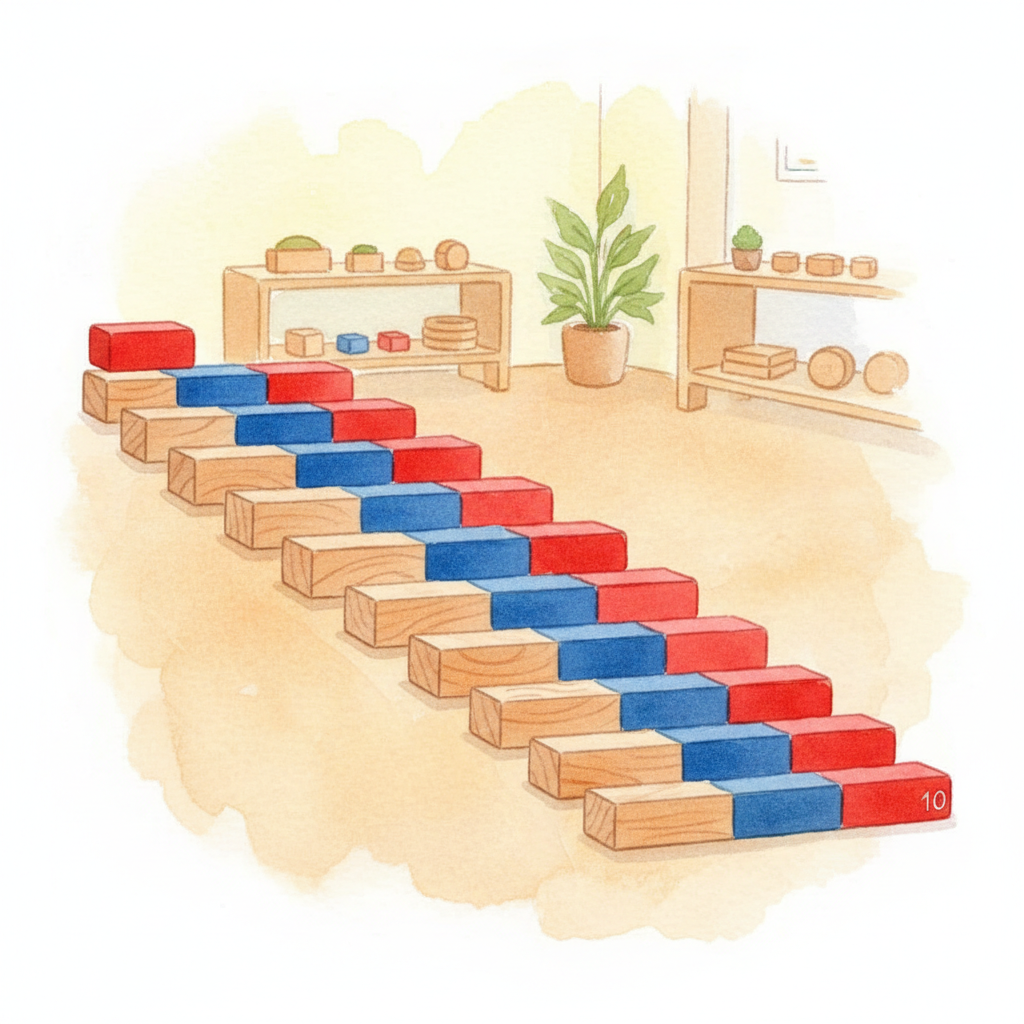
All of the early sensorial materials for dimensions — the cubes, the stairs, the rods — come in sets of ten. The Long Rods (also called Red Rods) consist of rods measuring from one to ten decimeters in length. When a child has mastered arranging these rods from shortest to longest, they've developed a sensorial awareness of graduated quantity — even before numbers are formally introduced.
From Sensorial to Numerical
The next step is beautifully logical. The Number Rods are identical to the Long Rods, except that each decimetre section is colored in alternating red and blue segments. These color markings draw the child's attention to the individual units within each rod — turning a sensorial experience into a mathematical one.
Because the child already knows how to arrange the rods by size, the physical task is easy. This frees their mind to focus on the new intellectual challenge: connecting quantities to their names. The names of the numbers are taught in connection with the appropriate rods. Then, the same names are practiced with sandpaper numerals, so the child can trace the shape of each figure. Finally, the rods are laid out and the written numerals are placed beside them.
Notice the progression: first the hands, then the words, then the symbols. Each layer of abstraction is built on a solid foundation of concrete experience.
Why the Units Are Fixed — And Why That Matters
Here is a subtle but crucial point about the Montessori Number Rods that parents sometimes overlook: the units on each rod are fixed together. A rod representing "four" cannot be broken apart into four separate pieces. This is intentional.
Because the units are permanently joined, there is no possibility of confusion. The child can work with the rods and absorb the concept of "four-ness" or "seven-ness" as a unified whole. This kind of deep absorption would not be possible with loose, moveable counters, where a child might learn the name of a number before truly grasping what that quantity means.
Additional counting exercises with the Spindle Box and loose counters with number cards come later, reinforcing and extending the knowledge. But the fixed rods come first, building a rock-solid foundation.
Until a thorough knowledge of the units is achieved, the material is limited to ten. In none of these first exercises is it possible to go beyond ten. This is an important point to avoid confusion.
The Leap to Large Numbers
Once a child has truly mastered the units from one to ten, something surprising happens in the Montessori classroom: the next step is not counting tediously from ten to one hundred. Instead, the child is introduced to the entire decimal system — units, tens, hundreds, and thousands — all at once.
This might sound radical, but consider this: the method of studying numbers from ten to one hundred sequentially is, frankly, very dull. Any interest the child might have had is typically exhausted long before they arrive at any real conception of large numbers.
The Golden Bead Material
In the Montessori approach, the knowledge of the decimal system is given through the golden bead material:
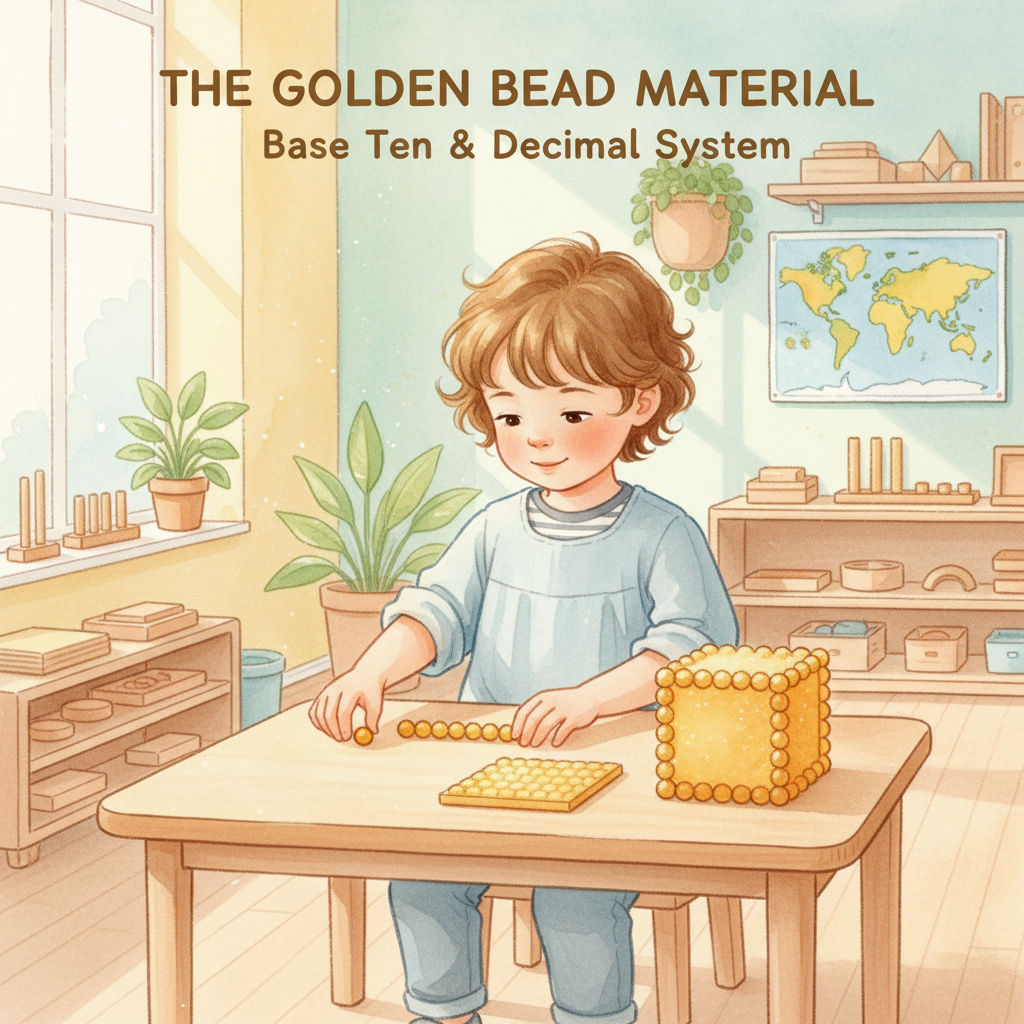
- Units are single golden beads — tiny and individual
- Tens are bars of ten golden beads strung together
- Hundreds are squares made up of ten ten-bars
- Thousands are cubes made up of ten hundred-squares
There are also hundred chains and thousand chains made up of ten-bars linked together, which children can stretch across the floor and count, bead by bead.
Children naturally learn the names of the most striking objects first — the imposing thousand cube, the satisfying hundred square. Then, with the help of number cards, they learn how these quantities are written. In every case, the child never learns a name that doesn't have a concrete meaning. Every word is associated with a specific, tangible quantity of beads.
Why Children Love Big Numbers
Many adults feel a jolt of anxiety when they see numbers with commas in them. The instinct is: "If I struggled so much with two- and three-digit numbers, surely working with millions would be impossible." But this is a misconception. The same nine digits are used in every place value — so operating with millions is not fundamentally different from operating with units.
This simple fact often strikes even adults with surprise. And once it is realized, it can provide a great deal of courage. But it should never need to be pointed out to anyone who has properly mastered arithmetic from the beginning.
Children, far from being intimidated by large numbers, are often fascinated by thousands and millions. They genuinely prefer working with large figures when these are introduced early and concretely. There is something thrilling about carrying a thousand cube across the room or counting a thousand-chain that stretches from one end of the classroom to the other.
Preventing the "Fog of Misunderstanding"
One of the most practical benefits of early Montessori math work is what it prevents: the painful experience of a child at age seven who is expected to do arithmetic on paper but has never truly internalized what numbers mean.
Without a concrete foundation, children often learn number names by rote. It may be years before they develop a real conception of different numbers and their relationships to each other. The names become associated only with written figures, and arithmetic becomes a fragile succession of verbal formulas, held together precariously by counting on fingers.
We greatly underrate the intelligence of the four- or five-year-old if we think that this learning is too much. And if we do this, we are likely to make the opposite mistake later — expecting the child of five-and-a-half or six to grasp numbers in a few short lessons with counters.
Beyond Finger Counting
Finger counting — the kind where a child stops mid-problem to laboriously add on their fingers, only to arrive at the wrong answer — is only necessary for the combinations of the nine basic units. If a child knows these combinations thoroughly and correctly, they never need to interrupt their work to count on fingers.
A child who has worked extensively with number rods learns which pairs of numbers make ten. Later, exercises with small bead bars and the addition board teach many more addition and subtraction combinations, until finally all the combinations of the nine units are perfectly familiar — as familiar as counting itself.
At that point, it becomes easier and more natural to know instantly that sixteen and three are nineteen — because the child has a mental picture of six and three — than to embark on the uncertain operation of adding three fingers to a hazy idea of "sixteen" floating somewhere in the imagination.
Concrete Before Abstract: A Lifelong Gift
Some might criticize the Montessori approach as overly material or "clumsy" — after all, why spend so much time with beads and rods when the child will eventually need to work with abstract numbers on paper? The answer is straightforward: for most people, handling concrete materials is a necessary step in truly understanding numbers.
However late a child begins arithmetic in a traditional school, they cannot get a clear idea of number from abstraction alone. It is far better to give these materials to a young child who can work with them patiently and with genuine interest for years before it becomes necessary to attempt paper-and-pencil calculations.
Children are not truly interested in blocks and beads for long without real intellectual stimulation. Once they've achieved the manual dexterity to build and arrange materials securely, they want a new challenge — and this is precisely the right moment to introduce numbers. The physical mastery and the intellectual hunger arrive together, creating a perfect window for learning.
What This Means for Your Child
If your child is between three and six years old, you are in the midst of a remarkable sensitive period for mathematical learning. The foundations laid now — through sensorial exploration, hands-on materials, and patient, concrete experiences with quantity — will have a lifelong effect on your child's relationship with numbers.
The goal is not to produce a tiny mathematician who can perform impressive calculations. The goal is to give your child a deep, intuitive understanding of how numbers work — the kind of understanding that makes all future math learning feel like a natural extension of something they already know, rather than an intimidating mystery.
As one Montessori educator beautifully summarized: life becomes easier and happier for the child when the foundations are laid through sensorial work in the early years. The fog of misunderstanding and the despair that so often traps children at age seven are simply not necessary — not when the groundwork has been done with care, patience, and the right materials at the right time.
Give your child the gift of mathematical confidence. Start with what they can touch, and trust them to reach for what they can understand.
Free Printouts for Montessori Math
- Number Rods Printout — Color-coded red and blue rods for hands-on counting practice
- Number Rods Key — Answer key for the number rods printout
- Golden Bead Material Printout — Printable bead bars and squares for decimal system work
- Bead Stair Printout — Visual bead stair for quantity recognition
- Counting Cards Set 1
- Counting Cards Set 2
- Counting 1–10
Recommended Materials
If you're setting up a Montessori math area at home, these materials are a wonderful starting point:
- Montessori Number Rods with Number Tiles — The classic red-and-blue rods for learning quantities 1 through 10
- Montessori Golden Bead Material — Complete decimal system set with unit beads, ten-bars, hundred-squares, and thousand-cubes