Montessori Mom

The Three Period Lesson

Published on: June 30, 2007

One of the most elegant and effective teaching techniques in the Montessori Method is the Three Period Lesson, also known as the Three-Part Lesson. This beautifully simple approach helps children learn new vocabulary, concepts, and names of objects in a way that is positive, non-critical, and deeply respectful of how the young mind naturally acquires knowledge.

Whether you're introducing colors, letter sounds, geometric shapes, or the names of animals, the Three Period Lesson gives you a clear, gentle framework that builds understanding step by step — from introduction to mastery.

The Origins of the Three Period Lesson

Dr. Maria Montessori adapted this technique from the work of Édouard Séguin, a French physician who pioneered educational methods for children with special needs. Montessori recognized its power and made it a cornerstone of her method, used across Practical Life, sensorial, language, and math areas of the classroom.

In her own words, Montessori described the underlying process of learning this way:

Finally there is the period of complete development in which the capacity to perform some operation is permanently acquired. There are, therefore, three periods: a first, subconscious one, when in the confused mind of the child, order produces itself by a mysterious inner impulse from out the midst of disorder, producing as an external result a completed act, which, however, being outside the field of consciousness, cannot be reproduced at will; a second, conscious period, when there is some action on the part of the will which is present during the process of the development and establishing of the acts; and a third period when the will can direct and cause the acts, thus answering the command from someone else.

— Dr. Maria Montessori

Think of it this way: when you took exams in school, multiple choice tests were often much easier than essay questions. Multiple choice is like the second period — you recognize and point out the correct answer. An essay requires the abstract, recalled knowledge of the third period. And the original lecture? That was the first period — "a mysterious inner impulse from the midst of disorder"!

The Three Periods Explained

To begin, select two or three objects or concepts you wish to teach. With slow, deliberate movements, present the items to your child. Here is how each period works:

Period 1: Naming (Introduction) — "This is…"

Point to the first object and say slowly and distinctly, "This is big." Then point to the second object and say, "This is small." Repeat each name clearly, allowing your child time to absorb the new vocabulary. This period introduces the concept and creates a connection between the word and the object. Keep your language simple and precise — use only the essential words.

Period 2: Recognition (Association) — "Show me…" / "Give me…"

Now ask your child to identify the objects: "Can you give me the big one?" and "Can you show me the small one?" You can make this period playful — ask your child to place the big ball on the table, or hand you the small one. If your child struggles, simply return to Period 1 with a warm smile. There is no failure here, only more practice. This period confirms that your child recognizes the differences at a concrete level.

Period 3: Recall — "What is this?"

Point to one of the objects and ask, "What is this?" Now your child must retrieve the word from memory without any hints. This is the most abstract and challenging period. If your child has difficulty, gently return to Period 2. When your child can confidently name the objects on their own, the concept has been truly internalized.

This is a wonderfully positive and non-critical way to teach your child. There are no wrong answers — only invitations to revisit an earlier period until the child is ready to move forward.

Practical Examples of the Three Period Lesson

The beauty of this technique is its versatility. Here are several ways you can use it at home:

Teaching Colors

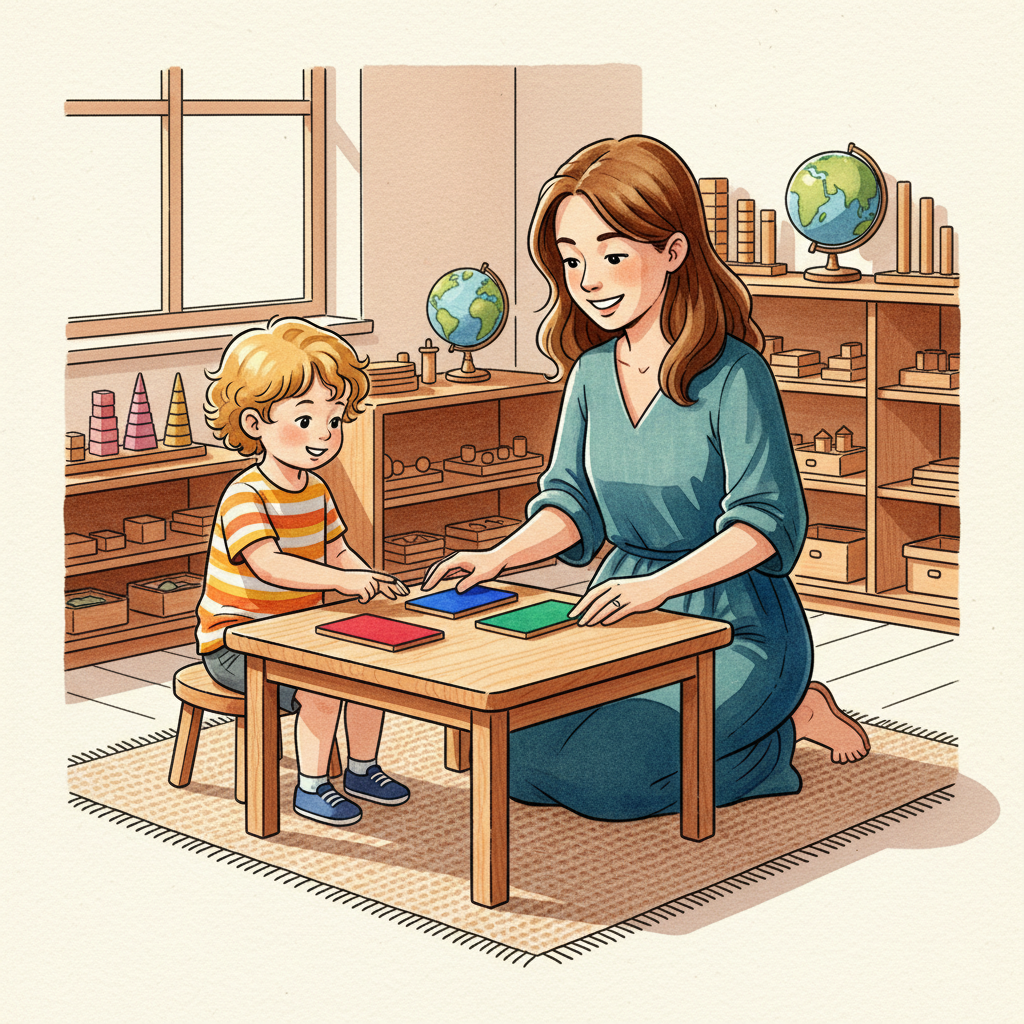
Select two color tablets — perhaps red and blue. Hold up the red tablet and say, "This is red." Hold up the blue and say, "This is blue." Then ask, "Can you point to red?" Finally, hold up one tablet and ask, "What color is this?" Montessori color tablets are a classic material for this lesson, and you can also use Color Nomenclature Cards to extend the activity.

Teaching Letter Sounds

Using Montessori sandpaper letters, trace the letter with two fingers and say, "This says /m/." Then trace another letter: "This says /s/." Ask your child to "Show me /m/," and then "What sound does this make?" The tactile experience of the sandpaper letters combined with the Three Period Lesson creates a multi-sensory learning experience. You can find more about this approach on our Free Montessori Sandpaper Letters Printout page.

Teaching Size Concepts with the Pink Tower

The Pink Tower is a perfect material for teaching size vocabulary. Select the largest and smallest cubes and introduce: "This is large" and "This is small." As your child masters these, you can add the medium cube and work through all three periods with three objects. This kind of sensorial education builds the foundation for mathematical thinking.

Teaching Animal Names

Gather two or three realistic animal figurines — perhaps a horse, a cow, and a pig. Introduce each name in Period 1, then play a game in Period 2: "Can you make the horse gallop to me?" or "Can you put the cow in the barn?" This playful approach keeps Period 2 engaging and allows plenty of repetition before moving to Period 3's recall.

Teaching Textures

Using fabric swatches or sensorial materials, introduce concepts like smooth and rough, soft and hard. Have your child close their eyes during Period 2 and feel each texture: "Give me the rough one." This adds an exciting sensory dimension to the lesson.

Tips for Parents

Here are some practical guidelines to help you get the most out of the Three Period Lesson at home:

  • Start with just two items. Introducing too many new concepts at once can overwhelm a young child. Once your child masters two, you can add a third.
  • Keep it short and joyful. A Three Period Lesson should take only a few minutes. If your child loses interest, stop and return to it another day. Learning should never feel like a chore.
  • Spend the most time in Period 2. This is where the real learning happens. Make it playful — move the objects around, ask your child to place them in different spots, or turn it into a game.
  • Never correct harshly. If your child gives an incorrect answer in Period 3, simply say, "This is ___" (returning to Period 1) with warmth and encouragement. The child should never feel they have failed.
  • Use real objects when possible. Montessori education emphasizes concrete, hands-on learning. Real fruits, actual fabric textures, and quality wooden materials create richer learning experiences than flashcards or screens.
  • Follow your child's interests. If your child is fascinated by dinosaurs, use dinosaur figurines for a Three Period Lesson on names. If they love flowers, gather a few different types from the garden. Interest is the fuel for learning.
  • Be patient with the process. Some children sail through all three periods in one sitting. Others may need days or weeks of gentle repetition in Periods 1 and 2 before they're ready for Period 3. Both paths are perfectly normal.

Why the Three Period Lesson Works

The genius of this technique lies in its respect for how the brain naturally learns. It moves from passive reception (hearing the name) to active recognition (identifying the correct item) to independent recall (producing the name from memory). Each period builds on the last, creating a solid foundation of understanding rather than rote memorization.

This approach also protects the child's confidence and love of learning. Because you always return to an earlier period when the child struggles — rather than pointing out mistakes — the child experiences only success. This positive cycle encourages them to keep exploring, keep trying, and keep learning with joy.

Once you begin using the Three Period Lesson, you'll find yourself reaching for it naturally throughout your day. It's one of those Montessori tools that, once learned, becomes an indispensable part of how you share the world with your child.

Back to Home