Lesson of the Day 101: The Brown Stair (Broad Stair) — Montessori's Sensorial Lesson in Width, Weight, and the Joy of Building a Perfect Series
Published on: June 10, 2026
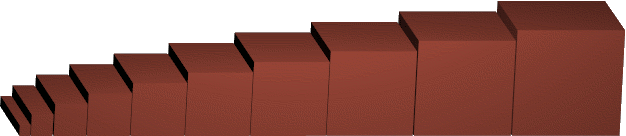
Montessori Lesson of the Day #101 — Welcome back to our daily Montessori journey! Today we explore one of the most beloved materials in the entire Sensorial curriculum: the Brown Stair, also called the Broad Stair. If your child has already enjoyed the Pink Tower and the Red Rods, the Brown Stair is a natural and beautiful next step that isolates yet another quality for the child to discover.
What Is the Brown Stair?
The Brown Stair is a set of ten solid wooden prisms, all stained the same warm brown and all exactly the same length — 20 centimeters. The only dimensions that change are the height and width (the thickness) of each prism. The thickest prism is 10 cm by 10 cm, and each successive prism decreases by 1 centimeter in both height and width, down to the thinnest, which is just 1 cm by 1 cm.
This is what Maria Montessori called the "isolation of one quality." Where the Pink Tower isolates size in three dimensions and the Red Rods isolate length, the Brown Stair isolates thickness — the difference between thick and thin, broad and narrow. By keeping color, length, and texture constant, the child's whole attention is drawn to this single changing quality.
When the ten prisms are arranged in order, they form a graceful, descending staircase — which is why the material is so often called the Broad Stair. The regular 1 cm progression means the finished stair has a beautifully even slope, and any prism placed out of order is immediately, visibly wrong. This is the material's built-in control of error.
Ages
The Brown Stair is typically introduced to children between 2½ and 4 years old, usually after the child has had some experience with the Knobbed Cylinders and the Pink Tower. Many Montessori guides present the Pink Tower and the Brown Stair close together, because the two materials complement each other so naturally and are often combined in beautiful extension work.
Older children in the 4-to-6 range will return to the Brown Stair for more advanced explorations — combining it with the Pink Tower, building patterns, and discovering early geometric and mathematical relationships hidden in the prisms.
Purpose and Aims of the Brown Stair
Direct Aims
- Visual discrimination of thickness: The child learns to perceive, compare, and order differences in width and height — the dimension of "thick" and "thin"
- Understanding of a graduated series: Building the stair helps the child internalize that objects can be ordered in a precise, regular progression from thickest to thinnest
- Muscular and tactile perception: The prisms vary noticeably in weight, so carrying and handling them gives the child an embodied, whole-body sense of "broad" and "narrow"
Indirect Aims
- Preparation for mathematics: The regular 1 cm increment quietly introduces the idea of a constant difference and graduated quantity, laying groundwork the child will later meet in the Number Rods and beyond
- Development of concentration: Building the stair correctly requires sustained focus and careful judgment
- Refinement of order: The child's strong sense of order in the 3-to-6 years is nourished and refined
- Coordination and motor control: Grasping each prism with the whole hand and placing it precisely develops fine and gross motor control
- Independence and self-correction: The built-in control of error lets the child work — and correct themselves — without an adult hovering
Materials Needed
To present this lesson at home, you'll need a set of Brown Stair prisms and a floor mat or rug. Like the Red Rods, the Brown Stair is traditionally worked on the floor, where the child has room to carry each prism and stand back to admire the finished stair.
Brown Stair Sets
- Elite Montessori Brown Stair — Full 10-Prism Set — The classroom-standard size, with prisms graduated from 1 cm to 10 cm in thickness. If you have the space, the full-size set gives your child the most powerful sensorial experience, including the meaningful difference in weight between the thickest and thinnest prisms
- Adena Montessori Small Brown Stair (5×5×10 cm) — A compact version perfect for home use when space is limited. While smaller than the classroom set, it teaches exactly the same concepts of thickness and graduated order
You'll also want:
- A large floor mat or rug to define the child's workspace
- Enough floor space for the child to carry each prism, one at a time, from the shelf to the mat
Presenting the Brown Stair: The Three Period Lesson
Begin by inviting your child to help you carry the prisms — one at a time, using both hands — to the mat, placing them in a random jumble. Show your child how to feel the difference between the thickest and the thinnest prism, grasping each so the hand registers the width.
Then build the stair slowly and deliberately: find the thickest prism, place it down, then find the next-thickest and align it carefully alongside, and so on, until the descending staircase is complete. Work in silence at first — let the child watch the careful, ordered movement. Then invite them to mix the prisms and build it themselves.
Once your child can build the stair, introduce the vocabulary with a Three Period Lesson, just as you would with the Knobbed Cylinders: "This is thick. This is thin." Then, "Show me the thick one. Show me the thin one." Finally, "What is this one?" Add the comparatives and superlatives — thicker, thinner, thickest, thinnest — as the child is ready.
Extensions and Variations
- Combine with the Pink Tower: The Brown Stair and the Pink Tower are natural partners. Children love building elaborate combined designs, discovering how the cubes of the tower relate to the prisms of the stair
- Build along a wall: Lining up the prisms against a straight edge highlights the even slope of the staircase and makes any error stand out
- Patterns and designs: Older children enjoy arranging the prisms into symmetrical patterns, bridges, and zig-zags
- Eyes-closed exploration: Once familiar, a child can match prisms by touch alone, deepening the tactile-muscular impression of thickness
Why Children Love the Brown Stair
Like all the Sensorial materials, the Brown Stair does not pour new impressions into the child — it helps the child organize and classify impressions already gathered from the world. Your child has been noticing thick and thin things since infancy. The Brown Stair gives those impressions a name, an order, and a system.
This is why the work is so satisfying. The finished stair "looks right" because it answers a need for order the child already feels. When you see your child building the stair with quiet, focused joy — then beaming at the perfect slope they've created — you are witnessing the beautiful alignment of inner need and outer material that is the hallmark of authentic Montessori education.
Summary and What Comes Next
The Brown Stair is far more than ten brown blocks. It is your child's formal exploration of thickness as an isolated dimension — broad and narrow, thick and thin. It prepares the hand, the eye, and the mind; it develops concentration, coordination, and an appreciation for order and precision.
Key takeaways from today's lesson:
- The Brown Stair isolates the single quality of thickness through 10 prisms graduated from 1 cm to 10 cm, all the same 20 cm length
- Carrying and handling the prisms is part of the lesson — the changing weight reinforces the sense of broad and narrow
- The even 1 cm progression provides a built-in control of error: any misplaced prism is instantly visible
- The Three Period Lesson introduces the vocabulary of thick/thin and their comparative and superlative forms
- The Brown Stair pairs beautifully with the Pink Tower for rich combined work
What comes next in our Montessori Lesson of the Day series? Having explored size with the Pink Tower, length with the Red Rods, and now thickness with the Brown Stair, your child is ready to refine other senses — for example the discrimination of color with the Color Tablets, or further visual grading with the Knobless Cylinders. For a deeper dive into this material, see our full Brown Stair guide. Every lesson builds on the last, and every material connects to the whole — that's the genius of Montessori.
Enjoy watching your child build their stair today. That careful, focused work — choosing each prism, placing it just so, standing back to admire the perfect slope — is the work of a mind constructing itself. What a privilege it is to witness.
Happy teaching, Montessori families! 🌟