Dinosaurs and Rocks
Published on: June 30, 2007
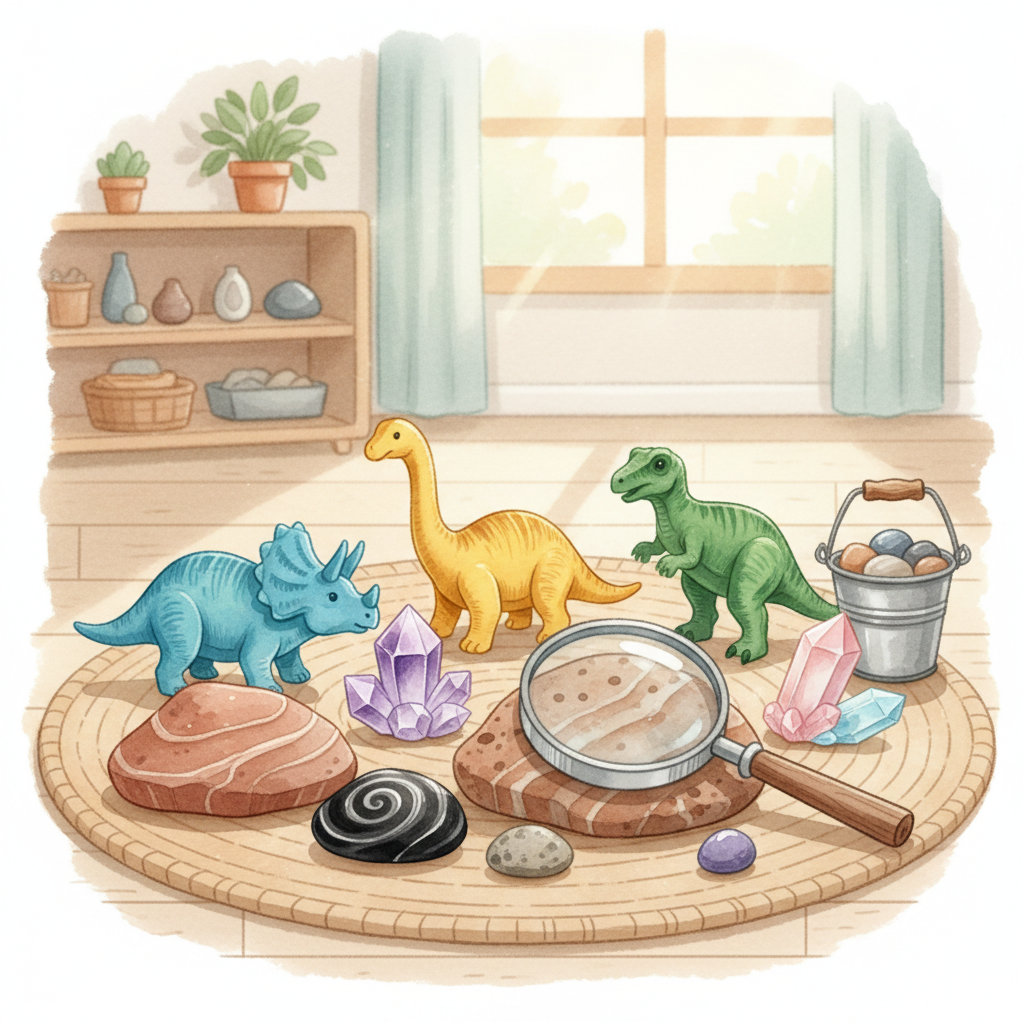
Dinosaurs and Rocks: A Montessori Journey into Deep Time
D-d-d, the dinosaur sound! "D" makes a dinosaur sound. Few topics light up a child's imagination like dinosaurs — and few invite as much hands-on wonder as the rocks and fossils that tell their story. Both dinosaurs and rocks can be introduced to preschool children (3–6) and explored in real depth by elementary students (6–12) working within the Montessori Great Lessons. They are a natural gateway to geology, geography, and cosmic education — the grand, interconnected story of our Earth.
Geology fits beautifully alongside the First Great Lesson, The Story of the Universe, and the cosmic study of how our planet formed. Rocks and minerals are the smaller, touchable pieces of that enormous story. A single rock sample can reveal where it formed, the climate and history of the Earth, and the slow, patient forces that shaped our world.
📄 Download our free Compass & Directions Printout (PDF) to pack in your rock-hounding kit — and browse the full Geology Printouts collection for nomenclature cards, landform names, and more to extend this lesson.
A-Hunting We Will Go: Rock Hounding with Children
You can find rocks almost anywhere. Rock hounding is a worldwide hobby that usually begins the moment a child picks up their first shiny stone. If your family loves to hunt for rocks, here are some classic tools to tuck into a backpack:
- A compass — children love watching the direction they are heading while they walk. A compass pairs perfectly with a map for finding your way (and your way back).
- A magnifying glass (10x) — crystal formations leap into view under magnification. Choose one small enough to slip into a pocket or hang around the neck. A sturdy handheld magnifying glass is one of the most-used tools in any young geologist's kit.
- A small garden trowel — for gentle digging.
- A piece of plain tile — rub a rock on the unglazed back to reveal its true "streak" color, then match it to a color chart.
- Small containers — empty egg cartons secured with rubber bands and newspaper to wrap delicate finds.
- A pocketknife with a few simple accessories (a safer alternative to a chisel or rock hammer for younger collectors).
- Tags & a pencil — number each rock 1 through 10, and record on a map or pad exactly where it was found so you can research the geology of that spot later.
If you would rather start indoors, a ready-made set of polished rocks and minerals gives children a beautiful sorting, sequencing, and nomenclature material — wonderful for a sensorial grading lesson or a three-part card extension.
Rocks, Minerals, and the Three Kinds of Stone
As children sort and compare their finds, you can introduce the idea that rocks belong to three great families:
- Igneous — born from cooled molten rock (connect this to the study of volcanoes and the fiery interior of the planet).
- Sedimentary — built up grain by grain over enormous stretches of time. These are the rocks that most often hold fossils.
- Metamorphic — changed by heat and pressure deep within the Earth.
This is a natural moment to explore the layers of the Earth and continental drift and plate tectonics — the slow movement of the ground beneath our feet that builds mountains, opens oceans, and, over millions of years, buries and reveals the bones of ancient creatures.
Meeting the Dinosaurs
Dinosaurs ruled the Earth for over 160 million years. Studying them helps children grasp deep time — the idea that the Earth is unimaginably old and that life has changed dramatically across the ages. A timeline of life, even a simple one rolled out across the floor, gives this its full Montessori impact: the child sees with their own eyes how recently humans arrived in the long story of the planet.
Wonderful hands-on dinosaur work includes:
- Matching and three-part cards — match model dinosaurs to their pictures and names.
- Coloring and nomenclature — name the parts of a skeleton, then color a dinosaur of your child's own design.
- A dinosaur dig — fill a large container or small pool with sand and bury "fossils." Provide plastic shovels, buckets, old paintbrushes for dusting, and a tray to display each find. Make it richer for older children by burying modern objects (a rubber band, a paperclip, a shell) and letting them decide what truly belongs to the dinosaur era.
Are Dinosaurs Alive Today?
Ask your child the big question: what happened to the dinosaurs — and are any still here? Many scientists consider today's birds to be living dinosaurs, and the saltwater crocodile is often called a living relic of that ancient age. You never quite know where you might meet a dinosaur.
Extend the Lesson
Dinosaurs and rocks connect outward into much of the Montessori cosmic curriculum:
- Lesson of the Day 27: Dinosaurs and Rocks — the lesson-plan companion to this newsletter.
- Earth Science: Plate Tectonics & Volcanoes — how the restless Earth shapes the land.
- Earthquakes — A Montessori Geology Lesson — the planet's moving crust in action.
- Land and Water Forms — geography work that pairs naturally with rock study.
- Maps of Earth's Surface — record and locate where your rocks were found.
- Nature Studies — squirrels, beavers, and the living world to balance the ancient one.
- The Five Great Lessons — the cosmic framework that holds all of this together.
- Great Lessons & Cosmic Education — further reading and links.
A Final Thought
Maria Montessori believed children should be given the universe — not in small, disconnected fragments, but as a magnificent whole. A handful of rocks and a model dinosaur are tiny doorways into that whole: the formation of the Earth, the slow dance of continents, the rise and fall of life, and the child's own place in a story far older and grander than themselves. Hand them a magnifying glass, and let the wondering begin.