Volcanoes
Published on: January 19, 2009
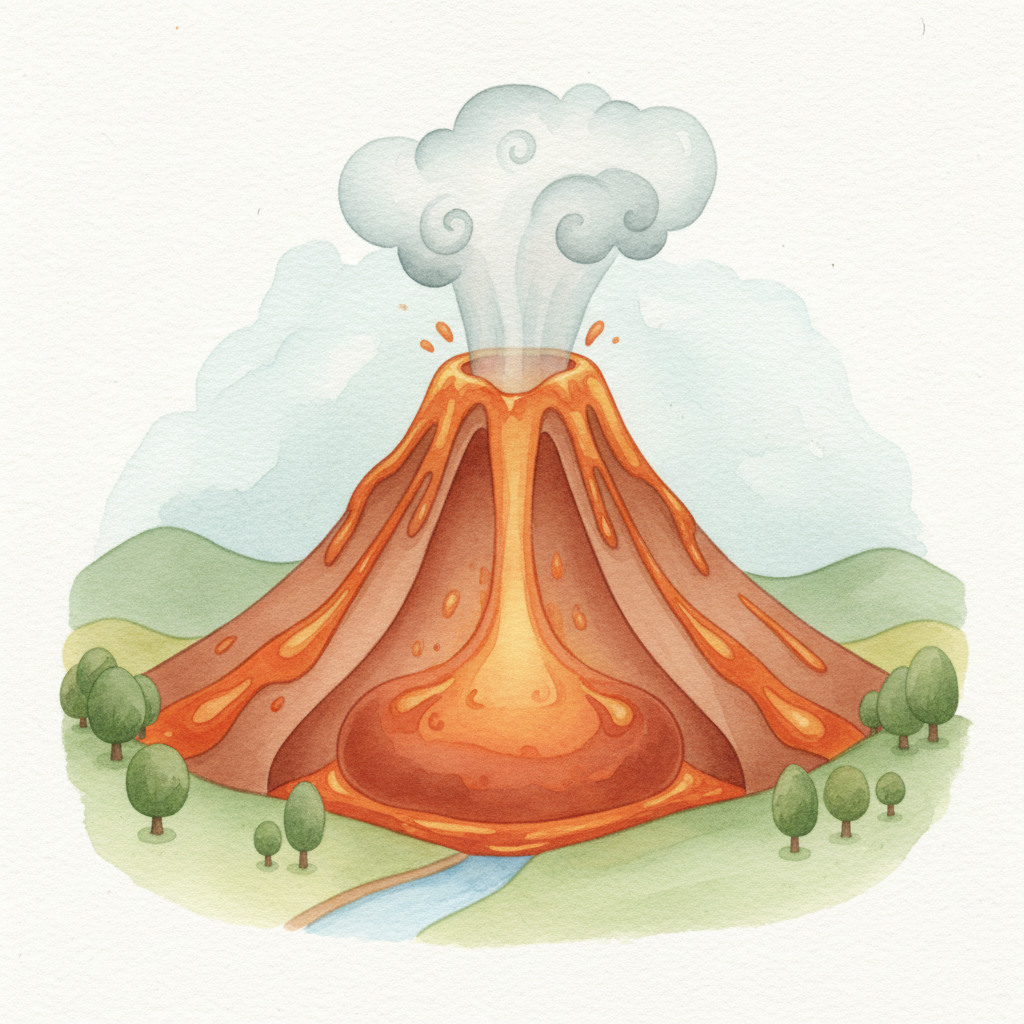
Volcanoes: A Montessori Exploration of Earth's Fiery Forces
Few natural phenomena capture a child's imagination quite like a volcano. The dramatic eruption of molten rock from deep within our planet is a powerful reminder that the Earth beneath our feet is alive, dynamic, and constantly changing. In the Montessori classroom, the study of volcanoes connects beautifully to the First Great Lesson — The Story of the Universe — and invites children into a deeper understanding of geology, geography, and the interconnected systems of our planet.
Whether you are working with primary-age children (3–6) who are encountering these ideas for the first time, or elementary students (6–12) ready for more detailed scientific exploration, the volcano is a gateway to wonder and discovery.
📄 Download our free Volcano Printout (PDF) to use alongside this lesson!
What Is a Volcano?
A volcano is an opening — or vent — in the Earth's crust through which molten rock, gases, and rock fragments escape to the surface. Volcanoes can take many forms: towering mountains, gentle slopes, cracks in the ocean floor, or even flat plains. The word "volcano" comes from Vulcan, the Roman god of fire.
Volcanism is the scientific term for any eruption of molten rock at the Earth's surface. Sometimes these eruptions are quiet, with lava gently flowing across the landscape. Other times, they are explosive — sending ash, cinders, and superheated gas high into the atmosphere.
Key Vocabulary
- Magma — Molten (melted) rock found beneath the Earth's surface, in the mantle and lower crust.
- Lava — What magma is called once it reaches the Earth's surface through a volcanic vent.
- Vent — The opening in the Earth's crust through which volcanic material escapes.
- Crater — The bowl-shaped depression at the top of a volcano, surrounding the vent.
- Crust — The thin, solid outermost layer of the Earth.
- Mantle — The thick, semi-solid layer beneath the crust where magma originates.
- Eruption — The release of magma, gases, and rock fragments from a volcano.
- Ash — Tiny fragments of rock and glass expelled during a volcanic eruption.
- Cinder — Small, rough pieces of hardened lava thrown into the air during an eruption.
- Dormant — A volcano that is not currently erupting but could erupt again in the future.
- Extinct — A volcano that scientists believe will never erupt again.
- Active — A volcano that has erupted recently or is currently erupting.
How Do Volcanoes Form?
To understand volcanoes, we must first look deep inside our planet. The Earth is made up of several layers — the crust, the mantle, the outer core, and the inner core. You can explore these layers in detail in our article on the Layers of the Earth.
Deep within the mantle, temperatures are so high that rock exists in a soft, semi-molten state. This molten rock — magma — is lighter than the solid rock around it, so it slowly rises through cracks and weaknesses in the crust. When magma finds a path to the surface, it erupts — and a volcano is born.
The Earth's crust is not a single, unbroken shell. It is divided into large pieces called tectonic plates that float on the mantle and are constantly — though very slowly — moving. Where these plates meet, pull apart, or slide past one another, volcanic activity is most common. To learn more about this process, visit our lesson on Plate Tectonics.
The Pacific Ring of Fire
Most of the world's volcanoes — about 75% — are found along the edges of the Pacific Ocean in a horseshoe-shaped zone called the Pacific Ring of Fire. This region stretches from New Zealand, along the eastern coast of Asia, across the Aleutian Islands of Alaska, and down the western coasts of North and South America. The Ring of Fire exists because so many tectonic plates converge in this area, creating ideal conditions for volcanic activity and earthquakes.
What Happens During an Eruption?
While each volcanic eruption is unique, they often follow a similar pattern:
- Warning Signs: Before an eruption, there are often several small earthquakes as magma forces its way upward through the rock. The ground may swell, and gases may escape from vents.
- Magma Rises: Pressure builds as magma presses against the upper mantle and crust. Eventually, it breaks through to the surface.
- Eruption: Lava, gases, ash, and rock fragments are expelled from the vent. The eruption may be a quiet flow of lava or a violent explosion, depending on the type of magma and the amount of gas trapped within it.
- Eruption Cloud: Explosive eruptions produce a large cloud — sometimes towering miles into the sky — composed of vaporized water, volcanic ash, and cinders.
- Cooling and Hardening: When lava cools, it hardens into solid rock. Over time, repeated eruptions build up layers of rock, creating the classic cone shape of many volcanoes.
The combination of magma and water is particularly dangerous, often producing the most violent eruptions. When water (from underground sources, lakes, or the ocean) meets superheated magma, it flashes instantly to steam, dramatically increasing the explosive force of the eruption.
Volcanoes and the Rock Cycle
Volcanic activity plays a crucial role in the rock cycle — the continuous process by which rocks are created, transformed, and recycled over millions of years. When lava cools and hardens, it forms igneous rock (from the Latin word ignis, meaning "fire"). Basalt and obsidian are examples of igneous rocks formed from volcanic activity.
Over time, wind, water, and ice break these rocks down into sediment, which may eventually form sedimentary rock. Under extreme heat and pressure deep underground, rocks can transform into metamorphic rock. This interconnected cycle is one of the great stories of our planet. You can explore related geological concepts in our Geology Printouts collection.
Types of Volcanoes
Not all volcanoes look or behave the same. Scientists classify volcanoes into several types based on their shape, size, and eruption style:
- Shield Volcanoes: Broad and gently sloping, built by many layers of fluid lava flows. Mauna Loa in Hawaii is the world's largest shield volcano.
- Stratovolcanoes (Composite Volcanoes): Tall, steep-sided cones built from alternating layers of lava, ash, and rock fragments. Mount Fuji in Japan and Mount St. Helens in Washington State are stratovolcanoes.
- Cinder Cone Volcanoes: Small, steep-sided cones built from fragments of lava (cinders) that are ejected from a single vent. Parícutin in Mexico is a famous cinder cone that grew in a farmer's cornfield in 1943!
- Lava Domes: Formed by thick, slow-moving lava that piles up around the vent rather than flowing far away.
- Submarine Volcanoes: Found on the ocean floor, these volcanoes can build up over time to form volcanic islands. The Hawaiian Islands were formed this way over millions of years.
- Calderas: Large, basin-shaped depressions formed when a volcano collapses into itself after a massive eruption. Yellowstone's caldera is one of the most famous.
Famous Volcanoes Around the World
Studying specific volcanoes helps children connect abstract geological concepts to real places. Here are a few volcanoes worth exploring:
- Mount Vesuvius (Italy): Buried the ancient Roman city of Pompeii in 79 AD. A powerful example of how volcanoes shape human history.
- Mount St. Helens (USA): Erupted dramatically on May 18, 1980, in Washington State. The eruption removed the top of the mountain and devastated the surrounding landscape.
- Kilauea (Hawaii, USA): One of the most active volcanoes on Earth, with nearly continuous eruptions since 1983.
- Mount Fuji (Japan): A beautifully symmetrical stratovolcano and cultural icon. Last erupted in 1707.
- Eyjafjallajökull (Iceland): Its 2010 eruption disrupted air travel across Europe for weeks — demonstrating how volcanoes can affect people far from the eruption site.
Use a globe or our Maps of Earth's Surface lesson to help children locate these volcanoes and observe patterns in where volcanic activity occurs.
Montessori Presentation Ideas
For Primary (Ages 3–6)
Young children are naturally drawn to the dramatic and sensory aspects of volcanoes. At this age, keep presentations concrete and experiential:
- Sensory Vocabulary: Introduce key terms like volcano, lava, magma, and eruption using three-period lessons with picture cards and models.
- Parts of a Volcano: Use our free volcano printout to label and color the main parts of a volcano — crater, vent, magma chamber, and lava flow.
- Clay Volcano Model: Build a simple volcano from clay or playdough. Children can shape the cone and identify the crater and vent. This is a wonderful practical life and sensorial activity.
- Volcano Eruption Experiment: The classic baking soda and vinegar experiment never fails to delight! Place a small container inside a clay volcano model, add baking soda, a squirt of dish soap, red food coloring, and then pour in vinegar. Children observe the "eruption" and can discuss what they see.
- Sorting Activity: Provide pictures of volcanoes, mountains, and other landforms. Children sort them, developing their powers of observation and classification.
For Elementary (Ages 6–12)
Elementary children are ready for more complex scientific content, research, and independent exploration:
- The First Great Lesson Connection: Revisit the Story of the Universe and discuss how volcanic activity shaped the early Earth. How did volcanoes help create the atmosphere? How did they form the first landmasses?
- Cross-Section Diagram: Have children draw a detailed cross-section of the Earth, showing the layers and the path magma takes from the mantle to the surface. This connects beautifully to the Layers of the Earth lesson.
- Research Projects: Assign or let children choose a specific volcano to research. They can create a booklet or presentation covering its location, type, eruption history, and effects on surrounding communities.
- Comparative Study: Compare different types of volcanoes. Children can create charts showing the differences in shape, eruption style, and examples of each type.
- Timeline of Eruptions: Create a timeline of famous volcanic eruptions throughout history. This integrates geography with history and helps children grasp the scale of geological time.
- Rock Cycle Connection: Collect samples of igneous rocks (pumice, obsidian, basalt, granite) and let children examine them with magnifying glasses. Discuss how each was formed and connect to the rock cycle.
- Map Work: Using a world map, mark the locations of active volcanoes and the boundaries of tectonic plates. Children will discover the Ring of Fire on their own!
Hands-On Activity: Build and Erupt a Volcano
One of the most beloved Montessori science activities is building a volcano model. Here is a more detailed approach:
Materials
- Empty plastic bottle or small container
- Modeling clay, papier-mâché, or air-dry clay
- Baking soda (2 tablespoons)
- White vinegar (½ cup)
- Dish soap (a small squirt)
- Red and yellow food coloring
- A tray or baking sheet to contain the mess
Steps
- Place the bottle on the tray. Build up clay or papier-mâché around the bottle to form a volcano shape, leaving the top open.
- Allow the model to dry completely if using air-dry clay or papier-mâché.
- Add baking soda to the bottle.
- Add a squirt of dish soap and several drops of red and yellow food coloring.
- When ready, pour vinegar into the bottle and watch the "eruption!"
Science connection: Explain that the chemical reaction between baking soda (a base) and vinegar (an acid) produces carbon dioxide gas — the bubbles that cause the "lava" to overflow. While this is a chemical reaction rather than a geological one, it helps children visualize how pressure and gas can cause material to erupt from an opening.
For a more comprehensive hands-on experience, consider the BenBen Science Kits for Kids, which includes materials for volcano experiments and other engaging science activities. Another excellent option is the SpiceBox Food Science Lab Kit, which encourages children to explore chemical reactions — including the very type of reaction that makes our volcano model erupt!
Observation Questions for Children
In the Montessori approach, we encourage children to observe carefully and think deeply. Here are questions you can use during and after volcano lessons:
For Younger Children (3–6)
- What do you see happening when the volcano erupts? Describe the colors, movement, and sounds.
- What does the word "lava" mean? Where does lava come from?
- Can you point to the crater on our volcano model?
- Is the Earth still and quiet inside, or is it moving and changing?
- What do you think happens to the lava after it cools down?
For Older Children (6–12)
- Why are most volcanoes found along the edges of tectonic plates?
- What is the difference between magma and lava?
- How does a shield volcano differ from a stratovolcano? Why do they have different shapes?
- How do volcanoes contribute to the rock cycle?
- Can volcanoes affect the weather or climate? How? (Connect to Types of Weather and The Water Cycle)
- How might people living near volcanoes prepare for an eruption?
- What are some benefits of volcanic activity? (Hint: think about fertile soil, new land, geothermal energy)
- If you could study any volcano in the world, which would you choose and why?
Connecting Volcanoes to Other Montessori Lessons
The study of volcanoes is a wonderful springboard to many other areas of the Montessori curriculum:
- Layers of the Earth: Understand the structure of our planet and where magma originates.
- Plate Tectonics: Discover why volcanoes, earthquakes, and mountain-building occur where they do.
- Earthquakes: Explore the closely related phenomenon of seismic activity.
- The Water Cycle: Learn how volcanic eruptions release water vapor and affect the atmosphere.
- Maps of Earth's Surface: Practice map skills by locating volcanoes around the world.
- Geology Printouts: Use additional printable resources to extend learning about rocks, minerals, and Earth's processes.
- Our Solar System: Did you know that volcanoes exist on other planets and moons? Olympus Mons on Mars is the largest volcano in our solar system!
Free Printout
Download and print our Volcano Printout (PDF) for use in your classroom or homeschool. This printout includes a labeled diagram of a volcano that children can color, study, and use for nomenclature work. It pairs beautifully with a three-part card lesson for younger children or as a reference for older children's research projects.
A Final Thought
Maria Montessori believed that children should be given the universe — not in small, disconnected pieces, but as a magnificent whole. The study of volcanoes is a perfect example of this philosophy in action. A single erupting mountain connects to the deepest layers of the Earth, the movement of continents, the formation of rocks, the composition of the atmosphere, and the story of life itself.
When we invite children to explore volcanoes, we are not simply teaching a science lesson — we are opening a door to cosmic education, helping them see their place in the grand, interconnected story of our planet.
Encourage your child to observe, ask questions, and follow their curiosity. The Earth has so many stories to tell — and every volcano is a chapter waiting to be explored.