Montessori Newsletter (Plate Tectonics)
Published on: August 17, 2008
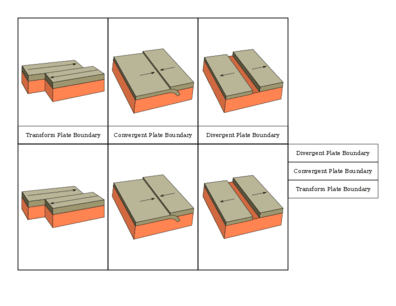
Plate Tectonics and Continental Drift
Continental Drift
The crust of the earth isn't one solid piece — it's made of various plates. Land plates are called continental plates. Other plates lie under the oceans; these are called oceanic plates.
These plates move, very slowly, over the surface of the earth. The oceanic plates are expanding through a process called oceanic spreading. Molten rock from the mantle and lower crust seeps up through cracks in the middle of the oceanic plates. Because of this, the plates on top are moved along like objects on a conveyor belt. In the softer plates, the rock is sheared by this force; in the harder rock, the tension builds up and is released in earthquakes.
When the continental plates move, it is called continental drift. A geologist named Alfred Wegener proposed the theory of continental drift in his book The Origin of Continents and Oceans. According to Wegener, primeval Earth (about 300 million years ago) consisted of a supercontinent called Pangaea. Eventually it broke apart, forming the present-day continents and oceans.
Wegener believed the modern continents had broken up from an ancient supercontinent because fossils of plant and animal life from widely separated places on Earth were so similar — and because the continents fit together like a jigsaw puzzle.
Tectonic plates move in three different ways. Transform plate boundaries are where two plates slide past each other. A convergent plate boundary is one where one plate is subducted under the other; these boundaries often have mountains or volcanoes. The third type is a divergent plate boundary, which forms the oceanic ridges.
Three-part cards for the different types of plates (PDF)
Pangaea and the Ancient Continents
Long ago there was a single continent called Pangaea, made up of all the continents pushed together. Geologists now think there were earlier supercontinents and rearrangements of the continents before Pangaea as well. The earliest known continent, called Ur, dates back about 3 billion years. Pangaea was the supercontinent at the beginning of the Paleozoic, the first geologic era with complex land life.
Pangaea eventually split into two supercontinents: the northern part became Laurasia and the southern part became Gondwana. Eurasia and North America are fragments of Laurasia. South America, Africa, India, Australia, and Antarctica are the present-day remnants of Gondwana.
Three-part cards (PDF) and matching cards (PDF) for the continental plates that made up Pangaea.
Explore More on MontessoriMom
- Continental Drift
- The Layers of the Earth
- Volcanoes
- Earthquakes & Geology Lesson
- The Great Lessons
- Geology Printouts