Lesson of the Day 80: Fraction Skittles — Discovering That Wholes Come Apart (and Go Back Together)
Published on: May 18, 2026
"The child's mind is not merely a receptacle for facts; it is a living organ that grows by absorbing impressions from the environment and building from them an understanding of the world." — Dr. Maria Montessori
Over the past five lessons, your child has been deep in the world of operations — adding with the Addition Strip Board, arranging numbers on the Hundred Board, subtracting with the Subtraction Strip Board, multiplying on the Multiplication Bead Board, and dividing with the Division Bead Board. That's a tremendous amount of mathematical ground covered, and if your child has been working through these materials with enthusiasm, you should feel proud of what's been accomplished. But today, we're going to do something a little different. We're stepping sideways — into a corner of mathematics that feels almost like play, where the child picks up charming little wooden figures, twists them apart, and discovers that the world of numbers extends far beyond whole quantities.
Today, we meet the Fraction Skittles.
If you've ever watched a child try to share a cookie equally with a sibling, you've already witnessed the seed of fractional understanding. "I want half!" "That's not fair — your piece is bigger!" Children intuitively grasp that wholes can be divided into parts, and that those parts must be equal to be fair. The Fraction Skittles take this everyday intuition and give it a beautiful, tangible form — little wooden pin-shaped figures that come apart into halves, thirds, and quarters, inviting the child to explore one of mathematics' most important ideas: that a whole can be divided into equal parts, and those equal parts can be put back together to remake the whole. It's a gentle, joyful introduction to fractions — and it's the perfect breath of fresh air after our intensive operations sequence.
🎳 What Are Fraction Skittles?
Fraction Skittles are a classic Montessori sensorial-math material consisting of small wooden pin-shaped figures — imagine a set of miniature bowling pins or skittles, each about 8-10 centimeters tall. They are beautifully simple, and like all the best Montessori materials, they isolate a single concept with elegant clarity.
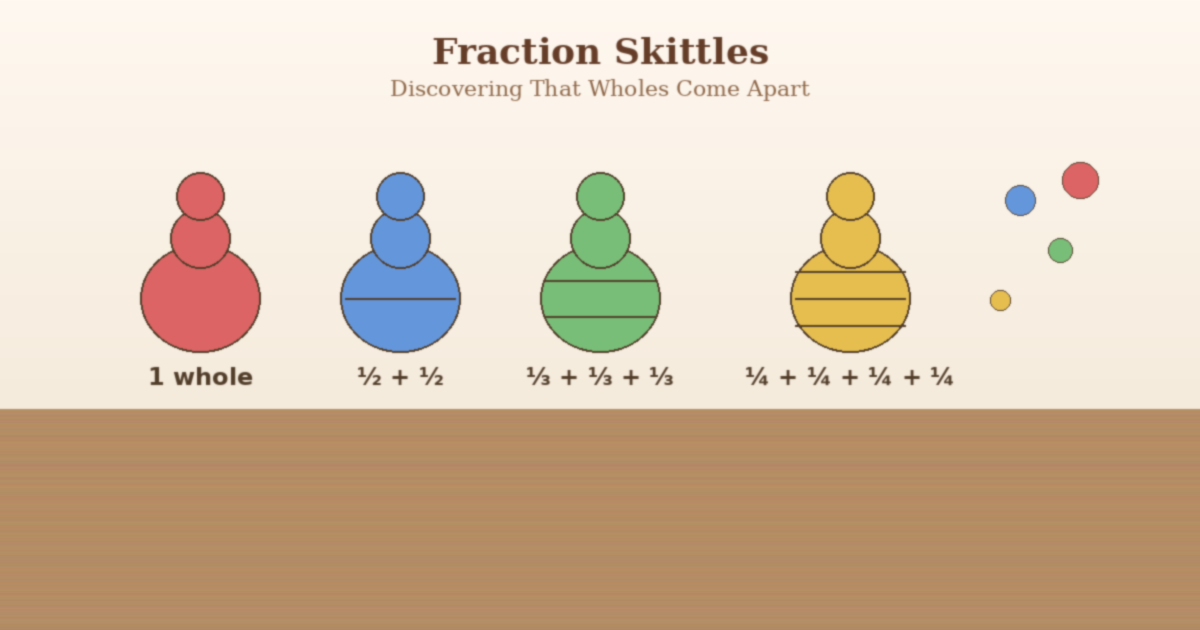
A standard Fraction Skittles set includes four skittles, each a different color:
- The Whole Skittle (typically red or natural wood): This skittle is one solid piece. It cannot be taken apart. It represents 1 whole — the reference point against which all the other skittles are measured.
- The Halves Skittle (typically blue): This skittle looks identical to the whole skittle in size and shape, but it is divided into 2 equal pieces. The child can twist or pull it apart at the center and hold one half in each hand. Two halves, when placed together, form a complete skittle — exactly the same size as the whole.
- The Thirds Skittle (typically green): This skittle is divided into 3 equal pieces. Each piece is noticeably smaller than a half, and the child needs all three pieces to reconstruct the complete skittle.
- The Quarters Skittle (typically yellow): This skittle is divided into 4 equal pieces. Each quarter is the smallest piece in the set, and four of them are needed to rebuild the whole.
Some extended sets — sometimes called Family Sets or Large Fraction Skittles — include additional skittles divided into fifths, sixths, sevenths, eighths, ninths, and tenths. These are wonderful for older children who are ready to explore more complex fractions, but the basic set of four is where most children begin.
The genius of this material lies in its three-dimensional, tactile nature. Unlike fraction circles drawn on a worksheet, these are objects the child can hold, rotate, stack, and compare in space. The child doesn't just see that two halves make a whole — they feel the two pieces click together. They experience the satisfying moment when three thirds reassemble into a complete figure. This is mathematics through the hands, exactly as Dr. Montessori intended.
🧩 Where Do Fraction Skittles Fit in the Montessori Math Sequence?
Fractions in Montessori are not an afterthought or a topic reserved for older children. Dr. Montessori recognized that young children have a natural, intuitive sense of "parts" and "wholes," and she designed materials to nourish that understanding from an early age. The Fraction Skittles occupy a fascinating position in the sequence — they serve as a bridge between the concrete whole-number work of the Casa environment and the more formal fraction work that unfolds in the Elementary years.
Here's how the Fraction Skittles relate to the broader Montessori math journey:
- Counting and Quantity (1-10): The child has established one-to-one correspondence and a deep understanding of whole numbers using materials like the Number Rods, Spindle Boxes, and Cards and Counters.
- Introduction to the Decimal System: Through the Golden Bead Material, the child understands units, tens, hundreds, and thousands — and has performed all four operations with concrete beads.
- Linear Counting and Operations: The child has worked with the Seguin Boards, the Hundred Board, the Bead Chains, and the various strip boards and bead boards for memorizing math facts.
- Fraction Skittles ← You are here! This is the child's first formal introduction to fractions as a concept. The skittles present the idea concretely and sensorially: a whole can be divided into equal parts.
- Fraction Metal Insets (Fraction Circles): After the Fraction Skittles, children move to the Fraction Metal Insets — circular metal frames divided into halves through tenths. These allow for more detailed exploration of equivalence, comparison, and eventually operations with fractions. (You can read more in our Fractions Part II article.)
- Abstract Fraction Work: In the Elementary years, children move toward writing fraction notation, performing addition and subtraction of fractions, finding common denominators, and eventually working with improper fractions and mixed numbers.
Think of it this way: the Fraction Skittles are to fraction work what the Golden Beads are to place value work — the very first concrete encounter with a big, important idea. The child doesn't need to know the word "numerator" yet. They don't need to write ½. They simply need to hold two equal pieces in their hands and discover: "These two parts, together, are the same as one whole." That's the foundation upon which everything else is built.
Age Range
Fraction Skittles are typically introduced between ages 3.5 and 5 in the Casa (Primary) environment. Yes — that early! The initial presentations are entirely sensorial and concrete. The child is simply exploring the pieces, taking them apart, putting them back together, and comparing sizes. There is no written notation, no formal vocabulary beyond "whole," "half," and "part."
The material is then revisited and extended between ages 5 and 7, as the child begins to attach language (halves, thirds, quarters) and eventually notation (½, ⅓, ¼) to what they've already discovered with their hands. Children in Lower Elementary (ages 6-9) may return to the skittles when they begin formal fraction work, using them as a reference and a bridge to the Fraction Metal Insets.
The beauty of this material is that it grows with the child. A 3-year-old will happily spend twenty minutes taking the skittles apart and reassembling them — a purely sensorial exercise. A 6-year-old will use the same material to prove that 2/4 = 1/2, recording her discoveries in a fraction notebook. Same material, deeper understanding.
📦 Materials You'll Need
The Fraction Skittles are one of the simpler Montessori materials to set up at home. Here's what you'll need:
- A set of Fraction Skittles — four wooden skittles (whole, halves, thirds, quarters), each a different color. Look for a set where the pieces fit together snugly and the assembled skittles are all the same height.
- A small tray or basket — to carry and store the material. A wooden tray works beautifully and adds to the sense of order and purpose.
- A small mat or felt pad — to define the workspace and prevent pieces from rolling away. A simple placemat works fine.
- Labels (optional, for older children) — small cards with fraction notation (1, ½, ⅓, ¼) that children can place next to the corresponding pieces.
- A pencil and paper or fraction notebook — for recording discoveries (age 5+).
Authentic wooden Fraction Skittles can be found from Montessori material suppliers. For home use, many families find that fraction manipulatives — including connecting fraction circles — provide a wonderful complement or alternative that allows for the same kind of hands-on exploration:
- hand2mind Plastic Connecting Fraction Circles — A highly-rated set of snap-together fraction circles in bright colors, covering wholes through twelfths. While not skittles in shape, these manipulatives offer the same core experience: the child physically assembles and disassembles fractional parts, discovers equivalences, and compares sizes. They're durable, affordable, and an excellent addition to a home fraction shelf.
DIY Note: If you're crafty, you can make a simple version of Fraction Skittles using wooden dowels or even play dough! Shape four identical cylinders or pin shapes. Leave one whole, cut one in half, one in thirds, and one in quarters. Paint each a different color. The key is that all four "complete" skittles should be the same size when assembled — this is what makes the equivalences visible. You can also use apples, oranges, or modeling clay for an introductory exploration before moving to a more precise material.
🎓 How to Present the Fraction Skittles
As with all Montessori presentations, approach this lesson with slow, deliberate movements and a sense of wonder. This is a material that naturally delights children — the act of twisting apart a little figure and discovering hidden pieces inside is almost magical. Let that magic breathe. There's no rush.
Invite the child warmly: "I have something very special to show you today. Would you like to come and see?"
Presentation 1: Exploring the Whole
This first presentation is purely sensorial. The goal is simply to let the child discover that these skittles come apart — and that the pieces fit back together.
- Carry the tray to the table together. Place it in the center of the workspace. On the tray are all four skittles, fully assembled. They should look nearly identical in size and shape — the only difference is their color.
- Observe together. Let the child look at the four skittles. You might say, "Look at these. What do you notice?" Allow the child to share observations. They may notice the colors, the shape, or that they're all the same size. Honor whatever they notice.
- Pick up the whole skittle. Hold it gently. "This one is all one piece. See?" Try to twist it lightly — show that it doesn't come apart. "It stays together. It is one whole." Place it back on the tray.
- Pick up the halves skittle. Hold it and, with a slow, deliberate motion, gently twist or pull it apart into its two pieces. Let the child see the moment of separation. Place the two halves on the mat, side by side. "Oh! This one comes apart. Look — it has two pieces."
- Reassemble the halves. Slowly bring the two pieces back together, fitting them snugly. Hold the reassembled skittle next to the whole skittle. "When we put the two pieces together, it's the same size as the whole one."
- Invite the child to try. Hand the halves skittle to the child and let them take it apart and put it back together. Most children will want to do this several times. Let them.
- Repeat with the thirds and quarters. One at a time, take apart the thirds skittle ("This one has three pieces!") and the quarters skittle ("And this one has four pieces!"). Each time, reassemble the skittle and compare it to the whole. Each time, invite the child to try.
- Free exploration. Once you've demonstrated all four, step back and let the child explore freely. They may spend a long time simply taking the skittles apart and putting them back together, sorting the pieces, or lining them up. This is valuable work — the child is building a sensorial foundation for everything that follows.
What to observe: Watch whether the child notices that the pieces get smaller as there are more of them. Does the child try to mix pieces from different skittles? (This is a wonderful discovery moment — a third won't fit where a half should go!) Does the child spontaneously line up all the pieces from largest to smallest? These are all signs of mathematical thinking at work.
Presentation 2: Naming the Parts
Once the child is comfortable assembling and disassembling the skittles (this may be the same day or days later — follow the child), introduce the language of fractions.
- Begin with the whole. Place the whole skittle on the mat. "This is one whole. We call it 'one whole' because it is all one piece — nothing has been taken away, nothing has been divided."
- Introduce halves. Take apart the halves skittle and place the two pieces next to the whole. "When we divide something into two equal parts, each part is called a half. This is one half" (hold up one piece) "and this is one half" (hold up the other). "Two halves make one whole."
- Introduce thirds. Take apart the thirds skittle. "When we divide something into three equal parts, each part is called a third. This is one third... one third... one third. Three thirds make one whole."
- Introduce quarters. Take apart the quarters skittle. "When we divide something into four equal parts, each part is called a quarter — or a fourth. One quarter... one quarter... one quarter... one quarter. Four quarters make one whole."
- Three Period Lesson. Use the Montessori three-period lesson to solidify the vocabulary:
- Period 1 (Naming): "This is a half. This is a third. This is a quarter."
- Period 2 (Recognition): "Show me a third. Can you point to a quarter? Where is a half?"
- Period 3 (Recall): Hold up a piece: "What is this called?"
- Emphasize "equal parts." This is perhaps the most important concept in the entire presentation. Pick up two pieces from the halves skittle and show that they are the same size. "For something to be a half, the parts must be equal — exactly the same. If I broke a skittle into two pieces but one was big and one was tiny, those wouldn't be halves. Halves are always equal."
Presentation 3: Comparing Fractional Parts
This presentation helps the child discover a key fractional relationship: the more parts you divide something into, the smaller each part becomes.
- Lay out one piece from each skittle. Place them in a row from left to right: one whole, one half, one third, one quarter. Arrange them so the bottoms are aligned.
- Observe the sizes. "Look at these pieces. What do you notice?" Give the child time to observe. They will likely notice that the pieces get progressively smaller.
- Name the pattern. "The whole is the biggest. Then the half is smaller. Then the third is even smaller. And the quarter is the smallest. When we divide something into more pieces, each piece gets smaller."
- Ask a guiding question. "Which is bigger — one half or one quarter?" Let the child hold the two pieces and compare them physically. "One half is bigger! Even though 2 is a smaller number than 4, one half is bigger than one quarter. Isn't that interesting?"
- Extend (if the child is ready). "What if we had a skittle divided into ten pieces? Would each piece be bigger or smaller than a quarter?" Let the child reason through this. Most children will correctly intuit that more pieces mean smaller pieces.
Presentation 4: Equivalence Discoveries
This is where the fraction skittles truly shine — and where many children experience genuine mathematical wonder.
- Set up the question. Place the whole skittle on the mat. Take apart the halves skittle and place the two halves next to it. "We already know that two halves make one whole. But I wonder — can we make a whole using different pieces?"
- Explore with quarters. Take apart the quarters skittle. "How many quarters do we need to make a whole?" Let the child build up: one quarter, two quarters, three quarters, four quarters — a whole! Line up the four quarters next to the whole skittle to confirm they are the same height.
- The key discovery — halves and quarters. Place two quarters side by side. Place one half next to them. "Look — two quarters are the same size as one half!" Let the child hold the pieces and verify this with their own hands. This is the discovery of equivalent fractions — one of the most important concepts in all of fraction work — and it's happening through touch and sight, without a single formula.
- Record the discovery (for older children, age 5+). Help the child write or draw what they've found:
- 2 halves = 1 whole
- 3 thirds = 1 whole
- 4 quarters = 1 whole
- 2 quarters = 1 half
- Challenge questions (follow the child's interest):
- "Can you show me three quarters? How much more do we need to make a whole?"
- "If I take away one third from a whole, how many thirds are left?"
- "Can you find two different ways to make one whole?"
Presentation 5: Introduction to Written Notation (Age 5.5+)
When the child has had extensive hands-on experience — when they can confidently name halves, thirds, and quarters, assemble and disassemble the skittles, and articulate equivalences — it's time to connect the concrete work to written symbols.
- Introduce the fraction bar. Write on a piece of paper: a horizontal line. "This line means 'divided into.' It's called a fraction bar."
- Connect to the material. Hold up one half of the halves skittle. "We know this is one half — one piece out of two equal pieces." Write on the paper:
1
"The bottom number tells us how many equal parts the whole was divided into — two. The top number tells us how many parts we have — one. One out of two. One half."
—
2 - Repeat with thirds and quarters. Hold up one third: write ⅓. Hold up two quarters: write 2/4. Each time, connect the written symbol to the concrete piece the child is holding.
- Label the skittles. If you have small cards or labels, write the fraction notation on each card and let the child match the cards to the corresponding pieces. This becomes a lovely independent activity.
- Introduce "numerator" and "denominator" (optional at this stage). Some children love big words. If your child is that type: "The top number has a special name — it's called the numerator. The bottom number is called the denominator. 'Denominator' sounds a bit like 'name,' doesn't it? It names what kind of parts we have."
🔄 Extensions and Variations
Once the child has mastered the basic presentations, the Fraction Skittles open up a world of extension activities. Here are several to try, arranged roughly from simpler to more complex:
Everyday Fraction Hunt
Challenge the child to find fractions in daily life. A pizza cut into four slices? Quarters! An orange split in half? Halves! A chocolate bar with three sections? Thirds! This extension costs nothing and reinforces the understanding that fractions aren't just a math lesson — they're everywhere. Keep a "Fraction Journal" where the child draws or photographs real-world fractions they discover.
Fraction Stories
Create simple story problems using the skittles as characters. "The red skittle invited the blue skittle to a party. The blue skittle said, 'I'll bring half of myself!' How many pieces did the blue skittle bring to the party?" Children love narrative, and embedding fraction concepts in stories makes them memorable and meaningful.
Mixing and Matching
Ask the child to try putting pieces from different skittles together. "Can you make a whole using one half and two quarters?" This is a natural extension of the equivalence work and lays the groundwork for adding fractions with unlike denominators — years before they'll encounter that concept formally.
Fraction Baking
Invite the child into the kitchen. Use measuring cups to explore fractions concretely. "We need one cup of flour. Can you measure it using just the half-cup measure? How many times do you need to fill it?" This is practical life and mathematics beautifully intertwined — a hallmark of the Montessori approach.
Transition to Fraction Metal Insets
When the child has thoroughly explored the Fraction Skittles and is comfortable with the language and notation, introduce the Fraction Metal Insets (fraction circles). These circular frames, divided into halves through tenths, allow for much more detailed exploration. The child can compare sixths to thirds, discover that 2/6 = 1/3, and eventually perform addition and subtraction of fractions. The skittles have prepared the child's hands and mind for this more detailed work. You'll find more activities in our Fractions Part II article and in Lesson of the Day 24: Fractions Fun.
Fraction Number Line
For children in early Elementary, create a number line from 0 to 1 on a long strip of paper. Ask the child to mark where ½ goes, where ¼ and ¾ go, and where ⅓ and ⅔ go. Use the skittle pieces as a physical reference to help determine placement. This connects fraction work to the linear representation of numbers — an important bridge to more abstract mathematics.
Simple Fraction Addition (Age 6+)
Use the skittles to demonstrate simple fraction addition concretely. "If we have one quarter and we add another quarter, how many quarters do we have? Two quarters! And two quarters is the same as..." (let the child discover) "...one half!" The equation ¼ + ¼ = 2/4 = ½ emerges from hands-on play, not from memorized rules.
💡 Why This Material Matters: The Montessori Perspective
Fractions are, for many children in conventional schooling, the first major stumbling block in mathematics. Study after study confirms that fraction understanding is one of the strongest predictors of success in algebra and higher mathematics — and yet, fraction anxiety is widespread. Why?
The answer, from a Montessori perspective, is clear: most children encounter fractions too late and too abstractly. They meet the fraction bar and the numerator and denominator as symbols on a page, disconnected from any physical reality. They're asked to memorize rules — "flip and multiply," "find a common denominator" — without ever having held a fraction in their hands and felt what it means.
The Fraction Skittles turn this on its head. They introduce fractions early — when the child's absorbent mind is hungry for new impressions — and they introduce them concretely, through the hands. Long before a child writes the symbol ½, they have:
- Held two equal pieces in their hands and felt them come together to form a whole
- Compared the size of a half to the size of a quarter and seen, physically, that the half is larger
- Discovered that more divisions mean smaller pieces — a counterintuitive idea that, once experienced concretely, becomes obvious and unshakable
- Built a whole from different combinations of parts, experiencing equivalence as a lived reality rather than a rule to memorize
This is the Montessori approach at its finest: give the child the experience first, and the symbols and abstractions will follow naturally. As Dr. Montessori wrote, "What the hand does, the mind remembers." A child who has spent hours taking apart and reassembling Fraction Skittles will never, years later, believe that ½ + ⅓ = 2/5. They'll know it can't be right — not because they remember a rule, but because they remember what halves and thirds feel like.
There's another beautiful aspect to this material that's worth noting. The Fraction Skittles provide a natural bridge between two areas of the Montessori math curriculum. Behind the child lies the rich, concrete world of whole-number operations — the Golden Beads, the Stamp Game, the strip boards and bead boards. Ahead lies the more formal fraction work of the Elementary years — the Fraction Metal Insets, fraction operations, decimal fractions, and eventually percentages. The skittles are the stepping stone, the gentle threshold. They say to the child: "You already understand so much about numbers. Now let's discover that numbers are even more interesting than you thought — because between the numbers you know, there are infinitely many more."
That's a gift that will serve the child for a lifetime.
🔍 Observation Tips for Parents
As your child works with the Fraction Skittles, watch for these signs of deepening understanding:
- Spontaneous comparison: The child holds pieces from different skittles side by side without being asked, noting which is larger or smaller.
- Self-correction: The child tries to fit a quarter where a third should go, notices it doesn't work, and adjusts. This is the material's built-in control of error at work.
- Language use: The child begins using fraction vocabulary spontaneously — "I want half!" at snack time, or "That's like quarters!" when they see a pie cut into four.
- Equivalence statements: "Look, Mom — two of these are the same as one of those!" This is a milestone moment.
- Desire for more: The child asks, "Are there fifths? Are there tenths?" This curiosity signals readiness for the extended set or for the Fraction Metal Insets.
- Repetition: The child returns to the material day after day, assembling and disassembling the skittles. In Montessori, repetition is not boredom — it's the child building and strengthening neural pathways. Trust the process.
⚠️ Common Questions and Troubleshooting
"My child just wants to play with the skittles like dolls. Is that okay?"
Absolutely. For young children (especially ages 3-4), the skittles are a sensorial material first and a math material second. Imaginative play with the pieces is perfectly valid — the child is still absorbing information about size, proportion, and part-whole relationships through play. Gently incorporate mathematical language during play: "Oh, is the blue skittle coming apart? Now there are two pieces — two halves!"
"My child can take the skittles apart but doesn't seem interested in the equivalence work."
That's fine — they may not be developmentally ready for that level of abstraction yet. Continue with Presentations 1 and 2, and try again in a few weeks or months. The journey from concrete to abstract happens on each child's unique timeline.
"Should I introduce the Fraction Skittles before or after the operations strip boards?"
There's no strict rule. In many classrooms, fraction skittles are available on the shelf alongside the operations materials, and children gravitate toward them when they're ready. In our lesson sequence, we've placed the skittles after the operations arc because they introduce a genuinely new mathematical concept (fractions) rather than continuing work with whole-number operations. But if your child shows interest earlier, follow the child!
"We can't find or afford wooden Fraction Skittles. Can we use something else?"
Yes! The hand2mind Connecting Fraction Circles provide essentially the same experience in a different form — circular pieces that snap together to form wholes. You can also use apples (cut one in half, one in thirds, one in quarters alongside a whole apple), play dough, or paper circles that you fold and cut together with the child. The concept is what matters, not the specific form of the material.
📋 Quick Summary
| Feature | Details |
|---|---|
| Material | Fraction Skittles (4 wooden pin-shaped figures: whole, halves, thirds, quarters) |
| Age Range | 3.5–5 (sensorial exploration); 5–7+ (language, notation, equivalence) |
| Prerequisites | Counting to 10; basic understanding of "whole" and "part"; ideally some experience with Golden Bead work |
| Direct Aim | To introduce the concept that a whole can be divided into equal parts; to explore halves, thirds, and quarters concretely |
| Indirect Aims | Preparation for fraction notation; understanding equivalence; foundation for operations with fractions; development of comparison and reasoning skills |
| Key Vocabulary | Whole, half, third, quarter (fourth), equal parts, fraction |
| Sequence Position | After whole-number operations work; before Fraction Metal Insets (fraction circles) |
| Control of Error | Pieces only fit together correctly with pieces from the same skittle; assembled skittles must match the whole in height |
| Next Steps | Fraction Metal Insets; Fractions Part II; fraction notation and operations |
The Fraction Skittles are one of those Montessori materials that remind us why this method is so beautiful. A young child picks up a small wooden figure, twists it gently, and it comes apart in their hands — two equal pieces where a moment ago there was one whole. Their eyes widen. They put it back together. They take it apart again. And again. Something deep and important is taking root: the understanding that the world of numbers is richer and more wondrous than they imagined, that between one and two there are infinitely many possibilities, and that their own hands can discover these truths.
After five lessons immersed in operations — adding, subtracting, multiplying, dividing — the Fraction Skittles offer your child something fresh and wonderful: an entirely new kind of mathematical thinking. Enjoy this material. Let your child explore at their own pace. And trust that every time those little wooden pieces click together, a deeper understanding of mathematics is being built. 🌻