Fractions
Published on: March 25, 2009
Fractions
Fractions are one of the most beautifully taught concepts in the Montessori math curriculum. While many children in traditional classrooms struggle with fractions as an abstract idea, Montessori students experience fractions through their hands first. By physically holding, combining, and comparing fraction pieces, children develop a deep, intuitive understanding of parts and wholes — taking something that feels complicated on paper and making it feel natural and concrete.
When Are Fractions Introduced?
In the Montessori classroom, fractions appear as early as age three in the most informal way. When a young child cuts an apple in half during a Practical Life exercise or shares bread equally with a friend, the teacher may casually use fraction language. “Look, you cut your apple into two equal parts. Each part is called one half.” There’s no pressure to memorize — just gentle exposure to vocabulary while the child is engaged in something real and meaningful.
By age four or five, many children are comfortable hearing words like “half” and “quarter.” This early foundation makes the transition to formal fraction work around ages five to seven feel like a natural next step.
The Montessori Fraction Materials
If you’ve watched a child work with Sensorial materials like the pink tower or brown stair, you’ve already seen the groundwork for fractions being laid. Earlier work with Number Rods also helps children internalize that quantities can be broken apart and recombined, a concept at the very heart of fraction work.
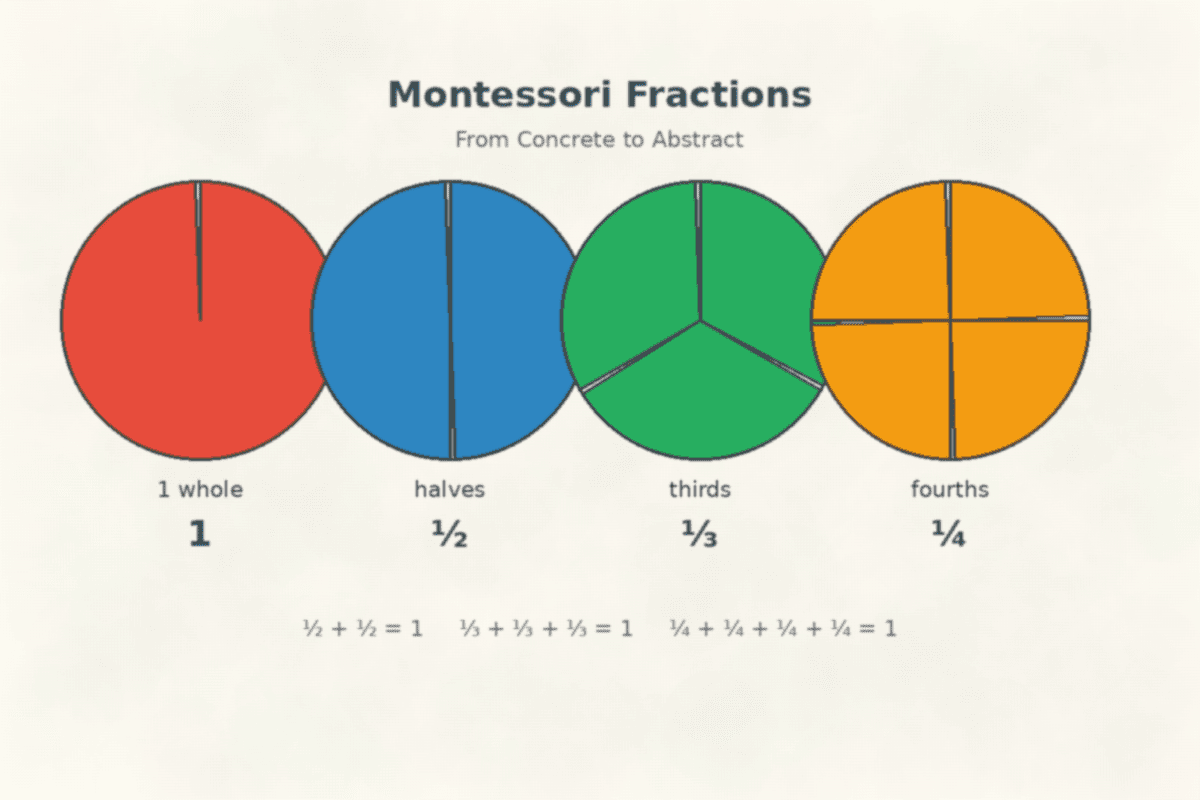
The signature Montessori fraction material is a set of metal fraction insets — a beautiful collection of circles, each divided into equal parts and color-coded for easy identification. Each piece fits snugly into a matching metal frame, and children can lift the pieces out, hold them, trace their shapes, and fit them back in.
What makes these materials so powerful is that the child can physically see and feel that two halves make a whole, that three thirds and two halves cover the same area, and that a fourth is smaller than a third. If you’d like to bring this experience home, a lovely set of Montessori fraction circles can give your child the same hands-on exploration. For something that mimics the classroom insets more closely, a set of fraction skittles and insets offers a wonderful tactile experience.
The Progression of Fraction Exercises
Like everything in Montessori, fraction work follows a careful progression from concrete to abstract. The child first learns to name the pieces — one whole, one half, one third, one fourth. Next comes comparing fractions by physically placing pieces side by side. From there the child explores equivalence, finding that two fourths equals one half. Eventually she uses the fraction circles for simple operations — adding and subtracting fractions, then multiplying and dividing. These advanced operations are covered in depth in our Fractions Part II guide.
Tips for Parents at Home
You don’t need a full classroom to support fraction understanding. Involve your child in cooking — measuring cups are fraction tools in disguise. Cut food into equal parts and name them casually. Most importantly, follow your child’s pace and trust that understanding will bloom when the time is right.