Lesson of the Day 79: The Division Bead Board — Discovering Division Facts Through Equal Sharing
Published on: May 18, 2026
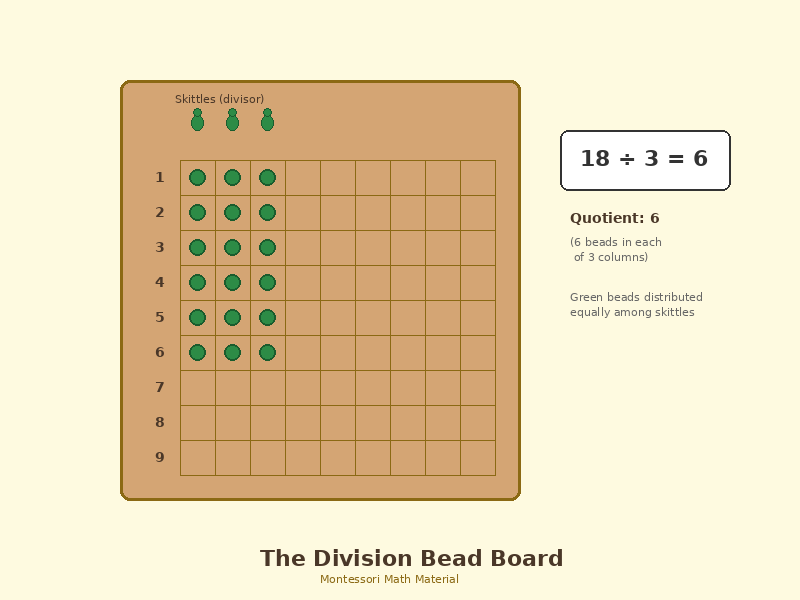
Of all the arithmetic operations children encounter, division often feels like the most mysterious. Multiplication builds things up — but division? Division asks a different kind of question: If I have this many, and I share them equally, how many does each person get? It's a question rooted in fairness, generosity, and the deeply human instinct to distribute equally. And in the Montessori classroom, the Division Bead Board transforms that abstract question into something a child can see, touch, and solve with their own hands.
If your child has already explored the Multiplication Bead Board, the Division Bead Board is a natural and beautiful next step. Where multiplication asks, "What do I get when I take this group this many times?", division reverses the question: "If I have this total and divide it equally, how many are in each group?" It's the inverse relationship made concrete — and watching a child discover that relationship through green beads and small wooden skittles is one of the most satisfying moments in Montessori math education.
What Is the Division Bead Board?
The Division Bead Board (sometimes called the Unit Division Board or Division Bead Board) is a classic Montessori math material used in both the Primary (ages 3–6) and Lower Elementary (ages 6–9) environments. It is part of the memorization sequence for arithmetic facts — the series of materials designed to help children internalize the basic facts of addition, subtraction, multiplication, and division through repeated, hands-on practice.
The material consists of several key components:
- A wooden board with 81 shallow holes (indentations) arranged in a 9 × 9 grid. Numbers 1 through 9 are printed along the left side of the board, representing the quotient (the answer).
- 9 green skittles (small wooden peg-like figures, sometimes called "unit men" or "divisor skittles") that are placed along the top of the board to represent the divisor — the number of groups the beads are being shared among.
- A box of 81 green beads used to represent the dividend — the total number being divided.
- A set of division fact cards (also called division equation slips), such as "81 ÷ 9 =" that guide the child through each problem systematically.
The board is elegantly simple and, like all the best Montessori materials, contains no distractions. There are no batteries, no flashing lights — just a child, a board, green beads, and the deeply satisfying act of sharing equally. The green color is intentional: in the Montessori color-coding system, green represents units, reinforcing the connection between this material and the broader Montessori math curriculum, including the Golden Bead Material and the Stamp Game.
Age Range
The Division Bead Board is typically introduced to children between the ages of 5 and 7, though this varies depending on the individual child's readiness and progression through the Montessori math sequence. In a Primary (Casa) environment, it may be introduced to older kindergarteners who have a strong foundation in the other bead board materials. In Lower Elementary, it is a standard part of the memorization work for the division facts.
Before a child is ready for the Division Bead Board, they should have:
- A solid understanding of one-to-one correspondence and counting
- Experience with the concept of equal sharing (often introduced informally through practical life activities and the Spindle Boxes)
- Familiarity with the Addition Strip Board and Subtraction Strip Board
- Completed or concurrent work with the Multiplication Bead Board
- An introduction to the concept of division through concrete materials such as the Golden Beads
Direct Aim
- To memorize the basic division facts (dividends up to 81, divisors 1 through 9)
- To understand division as the equal distribution of a quantity among a given number of groups
- To discover the quotient through concrete manipulation of beads
- To practice recording division equations and their answers
Indirect Aim
- To internalize the inverse relationship between multiplication and division
- To develop concentration, order, and precision in mathematical work
- To prepare for abstract division, long division, and later work with the Long Division Board
- To build confidence and independence in arithmetic problem-solving
- To reinforce the concept of remainders (through certain problems where division is not "even")
- To strengthen fine motor skills through the manipulation of small beads and skittles
Materials Needed
To present this lesson, you will need:
- The Division Bead Board — a wooden board with a 9 × 9 grid of indentations and numbers 1–9 along the left side. A quality option for home use is the Kid Advance Montessori Division Bead Board, which comes with the board, green beads, skittles, and fact cards.
- 81 green beads (included with most Division Bead Board sets)
- 9 green skittles (small wooden peg figures)
- Division fact cards (equation slips)
- A pencil and a small sheet of paper or recording booklet for writing answers
- A small tray or mat to define the workspace
For families interested in extending into more advanced division work later on, the Kghios Montessori Long Division Board with Test Tubes is a wonderful next-step material that handles larger dividends and multi-digit divisors.
Presentation (Step-by-Step)
As with all Montessori presentations, this lesson is given one-on-one or in a very small group. The adult sits beside the child (typically to the child's dominant side) and speaks sparingly, allowing the material to do the teaching. Move slowly and deliberately so the child can absorb each step.
Step 1: Invite the Child and Set Up the Workspace
Invite the child to the lesson by saying something like, "I'd like to show you something new today — the Division Bead Board. Would you like to come and see?" Together, carry the material to a table or mat. Place the board in the center, with the beads in their container to the right and the skittles nearby.
Step 2: Introduce the Material
Point to the board and briefly name its parts: "This is the Division Bead Board. These are our green beads — they represent the total number we're going to divide. And these are our skittles — they represent the people (or groups) we're sharing the beads among." Point to the numbers along the left side: "These numbers will help us find our answer."
Step 3: Select a Division Fact Card
Begin with a simple, accessible fact. A good starting problem is 18 ÷ 3 =. Place the fact card where the child can see it. Read it aloud together: "Eighteen divided by three." Explain: "This means we have 18 beads, and we're going to share them equally among 3."
Step 4: Place the Skittles (the Divisor)
Count out 3 skittles and place them along the top of the board, one above each of the first three columns. Say: "We have 3 skittles. These are the 3 groups we're sharing among." This is a crucial step — the skittles represent the divisor, and their physical presence helps the child understand who is receiving the beads.
Step 5: Count Out the Beads (the Dividend)
Count out 18 green beads and place them in a small group beside the board. Say: "We have 18 beads to share." The child can help with counting — in fact, encourage them to do so.
Step 6: Distribute the Beads Equally
Now comes the heart of the lesson. Pick up the beads one at a time and distribute them across the row, placing one bead under each skittle — just like dealing cards. Place one bead under skittle 1, one under skittle 2, one under skittle 3, then return to skittle 1 for the next bead. Continue distributing until all 18 beads have been placed.
As you do this, you may say: "One for you, one for you, one for you..." to emphasize the equal sharing. This language resonates with children who already understand the concept of fairness from everyday life — sharing snacks, distributing art supplies, dealing cards in a game.
Step 7: Read the Quotient
Once all 18 beads have been placed, look at the board. The beads will fill the first 3 columns, 6 rows deep. Point to the number on the left side of the board that corresponds to the last row of beads: 6. Say: "Each skittle received 6 beads. Eighteen divided by three equals six." Write the answer on the fact card or recording sheet: 18 ÷ 3 = 6.
Step 8: Clear the Board and Continue
Remove the beads and skittles. Invite the child to select the next fact card and repeat the process independently, with you observing and offering gentle guidance only as needed.
A Note on Remainders
One of the beautiful features of this material is that when a child encounters a problem that doesn't divide evenly (such as 10 ÷ 3), there will be leftover beads that cannot be distributed equally. This is a natural, concrete introduction to the concept of remainders. You can simply say, "We have one bead left over — it can't be shared equally. We call that a remainder." There's no need for an elaborate explanation; the material makes it self-evident.
Variations and Extensions
Once the child is comfortable with the basic presentation, there are many ways to extend the work:
- Sequential fact practice: Work through an entire division table (e.g., all the ÷ 3 facts) to see patterns emerge. The child may notice that the quotients increase by one as the dividends increase by three — a powerful discovery!
- Division booklet: The child can create a small booklet recording all the division facts for a given divisor, building toward mastery of the complete division table.
- Connecting to multiplication: After solving 18 ÷ 3 = 6, invite the child to verify using the Multiplication Bead Board: "If 3 × 6 = 18, then 18 ÷ 3 must equal 6!" This back-and-forth between multiplication and division deepens the child's understanding of inverse operations.
- Exploring remainders deliberately: Give the child problems that will have remainders (7 ÷ 2, 11 ÷ 4, etc.) and have them record the remainder. This prepares them for long division work.
- Finger charts and control charts: As the child progresses, they can use the Montessori division finger charts and control charts to check their own work independently — a hallmark of Montessori self-correction.
- Transition to abstraction: Eventually, the child begins to solve division problems without the board, using the internalized facts. You'll know they're ready when they can answer quickly without needing to distribute beads.
Observation Tips
The Montessori adult's role during this work is primarily one of quiet observation. Here are some things to watch for:
- Does the child distribute one bead at a time to each skittle? Some children try to give multiple beads to one skittle before moving on. Gentle redirection may be needed: "Remember, we give one to each person before going back to the first."
- Is the child counting the beads accurately? Miscounting the dividend is a common error. If the child counts out 17 instead of 18, the result will be off — and the material's self-correcting nature will reveal it when there aren't enough beads to complete a row.
- Does the child read the quotient from the left side of the board? Some children forget where to look for the answer. A simple reminder — "How many rows did each skittle get?" — can redirect them.
- Is the child making connections to multiplication? Listen for comments like, "Oh, this is like 3 times 6!" These spontaneous insights are gold. Affirm them warmly.
- Is the child frustrated or rushing? If so, step back. They may need more time with the Multiplication Bead Board before returning to division. There is never a rush in Montessori.
- Does the child handle remainders gracefully? Watch how they respond when beads are left over. Some children are bothered by the "leftover" beads, while others find it fascinating. Either response is perfectly normal.
Related Materials in the Montessori Math Sequence
The Division Bead Board does not exist in isolation — it is part of a carefully sequenced progression of materials that build upon one another. Understanding where it fits can help you support your child's journey:
- Addition Strip Board (LOTD 75) — Introduces the memorization of addition facts through concrete strip manipulation.
- Subtraction Strip Board (LOTD 77) — Presents subtraction as the inverse of addition, paralleling the relationship between multiplication and division.
- Multiplication Bead Board (LOTD 78) — The direct precursor to the Division Bead Board; the child should be well-established with this material first.
- Bead Chains (LOTD 60) — Provide early sensorial exposure to skip counting and multiples, which underpin both multiplication and division.
- Stamp Game (LOTD 66) — Introduces all four operations with a more abstract material; the Division Bead Board reinforces the division work begun there.
- Golden Bead Material — Where many children first encounter division through the "sharing" activity (dividing golden beads among mats).
- Long Division Board — The next step after the Division Bead Board for children ready to work with larger dividends. The Kghios Long Division Board is an excellent option for this progression.
Why This Material Matters
In conventional education, division is often taught as a set of procedures to memorize — "how many times does 3 go into 18?" The child is expected to simply know, or to guess and check. But the Montessori Division Bead Board does something radically different: it lets the child experience division as a physical act of equal sharing. The child doesn't memorize that 18 ÷ 3 = 6 because someone told them so. They know it because they placed 18 beads into 3 equal groups and counted 6 in each group. The knowledge is embodied, not just memorized.
This concrete foundation matters enormously as children move toward abstraction. A child who has spent weeks or months distributing beads on the Division Bead Board carries with them a deep, sensorial understanding of what division means. When they later encounter long division algorithms, fraction operations, or algebraic equations involving division, they have an internal reference point — a felt sense of the operation — that children who only memorized procedures often lack.
There's also something profoundly social and emotional about this material. Division, at its core, is about fairness and sharing. Young children are deeply invested in these concepts. "That's not fair!" is one of the most common phrases heard on any playground. The Division Bead Board channels that instinct for equity into mathematical understanding. It says to the child: Your sense of fairness is mathematically meaningful. Let's explore it.
As Maria Montessori herself observed, the hand is the instrument of the mind. When a child's hands distribute beads equally among skittles, their mind is constructing an understanding of division that no worksheet or flashcard could ever replicate. Trust the material. Trust the process. And most of all, trust your child.