Lesson of the Day 78: The Multiplication Bead Board — Discovering Multiplication Facts One Bead at a Time
Published on: May 17, 2026
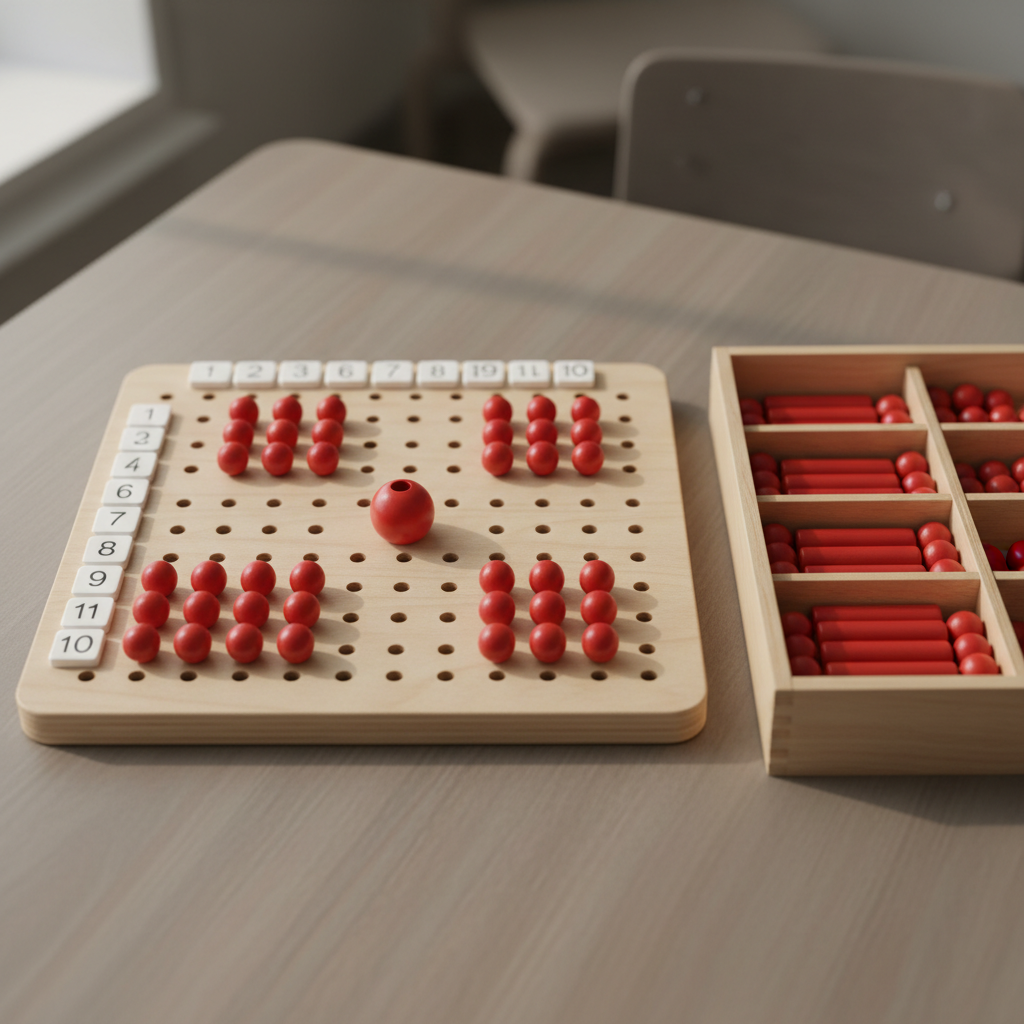
There's a magical moment in every child's mathematical journey when they first realize that multiplication isn't just a mysterious operation reserved for "big kids" — it's simply a beautiful, logical pattern of groups. The Montessori Multiplication Bead Board captures that moment and makes it tangible, visual, and deeply satisfying. With a simple wooden board, a handful of red beads, and a small numbered card, your child doesn't just memorize multiplication facts — they build them, row by row, bead by bead.
If your child has been working with materials like the Addition Strip Board or the Subtraction Strip Board, the Multiplication Bead Board is a natural and exciting next step. It takes the familiar concept of repeated addition and transforms it into a concrete understanding of multiplication — one of the most important arithmetic operations your child will ever learn.
What Is the Multiplication Bead Board?
The Multiplication Bead Board is a classic Montessori math material found in the Primary (ages 3–6) and Lower Elementary (ages 6–9) environments. It consists of several key components:
- A wooden board with 100 shallow indentations arranged in a 10 × 10 grid. The numbers 1 through 10 are printed along the top of the board.
- A red disc marker (or small red card) that slides along the top row of numbers to indicate the multiplicand — the number being multiplied.
- A box of 100 small red beads used to fill the rows on the board.
- A set of multiplication fact cards (for example, "3 × 4 =") that guide the child through each problem.
The board itself is beautifully simple. There are no batteries, no screens, and no bells and whistles — just a child, a board, and beads. And yet within that simplicity lies the entire world of multiplication tables from 1 through 10.
Age Range
The Multiplication Bead Board is typically introduced to children between the ages of 5 and 8. In a Montessori Primary classroom, it may be introduced to older kindergarteners who have a strong foundation in counting and addition. In Lower Elementary, it becomes a key material for solidifying multiplication facts. The child should be comfortable with numbers 1–100 and ideally have some experience with skip counting, perhaps through work with the Bead Chains.
Direct Aim
- To provide a concrete, hands-on understanding of multiplication as repeated addition
- To help the child learn and memorize the multiplication tables from 1 × 1 through 10 × 10
- To practice recording multiplication facts and their products
Indirect Aim
- To prepare for more abstract multiplication work, such as with the Stamp Game and the Bead Frame
- To develop concentration, order, and logical thinking
- To build a foundation for understanding the commutative property of multiplication
- To strengthen fine motor skills through careful bead placement
- To nurture the child's growing sense of mathematical patterns and relationships
Step-by-Step Presentation
Preparation
Invite the child to work with you at a table. Carry the Multiplication Bead Board, the box of red beads, the red disc marker, and a set of multiplication fact cards to the workspace. You'll also need a pencil and a piece of paper (or a prepared multiplication chart) for recording answers.
Presentation: Introducing the Board
- Introduce the material. Say warmly, "Today we're going to explore something wonderful — the Multiplication Bead Board. This board is going to help us discover multiplication facts using these beautiful red beads."
- Orient the child to the board. Point to the numbers along the top of the board (1–10) and explain: "These numbers across the top tell us what number we are multiplying — we call that the multiplicand." Show the child the red disc marker and demonstrate sliding it along the top row.
- Show the child the grid. Run your finger down the left side of the board where the rows are. Explain: "Each row represents one group. So if we're multiplying a number by 3, we'll fill in 3 rows."
- Select a fact card. Begin with something simple, such as 3 × 4. Read the card aloud: "Three taken four times" or "Three multiplied by four."
- Place the disc marker. Slide the red disc to the number 3 at the top of the board. This tells us we are working with groups of 3.
- Place the beads. In the first row, carefully place 3 red beads — one in each indentation under numbers 1, 2, and 3. Say, "That's one group of three." Move to the second row and place 3 more beads. "That's two groups of three." Continue for the third row ("Three groups of three") and fourth row ("Four groups of three").
- Count the beads. Now invite the child to count all the beads on the board: 1, 2, 3, 4… all the way to 12. "So, 3 taken 4 times is 12! Three times four equals twelve."
- Record the answer. Help the child write the equation: 3 × 4 = 12.
- Clear the board. Remove the beads and return them to the box. The child is now ready for the next fact.
Building the Tables
Once the child understands the process, they can work through an entire multiplication table systematically. For example, to build the table of 4:
- Place the disc marker on 4.
- Begin with 4 × 1: place 4 beads in the first row, count, and record.
- Without clearing, add 4 more beads in the second row for 4 × 2. Count all beads and record.
- Continue adding one row at a time through 4 × 10.
This cumulative approach allows the child to see the multiplication table growing before their eyes — a powerful visual experience that makes the abstract concept of multiplication wonderfully concrete.
Variations and Extensions
- Random fact practice: Once the child is comfortable building tables sequentially, shuffle the fact cards and let the child solve them in random order. This builds fluency and confidence.
- Commutative property exploration: Have the child build 3 × 5 (three beads in five rows) and then 5 × 3 (five beads in three rows). They'll discover that both produce 15! This concrete experience of the commutative property is far more meaningful than simply being told that "order doesn't matter."
- Multiplication booklet: Provide a small booklet where the child records each table as they complete it. Many children take great pride in completing all the tables from 1 through 10.
- Pattern discovery: Encourage the child to look at the shapes the beads make on the board. Square numbers (like 4 × 4 or 5 × 5) create perfect squares on the grid — a beautiful visual connection to geometry that plants seeds for later mathematical understanding.
- Connection to skip counting: If your child has worked with the Bead Chains, draw the connection explicitly: "Remember when you skip counted by fours with the bead chain? That's exactly what we're doing here!"
- Transition to abstraction: As the child becomes proficient, they may begin to answer multiplication facts mentally before placing the beads, using the board only to verify. This is the natural journey from concrete to abstract that is at the heart of Montessori mathematics.
Tips for Parents and Educators
- Follow the child's pace. Some children will want to build every table in one sitting; others will savor one table a day. Both approaches are perfectly valid.
- Don't rush to memorization. The board is designed to help the child understand multiplication before memorizing facts. Trust the process — fluency follows understanding.
- Keep the atmosphere joyful. Multiplication is not drudgery on the Bead Board. It's discovery. Celebrate the patterns your child notices and the connections they make.
- Pair with the Hundred Board. If your child has enjoyed the Hundred Board, they may enjoy coloring in multiples on a hundred chart alongside their bead board work — another way to see the beautiful patterns multiplication creates.
Where to Find It
If you're looking to bring the Multiplication Bead Board into your home or classroom, here are two excellent options:
- Kid Advance Montessori Multiplication Bead Board — a well-made, classic version with everything you need to get started.
- Montessori Math Manipulatives Multiplication Board — another quality option for hands-on multiplication practice.
A Warm Closing
The Multiplication Bead Board is one of those Montessori materials that reminds us why hands-on learning matters so profoundly. In a world that often rushes children toward flashcard drills and timed tests, this simple wooden board invites them to slow down, place one bead at a time, and truly see what multiplication means. Each row of beads is a group. Each completed grid is a table. And each "aha!" moment — when a child counts the beads and discovers the product — is a small mathematical triumph that belongs entirely to them.
Whether your child is just beginning to explore multiplication or is working to solidify facts they've already encountered, the Multiplication Bead Board offers a pathway that is concrete, logical, and deeply satisfying. One bead at a time, your child is building not just multiplication facts, but a lasting love of mathematics.