Lesson of the Day 64: The Bead Frame -- Bridging to Abstract Math
Published on: May 05, 2026
Materials Needed
- Montessori Bead Frame (small bead frame with 4 wires)
- Bead frame paper (formatted for recording operations)
- Pencil
What Is the Bead Frame?
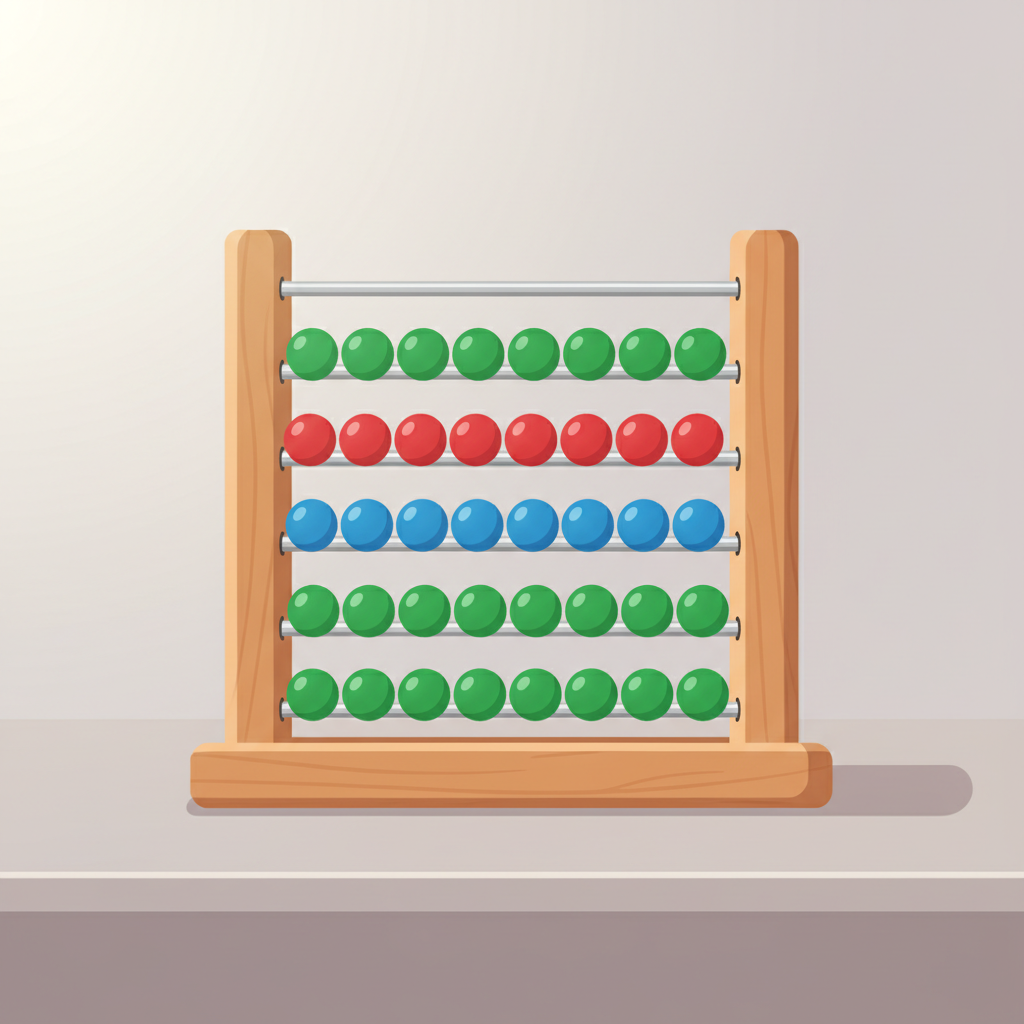
The Montessori Bead Frame is a specialized abacus used in the primary and lower elementary classroom to help children understand place value and perform the four basic operations -- addition, subtraction, multiplication, and division -- with numbers into the thousands. Each wire on the frame represents a category of the decimal system: units, tens, hundreds, and thousands, with ten beads on each wire color-coded to match the Golden Bead Material.
Where the Golden Beads give children a concrete, tactile experience of quantity, the Bead Frame bridges the gap toward abstraction. The child still moves something physical -- the beads -- but the representation is more symbolic. This is a hallmark of the Montessori approach: moving from concrete to abstract in carefully measured steps (see Lesson 38: From Concrete to Abstract).
Age Range
Typically introduced around age 5?-7, after the child has had thorough experience with the Golden Bead Material and the Stamp Game.
How to Present the Bead Frame
Step 1: Introduce the Frame
Sit beside the child and place the bead frame flat on the table. Point to each wire from bottom to top:
- Green wire (bottom): Units -- each bead is worth 1
- Blue wire: Tens -- each bead is worth 10
- Red wire: Hundreds -- each bead is worth 100
- Green wire (top): Thousands -- each bead is worth 1,000
"Let's see -- if I slide 3 beads on the units wire, that's 3. And if I slide 2 beads on the hundreds wire, that's 200. Together, we have 203!"
Step 2: Composing Numbers
Ask the child to show you different numbers on the frame. Start simple -- 45, 132, 1,507. This builds confidence with place value before introducing operations.
Step 3: Static Addition
Begin with an addition problem that requires no exchanging (carrying), such as 2,341 + 1,236:
- Have the child compose the first number on the frame
- Starting with units, slide the appropriate beads for the second number
- Read the result: 3,577
Step 4: Dynamic Addition (Exchanging)
When a wire fills past 10 beads, the child slides all 10 back and moves one bead on the next wire up -- just like carrying in written arithmetic. For example, 1,465 + 2,738: when the units reach 13, slide 10 back and carry 1 to the tens wire.
Step 5: Subtraction, Multiplication, Division
Once the child is comfortable with addition, the same frame supports all four operations. Subtraction reverses the process (sliding beads back, borrowing when needed). Multiplication can be introduced as repeated addition. Division as repeated subtraction or sharing.
Connection to the Montessori Sequence
The Bead Frame sits in a careful progression of mathematical materials:
- Number Rods -- quantity and sequence (ages 3-4)
- Short Bead Stair -- quantities 1-9 with color coding
- Counting Chains -- skip counting and multiplication readiness
- Golden Bead Material -- concrete decimal system operations
- Stamp Game -- semi-abstract operations
- Bead Frame (this lesson) -- bridging to paper-and-pencil math
- Large Bead Frame (7 wires) -- extending operations into the millions
- Hundred Board -- number patterns and sequences
Tips for Parents
- Follow the child's pace. Some children take weeks at the composing-numbers stage before they're ready for operations -- and that's perfectly fine.
- Use bead frame paper. Recording work on special paper with color-coded columns reinforces the place-value connection.
- Keep it joyful. If the child is frustrated, step back to the Stamp Game or Golden Beads for more concrete practice.
- Let errors teach. If the child gets 10+ beads on a wire, pause and ask, "What happens when we have ten of something in Montessori?" They'll often self-correct.
Explore More
Browse our full collection of math printouts and activities to support your child's mathematical journey at home.