Lesson of the Day 55: The Hundred Board -- Discovering Number Patterns
Published on: April 30, 2026
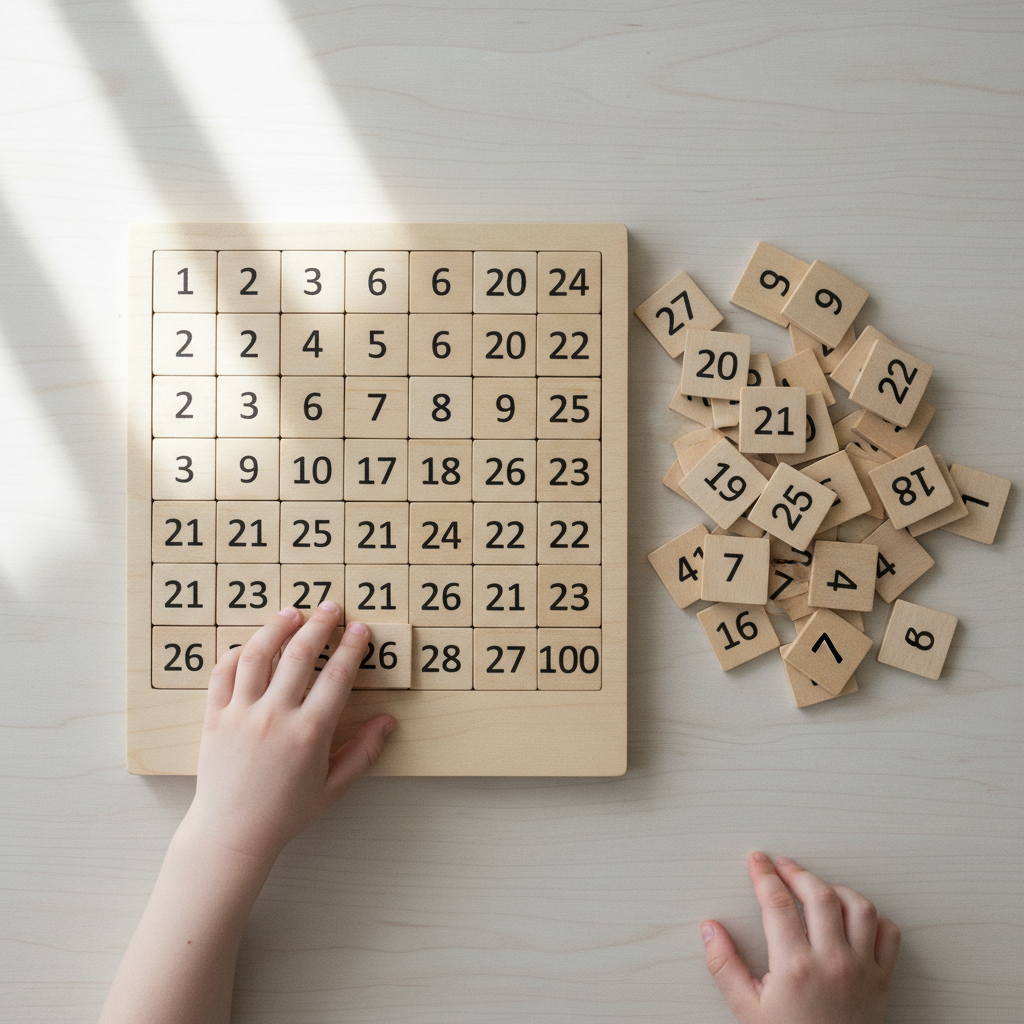
The Hundred Board is one of the most versatile Montessori math materials, bridging the gap between concrete counting and abstract number sense. With its simple grid of 1-100, this elegant tool lets children discover number patterns, skip counting, and even early multiplication -- all through their own hands-on exploration.
Materials Needed
- Hundred Board (wooden board with a 10x10 grid)
- Number tiles 1-100
- Control chart (completed board for self-correction)
Recommended:
- MONTESSORI OUTLET Hundred Board -- classic wooden design with individual number tiles
- Montessori Hundred Board with Wooden Tiles -- budget-friendly option with smooth, child-sized tiles
Age Range
4-7 years (Primary and early Elementary)
Presentation 1: Filling the Board
- Invite the child to the lesson. Carry the Hundred Board and tile box to a table together.
- Show the child the empty board. Point out that each square holds one number tile.
- Take tile "1" and place it in the top-left corner. Say, "This is one."
- Continue with tiles 2-10, placing them left to right across the first row.
- Pause after 10. Say, "When we reach ten, we start a new row."
- Place tile 11 at the start of the second row. Let the child notice the pattern.
- After a few more tiles, invite the child to continue independently.
- When the board is complete, admire it together. "You placed all one hundred numbers!"
- Show the control chart so the child can self-correct any misplaced tiles.
Presentation 2: Skip Counting
- With the board filled, ask the child to point to every number that ends in 0: 10, 20, 30...
- Place a small marker or colored chip on each one. Notice the vertical column that forms.
- Repeat with numbers ending in 5. "What pattern do you see?"
- Try skip counting by 2s, placing markers on 2, 4, 6, 8... Patterns emerge naturally.
- For older children, try skip counting by 3s or 4s and discuss why the patterns differ.
Presentation 3: Odd and Even
- Ask the child to place a blue chip on every odd number and a red chip on every even number.
- The alternating color pattern reinforces the concept visually across the entire board.
- Ask, "Is 47 odd or even? How can you tell without looking at the board?"
Extensions
- Mystery number: Give clues and let the child find the tile.
- Addition paths: Start on any number and count forward to practice adding.
- Multiplication introduction: Use skip counting rows to show that 5 x 3 means "count by 5 three times."
- Missing numbers: Remove several tiles and let the child figure out which are missing.
Points of Interest
- The satisfying click of each tile settling into its square
- Discovering that every row starts with a number ending in 1
- The visual patterns that emerge during skip counting
Control of Error
The control chart provides a completed reference. If a tile does not fit or a square is left empty, the child can self-correct without adult intervention -- a hallmark of Montessori design.
Connection to the Curriculum
The Hundred Board builds directly on the Golden Bead Material, where children first experience quantities in the decimal system. After mastering the board, many children move naturally to the Stamp Game for operations and the Counting Chains for skip counting with beads. For earlier number work, see Number Rods and Counting Games.
The beauty of the Hundred Board is how much mathematics lives inside such a simple grid. Children do not just memorize numbers -- they discover them. Browse our full collection of Math Printouts for hands-on activities that complement this work.