Lesson of the Day 57: The Trinomial Cube — Building (a + b + c) Cubed One Block at a Time
Published on: May 01, 2026
The Trinomial Cube
Ages
3½ to 6 years old for sensorial exploration; 6 and older for the algebraic connection
Material
If you have already spent time with the Binomial Cube, the Trinomial Cube will feel like meeting its older, more complex sibling — familiar in spirit, but richer in every way. Where the Binomial Cube contains 8 blocks and represents the cube of two quantities, the Trinomial Cube contains 27 blocks and represents the cube of three quantities. It is one of the most visually stunning materials in the entire Montessori classroom, and it holds within its elegant wooden box a remarkable amount of mathematical truth.
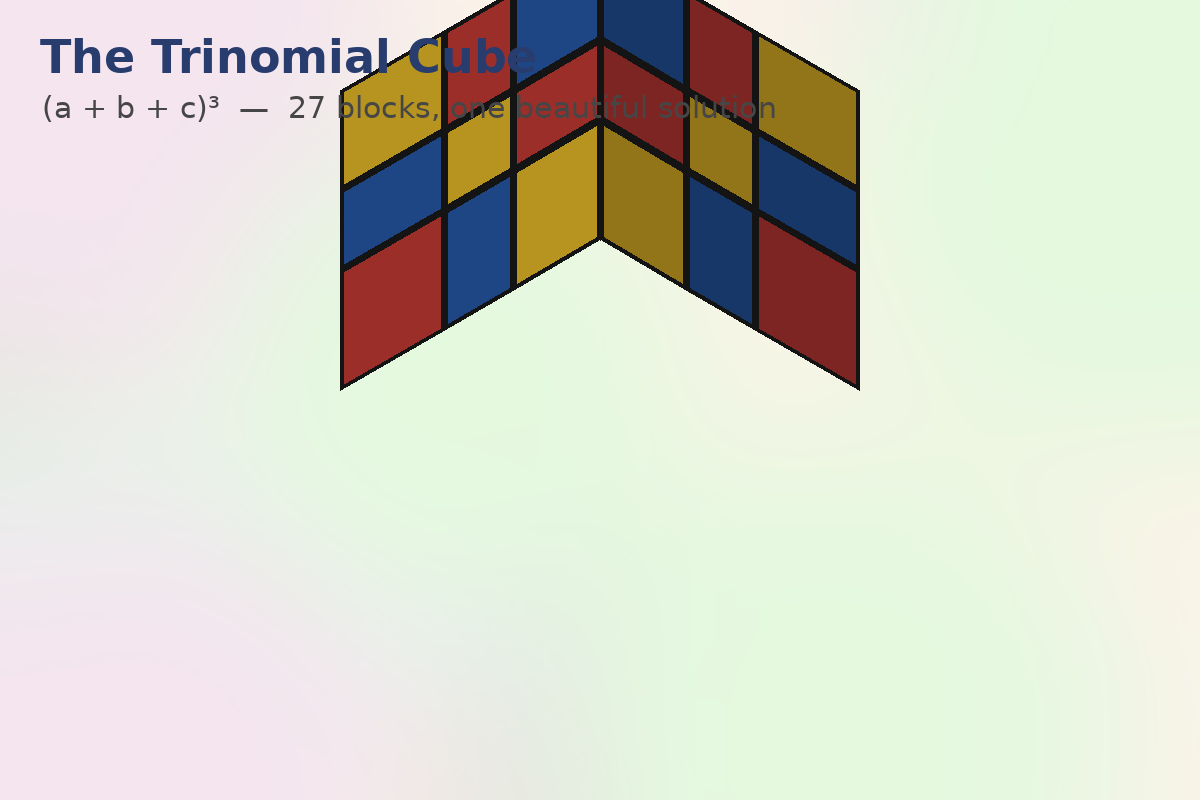
The Trinomial Cube consists of a hinged wooden box — larger than the Binomial Cube's box — containing 27 wooden blocks that fit together to form a single, larger cube. The lid of the box and two adjoining sides are painted with a color pattern that serves as a guide for assembling the blocks, just as with the Binomial Cube. The pattern is more complex this time, because we are now working with three layers instead of two, and nine positions per layer instead of four.
The 27 blocks are as follows:
Three colored cubes:
- 1 red cube — this represents a³ (a × a × a). It is the largest cube in the set and is painted red on all sides.
- 1 blue cube — this represents b³ (b × b × b). It is the medium-sized cube and is painted blue on all sides.
- 1 yellow cube — this represents c³ (c × c × c). It is the smallest cube and is painted yellow on all sides.
Six colored-and-black rectangular prisms (each appearing in a set of three):
- 3 red-and-black prisms — these represent a²b. Each has two square red faces and four rectangular black faces. Their red square faces are the same size as the faces of the red cube, and their length matches the edge of the blue cube.
- 3 red-and-black prisms — these represent a²c. Each has two square red faces and four rectangular black faces. Their red square faces are the same size as the faces of the red cube, and their length matches the edge of the yellow cube.
- 3 blue-and-black prisms — these represent ab². Each has two square blue faces and four rectangular black faces. Their blue square faces are the same size as the faces of the blue cube, and their length matches the edge of the red cube.
- 3 blue-and-black prisms — these represent b²c. Each has two square blue faces and four rectangular black faces. Their blue square faces are the same size as the faces of the blue cube, and their length matches the edge of the yellow cube.
- 3 yellow-and-black prisms — these represent ac². Each has two square yellow faces and four rectangular black faces. Their yellow square faces are the same size as the faces of the yellow cube, and their length matches the edge of the red cube.
- 3 yellow-and-black prisms — these represent bc². Each has two square yellow faces and four rectangular black faces. Their yellow square faces are the same size as the faces of the yellow cube, and their length matches the edge of the blue cube.
Six black rectangular prisms:
- 6 black prisms — these represent abc. Each is painted black on all sides. They are all identical in size, and each one has dimensions that correspond to one edge from each of the three cubes (a × b × c). These are the pieces that fill the remaining spaces in each layer, and they are the trickiest to place because they offer no color clue on their faces — only their dimensions distinguish where they belong.
Together, these 27 blocks are a concrete, three-dimensional representation of the algebraic formula (a + b + c)³ = a³ + 3a²b + 3a²c + 3ab² + b³ + 3b²c + 3ac² + 3bc² + c³ + 6abc. That is a formidable-looking expression, and it would be entirely abstract and meaningless to a four-year-old encountered on paper. But held in the hands, built layer by layer inside a beautiful wooden box, it becomes something a child can see, touch, and understand through the senses long before they ever encounter a variable or an exponent. This is the genius of Montessori's approach — the hand teaches the mind.
Presentation
Before presenting the Trinomial Cube, your child should be comfortable and confident with the Binomial Cube. The Trinomial Cube follows the same logic and the same process, but with greater complexity. A child who has internalized the patterns and procedures of the Binomial Cube will approach this new challenge with familiarity and confidence — they already understand the fundamental idea of matching colors, reading the painted guide, and building in layers. The Trinomial Cube simply extends what they already know.
Place the box on a table or mat in front of the child. Open the lid and turn it so that the painted pattern on the inside of the lid is visible. Take a moment to look at the pattern together. Your child will notice that it is more complex than the Binomial Cube's lid — there are more colors, more sections, more pieces to account for. That is fine. The lid tells the whole story of the top layer, and the painted sides of the box tell the story of how the layers align from front to side.
Begin by carefully removing the blocks from the box, one layer at a time. The Trinomial Cube is assembled in three layers. Remove the top layer first, placing each block on the table near the box in the approximate arrangement they held inside the box — this helps the child see the relationships before they attempt to rebuild. Then remove the second layer in the same fashion, placing those blocks in their own group. Finally, remove the bottom layer. Handle each block gently and deliberately, allowing the child to observe the colors, shapes, and sizes. There are many pieces, and taking your time here is important.
Now, reassemble the cube inside the box, starting with the bottom layer. Look at the painted pattern on the two sides of the box — these are your guide, just as with the Binomial Cube. The bottom layer corresponds to the lowest row of color on each painted side.
Place the red cube in the corner where the two painted sides meet. This is always the starting point — the red cube anchors the assembly, just as it does in the Binomial Cube. Then place the red-and-black prisms along each painted side, matching the red square faces against the red cube. You will place one a²b prism along one side and one a²c prism along the other side, with their red faces flush against the red cube and their black faces facing outward. Now look at the remaining spaces in this layer. An abc black prism fits into the corner diagonally opposite the red cube. The remaining spaces are filled by the appropriately sized colored-and-black prisms — the pieces whose colored square faces correspond to the colors shown on the painted box sides. Each piece should nestle snugly against its neighbors, with matching colors touching: red against red, blue against blue, yellow against yellow, and black against black.
Take your time with this first layer. It is a 3×3 arrangement of nine blocks, and getting it right establishes the foundation for everything above. Look at the painted sides of the box to verify that your arrangement matches the guide.
Build the second layer on top of the first. This middle layer does not contain any of the colored cubes — it is composed entirely of rectangular prisms. Again, use the painted sides of the box as your guide. The color pattern on the box sides shows you which colored faces should appear at each position. Place each prism so that its colored square faces align with the corresponding colors in the layer below and the guide on the box walls. The black abc prisms fill the spaces where no colored face is visible from the sides. This layer requires careful observation, and it is the layer where children often need the most time and patience.
Build the third and final layer on top, using the pattern on the lid as your primary guide. This top layer contains the blue cube and the yellow cube in their respective positions, along with the remaining prisms. Start with the piece that corresponds to the corner where the two painted sides meet — for the top layer, check the guide to see which block belongs there. Place the blue cube and yellow cube in their correct positions, and fill in the remaining prisms around them, matching colors carefully.
Close the lid. The cube is complete. The whole presentation should be done slowly, with quiet concentration and minimal language. Let your hands do the teaching. The child absorbs the process through careful observation — watching where your eyes look, how your fingers test each piece, and the deliberate way you check colors against the guide before placing each block.
If the child seems overwhelmed by the full presentation, you can simplify by focusing on just the bottom layer in the first session, then adding the second and third layers in subsequent presentations. There is no rush. The material will wait, and the child will come to it again and again.
Exercise
Your child assembles the Trinomial Cube after watching your demonstration. At first, this will be a challenging and absorbing task — there are 27 pieces to manage, compared to the Binomial Cube's 8, and the three-layer structure demands that the child hold more information in mind at once. But the underlying logic is identical to what they already know from the Binomial Cube: match the colors, follow the pattern, build from the corner outward, and work one layer at a time.
Encourage your child to begin as you did — with the red cube in the corner where the two painted sides meet. This anchor point gives the child a secure starting position from which everything else flows. From there, the child reads the painted guide and selects the pieces whose colors and sizes correspond to each position.
The rule of color matching is the same as with the Binomial Cube, and your child already knows it: red faces always touch red faces, blue faces always touch blue faces, yellow faces always touch yellow faces, and black faces always touch black faces. This simple principle, applied consistently, is the key to solving the puzzle. The child who has internalized this rule from the Binomial Cube will find that it carries them beautifully through the Trinomial Cube as well.
The black abc prisms are the most challenging pieces, because they have no colored faces to guide placement — they are black on all sides. The child must rely on the dimensions of each piece and the shape of the remaining space to determine where each one belongs. This is a wonderful exercise in spatial reasoning and problem-solving. If a black prism doesn't fit in one orientation, the child must rotate it and try again. The material itself provides the feedback: if the piece fits, it's right; if it doesn't, something needs to change.
Allow your child to repeat this work as many times as they wish. The Trinomial Cube is deeply satisfying to complete — perhaps even more so than the Binomial Cube, because the greater complexity makes the moment of completion feel like a genuine achievement. Each time the lid closes smoothly over a perfectly assembled cube, the child experiences that quiet, profound satisfaction that comes from bringing order out of apparent chaos.
Some children will want to work with the Trinomial Cube every day for weeks. Others will return to it periodically over months or even years. Both patterns are completely normal. The material reveals different things to the child at different stages of development, and there is always more to notice, more to understand, more to appreciate about the relationships among the pieces.
Once your child has mastered building the cube inside the box, you can invite them to try building it outside the box, on the table or mat, without the painted sides as a guide. This is a very significant leap in difficulty — far more challenging than the same exercise with the Binomial Cube, because there are three times as many pieces and no external reference at all. The child must hold the entire three-dimensional pattern in their mind and reconstruct it from memory and logic alone. Some children will be ready for this after a few months of confident work inside the box; others may not attempt it until they are five or six. There is no timeline. Follow your child.
Purpose
- Visual discrimination of color, form, and size — the child must observe and distinguish among 27 blocks in four colors, multiple shapes, and a range of sizes, making finer discriminations than the Binomial Cube requires
- Spatial reasoning and three-dimensional awareness — building a cube from 27 component parts across three layers develops a sophisticated sense of how shapes fit together in space
- Understanding of pattern and order — the child internalizes that there is one specific, logical way the pieces relate to one another, and that a complex whole can be understood as an organized arrangement of simpler parts
- Development of concentration, patience, and persistence — this is a multi-step, multi-layer puzzle that rewards sustained, careful attention. It is significantly more demanding than the Binomial Cube and builds the child's capacity for extended focus
- Fine motor coordination and precision of movement — each of the 27 blocks must be placed accurately and gently for the cube to come together
- Indirect preparation for mathematics and algebra — the child absorbs, through the hands and eyes, the concrete relationships that later correspond to the algebraic trinomial (a + b + c)³ = a³ + 3a²b + 3a²c + 3ab² + b³ + 3b²c + 3ac² + 3bc² + c³ + 6abc
- Strengthening of the work habits and strategies developed with the Binomial Cube — the child applies what they learned with the simpler material to this more complex challenge, building confidence in their own ability to transfer skills
- Preparation for later algebraic work in the elementary years, where the cube is deconstructed and its terms are studied explicitly
Control of Error
The box itself is the control of error, just as with the Binomial Cube. If any block is placed incorrectly, the remaining pieces will not fit, and the lid will not close properly. The painted patterns on the lid and two sides of the box also guide the child — if the colors visible on top or along the sides don't match the painted guide, the child can see that something is not right and self-correct without any adult intervention.
With 27 pieces and three layers, the Trinomial Cube offers more opportunities for error than the Binomial Cube — and therefore more opportunities for self-correction. Each mistake is a chance for the child to slow down, observe more carefully, and reason through the problem. The material communicates errors clearly and gently, preserving the child's dignity and encouraging independent problem-solving. An adult who swoops in to correct placement robs the child of the most valuable part of the experience: the discovery that they can figure it out themselves.
Extensions
The Trinomial Cube offers a rich range of extensions that grow with your child from the primary years well into elementary:
Building Outside the Box: As described above, once the child is fully confident assembling the cube inside the box, invite them to build it on a mat without the box at all. This removes every visual guide and requires the child to reconstruct the entire three-dimensional pattern from memory and spatial understanding alone. It is a magnificent exercise in concentration, spatial memory, and logical thinking. Many children find this deeply challenging and equally rewarding.
Comparing with the Binomial Cube: Place both cubes side by side — the Binomial Cube and the Trinomial Cube — and invite the child to notice how they are similar and how they are different. The child may observe that the Binomial Cube has two colored cubes (red and blue) while the Trinomial Cube has three (red, blue, and yellow). They may notice that the Binomial Cube has two layers and the Trinomial Cube has three. They may notice that the Binomial Cube has 8 pieces and the Trinomial Cube has 27. These observations are rich in mathematical meaning — 2³ = 8 and 3³ = 27 — though the child need not articulate this explicitly. The sensorial impression is what matters at this stage.
Deconstructing the Layers: Invite the child to remove the cube from the box and separate the three layers, placing them side by side on the mat. Each layer can be examined as its own flat arrangement. The child can compare the three layers and notice how they are different — each layer has a different combination of pieces. This is beautiful preparation for understanding how a three-dimensional form is composed of two-dimensional cross-sections.
Language Enrichment: Use the Trinomial Cube as an opportunity to reinforce precise geometric vocabulary. Name the shapes — cube and rectangular prism. Talk about faces, edges, and corners (or vertices). Discuss the colors and what they represent. A child in the primary years can absorb this vocabulary naturally through conversation during or after the work.
The Algebraic Connection (Elementary): For the elementary child — typically around age 7 or 8, depending on readiness — the Trinomial Cube can be revisited explicitly as an algebraic material. The child can label each block with its algebraic term: a³, a²b, a²c, ab², b³, b²c, ac², bc², c³, and abc. They can count how many of each type there are (1 of each cube, 3 of each colored prism type, and 6 of the black prisms) and write out the full expansion: (a + b + c)³ = a³ + 3a²b + 3a²c + 3ab² + b³ + 3b²c + 3ac² + 3bc² + c³ + 6abc. Because the child has been handling these pieces for years — fitting them together, noticing their relationships, absorbing their proportions through the senses — this algebraic formula is not an abstraction to be memorized. It is a description of something they already know in their hands and their eyes. The formula simply gives words and symbols to an experience they have lived. This is what Montessori meant when she said the materials move from the concrete to the abstract.
Connecting to Other Sensorial Materials: The Trinomial Cube shares deep connections with other sensorial materials your child may already know. The Pink Tower explores graduated three-dimensional size. The Brown Stair explores variation in two dimensions. The cubes and prisms in the Trinomial Cube bring together ideas about length, width, and height in a single, integrated puzzle. Drawing these connections — even just by placing materials near each other and letting the child notice similarities — enriches the child's understanding of the sensorial curriculum as a unified whole.
Continuity from the Binomial Cube
It is worth pausing to appreciate how beautifully the Trinomial Cube grows from the Binomial Cube. The Binomial Cube introduces the child to the essential concept: a larger cube can be decomposed into smaller blocks of different shapes and sizes, and these blocks fit together in one precise, logical way, guided by color. The Trinomial Cube takes that same concept and extends it — more blocks, more colors, more layers, more complexity — but the fundamental logic is unchanged. Red faces touch red faces. Blue faces touch blue faces. Yellow faces touch yellow faces. Black faces touch black faces. Start with the anchor piece in the corner. Build layer by layer. Trust the pattern.
A child who has spent weeks or months with the Binomial Cube comes to the Trinomial Cube with a set of internalized strategies and a deep confidence in their ability to solve three-dimensional puzzles. The Trinomial Cube honors that preparation by offering a challenge that is genuinely harder but not fundamentally different. The child stretches, but does not break. They apply what they know to something new, and they succeed. This experience — of meeting greater complexity with familiar tools and rising to the occasion — is one of the most powerful things a Montessori education offers.
And just as the Binomial Cube prepared the way for the Trinomial Cube, the Trinomial Cube itself prepares the way for further mathematical exploration. In the elementary years, both cubes become explicit algebra materials. The child who built these cubes with their hands at age four will encounter polynomial expressions at age eight or nine and think, "Oh — I know what that looks like. I've held it in my hands." There is no more powerful foundation for abstract mathematics than this kind of deep, sensorial, embodied understanding.
Where to Buy
You can find the Montessori Trinomial Cube from several sources. Here are some options available on Amazon:
- Elite Montessori Trinomial Cube : Toys & Games - Amazon.com
- Montessori Trinomial Cube Montessori Math Toys Sensorial ...
When selecting a Trinomial Cube, look for one made of solid wood with smooth, accurate cuts and vibrant, clearly differentiated paint colors. The blocks must fit together precisely — this is a material where manufacturing quality matters enormously, because the control of error depends on the pieces fitting snugly. A poorly made cube with loose tolerances will frustrate the child and undermine the self-correcting nature of the material. It is also worth checking that the painted pattern on the lid and box sides is clear and accurate, as this serves as the child's guide during assembly.
Related Lessons
- Lesson of the Day 91: The Binomial Cube — the direct prerequisite and companion material to the Trinomial Cube
- The Pink Tower — the iconic sensorial material exploring graduated three-dimensional size
- The Brown Stair — a sensorial material exploring variation in width and height
- Lesson of the Day 97: The Stamp Game — another material that bridges the concrete and the abstract in mathematics
- The Golden Beads — the foundational material for understanding the decimal system