Lesson of the Day 44: The Binomial Cube — From Puzzle to Algebra
Published on: April 27, 2026
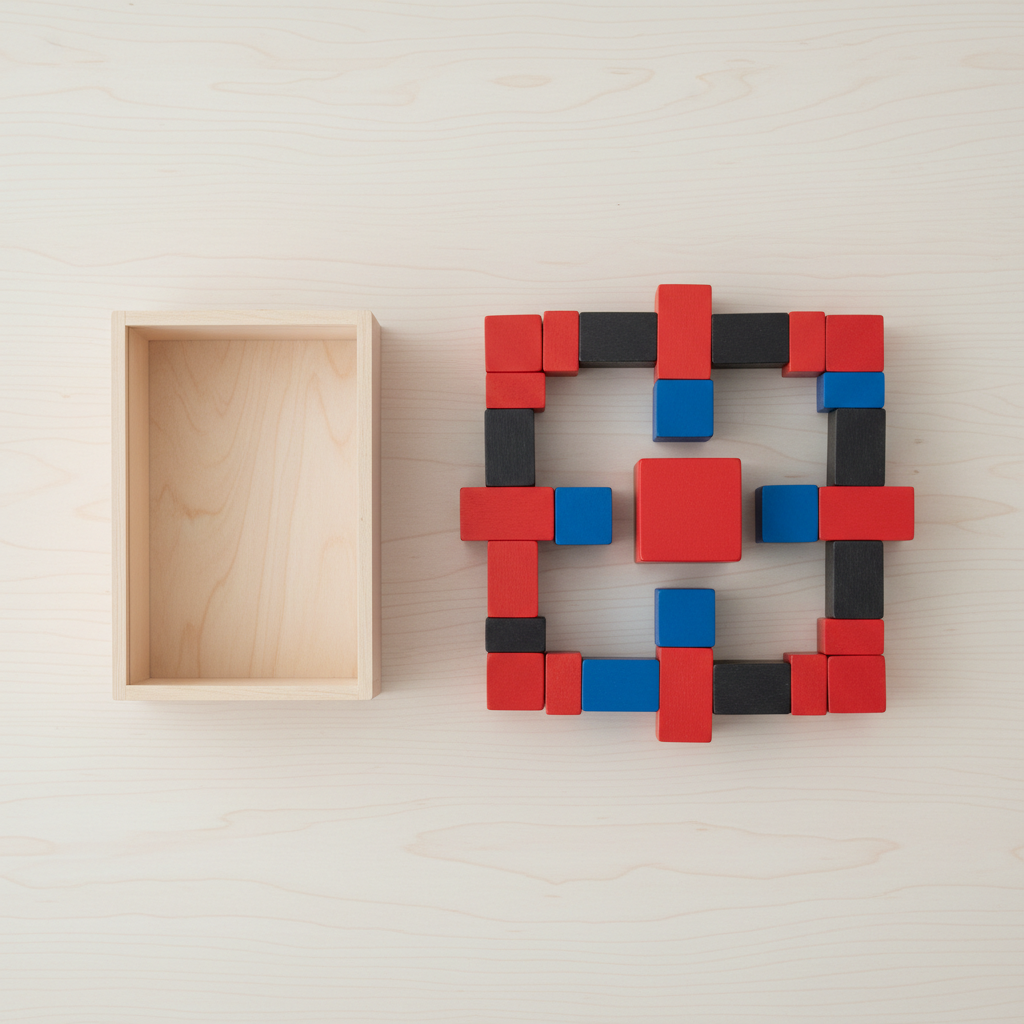
What Is the Binomial Cube?
The Binomial Cube is one of the most elegant materials in the Montessori sensorial curriculum. At first glance it looks like a colorful 3-D puzzle, but hidden inside its painted wooden box is a concrete representation of the algebraic formula (a + b)³. Children as young as three work with it — not to "do algebra," but to refine their visual discrimination of color, size, and pattern while building the sensorial foundation that makes abstract math feel familiar years later.
Where It Fits
The Binomial Cube sits in the sensorial area alongside the Pink Tower, Brown Stair, Knobless Cylinders, and Knobbed Cylinders. Like those materials, it isolates specific sensory qualities — here, color-coded volume relationships — so the child can internalize them through repetition.
Materials You'll Need
- Binomial Cube — a wooden box with a hinged lid whose top is painted with the color pattern that serves as the control of error. Inside are 8 wooden blocks: 1 red cube, 1 blue cube, 3 red-and-black prisms, and 3 blue-and-black prisms.
Elite Montessori Binomial Cube | Budget-friendly Binomial Cube - A small rug or mat for working on the floor
Presentation (Ages 3–4)
- Carry the box to the mat with both hands and place it with the lid facing up.
- Open the lid and tilt the box so the child can see the painted pattern on the inside of the lid — this is the "map."
- Remove the blocks one layer at a time, keeping each layer grouped on the mat in the order it came out.
- Rebuild the first layer inside the box by matching each block's painted faces to its neighbors and to the pattern on the lid.
- Rebuild the second layer on top of the first, again matching painted faces.
- Close the lid and invite the child: "Would you like to try?"
Control of error: The painted lid pattern and the color-coded faces make mistakes self-correcting — if a block is in the wrong spot, the colors won't match.
Extensions
- Build outside the box — once the child is confident, challenge them to assemble the cube on the mat without the box frame.
- Blindfold work — advanced children can try assembling by touch alone, refining their stereognostic sense.
- Connect to the Trinomial Cube — the natural next step, representing (a + b + c)³.
- Upper elementary algebra — around age 9–10, revisit the cube to show how each block corresponds to a term in the expansion: a³ + 3a²b + 3ab² + b³.
Why It Matters
Maria Montessori called the sensorial materials "materialized abstractions." The Binomial Cube is a perfect example: the child who has assembled it dozens of times between ages 3 and 6 already knows — in their hands — the spatial relationship that algebra will later name. When they encounter (a + b)³ in a textbook, it's a reunion, not a mystery.
Related Lessons
- The Pink Tower — visual discrimination of size in one dimension
- The Brown Stair — discrimination of width and weight
- Geometric Cabinet — shape discrimination and geometry readiness
- What Is Sensorial Education? — overview of the sensorial curriculum
- From Concrete to Abstract: How Montessori Math Works
- Counting Chains and the Bead Stair