Sorting Printouts
Published on: May 14, 2015
Sorting Printouts: Building the Foundation for Logical Thinking
Sorting is one of the most fundamental activities in a Montessori environment, and for good reason. When a child picks up an object, examines it, and decides where it belongs, they are doing far more than organizing items on a tray. They are building the neural pathways that will later support mathematics, reading, scientific reasoning, and everyday decision-making. Sorting printouts bring this powerful work into your home or classroom in a beautifully accessible way.
Why Sorting Matters in Montessori Education
Maria Montessori observed that young children have a natural drive to create order from the world around them. She called this the "sensitive period for order," and it typically occurs between the ages of one and three, though its effects ripple outward for years. When we offer sorting activities during this window, we are meeting the child exactly where their development calls them.
Sorting strengthens a child’s ability to observe, compare, and classify — skills that are deeply connected to practical life activities and later sensorial work. Every time a child groups red buttons together or separates large leaves from small ones, they are practicing discrimination, concentration, and independent thinking. These are the same cognitive muscles used when a child later works with the Pink Tower or explores math printouts.
Types of Sorting Activities
Sorting by Size
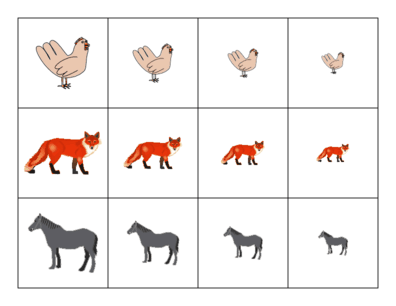
Size sorting invites the child to compare objects and arrange them according to dimension — big to small, tall to short, thick to thin. This type of work develops the child’s visual discrimination and lays the groundwork for understanding gradation, a concept central to Montessori sensorial materials like the Brown Stair. Our sorting sizes printouts and big and small activities are wonderful starting points for this work. Begin with just two sizes (big and small) before introducing a third medium option, allowing the child to build confidence gradually.
Sorting by Category
Category sorting asks the child to group objects by what they are — animals versus vehicles, fruits versus vegetables, land forms versus water forms. This work builds vocabulary, strengthens conceptual understanding, and nurtures the child’s ability to see relationships between objects. It also connects beautifully to cultural studies such as geography printouts and science topics. When a child sorts pictures of desert animals apart from ocean animals, they are doing both classification work and early geography.
Sorting by Attribute
Attribute sorting is perhaps the most nuanced type. Here, the child sorts by a single characteristic — color, shape, texture, or pattern — regardless of what the object actually is. A red apple, a red truck, and a red hat all belong together because they share the attribute of color. This type of sorting sharpens the child’s ability to isolate one quality from many, a skill that directly supports later work with color printouts and geometric exploration.
Tips for Presenting Sorting Work to Children
- Start simple. Begin with only two categories and a small number of items (six to eight total). Complexity can always be added later.
- Use a tray or sorting mat. A defined workspace helps the child focus. A set of wooden sorting trays creates clear visual boundaries for each group.
- Model slowly and silently. As with all Montessori presentations, show the child the activity with slow, deliberate movements. Let your hands do the teaching before offering words.
- Invite, don’t instruct. Say "Would you like to try?" rather than "Now you do it." The child should feel ownership over the work.
- Resist correcting. If a child places an item in the wrong group, observe. Often they will self-correct. If not, you can gently revisit the activity another day.
Extension Activities
- Multi-attribute sorting: Ask the child to sort by two qualities at once — for example, big red items and small blue items.
- Nature sorting: Collect leaves, stones, seeds, and shells from outdoors and invite the child to create their own categories.
- Sorting with counters: Use a set of counting and sorting bears to combine sorting with early math work such as counting and one-to-one correspondence.
- Verbal reasoning: After sorting, ask the child to explain why they grouped items together. This builds language and metacognition.
- Pattern creation: Invite the child to use sorted items to create patterns — red, blue, red, blue — bridging sorting into early algebraic thinking.
Sorting may look like simple play, but within each quiet moment of decision-making, your child is constructing their understanding of the world. Offer the materials, step back, and trust the process. The order they create on the outside reflects the beautiful order forming within.
Related Articles
- Lesson of the Day 48: Land & Water Forms — Montessori Geography for Young Explorers
- My child cries every day before going to school. What can I do?
- Lesson of the Day 33: Land and Water Forms — A Geography Adventure
🔎 Free Sorting Printouts
These free printable resources are perfect for hands-on sorting practice at home or in the classroom: