Lesson of the Day 92: The Trinomial Cube — From the Binomial Cube to a Deeper Sensorial Path Toward Algebra
Published on: June 02, 2026
Montessori Lesson of the Day #92 — Welcome back to our daily Montessori journey! Today we explore one of the most quietly profound materials in the Sensorial curriculum: the Trinomial Cube. If your child has already enjoyed building the Pink Tower and grading the Knobbed Cylinders, the Trinomial Cube is a natural and beautiful next step — a three-dimensional puzzle that, years later, will quietly reveal itself to be algebra.
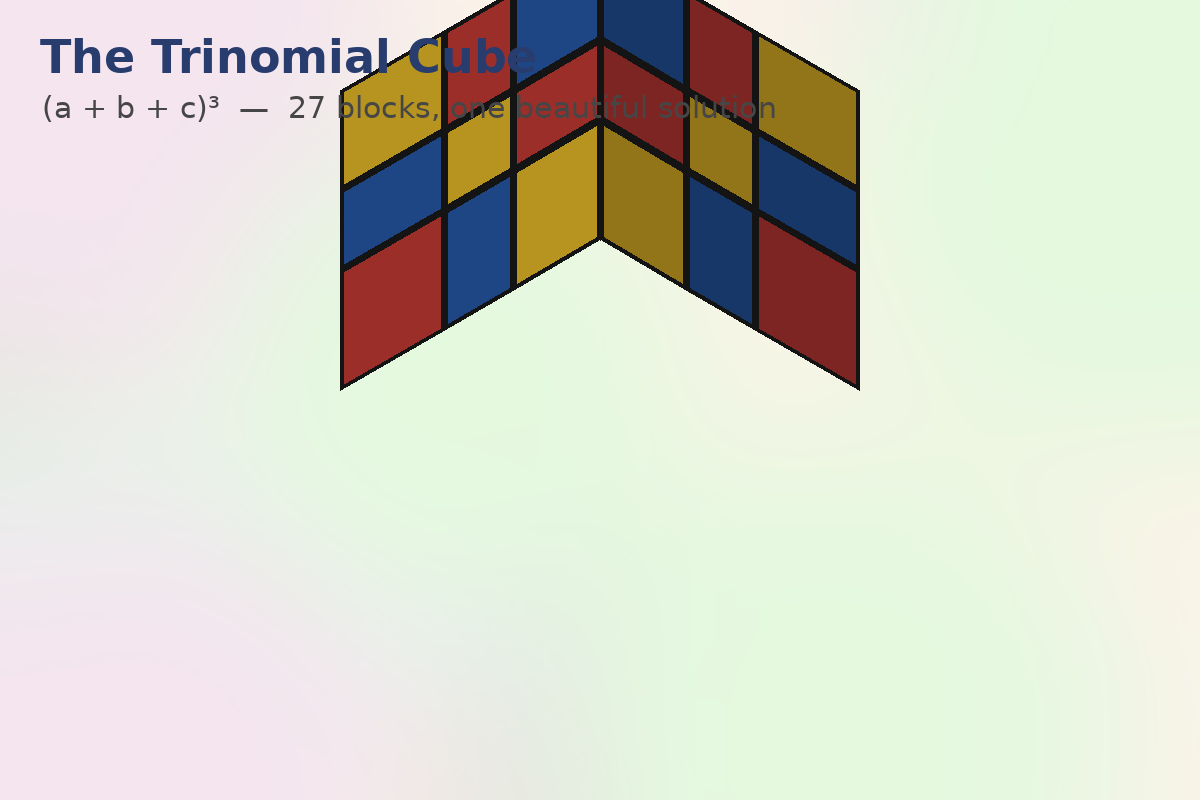
What Is the Trinomial Cube?
The Trinomial Cube is a wooden puzzle made up of 27 blocks that fit together inside a hinged box to form one large cube. The blocks come in a precise set of colors and sizes that, when assembled, represent the algebraic expansion of (a + b + c)³. But your child does not know that — and does not need to. To a three- or four-year-old, it is simply a satisfying, brightly colored puzzle that fits together in exactly one beautiful way.
The pieces include three cubes (one red, one blue, one yellow), and a series of rectangular prisms in red-and-black, blue-and-black, and yellow-and-black patterns. The colored faces act as a control of error: when the cube is built correctly, matching colors line up face to face, and the lid closes flush. The child does not need an adult to tell them they are "right" — the material itself confirms it.
How the Trinomial Cube Follows the Binomial Cube
The Trinomial Cube is the older sibling of the Binomial Cube. Where the Binomial Cube has 8 blocks representing (a + b)³, the Trinomial Cube has 27 blocks representing (a + b + c)³ — more pieces, more color relationships, and a greater demand on the child's developing powers of order and concentration. A child who has mastered the simpler puzzle is usually ready, and eager, for this richer one.
Ages
The Trinomial Cube is typically introduced between 4 and 6 years old, after the child has had success with the Binomial Cube. Some children meet it earlier if they show strong interest in puzzles and patterns; others come to it later. As always in Montessori, follow the child rather than the calendar. The readiness signs to watch for are sustained concentration, careful handling of small pieces, and pleasure in matching and ordering.
Purpose and Aims of the Trinomial Cube
Direct Aims
- Visual discrimination of color and dimension: the child learns to perceive and match subtle relationships between size and color across 27 pieces
- Development of logical, ordered thinking: the cube can only be built one way, so the child builds an internal sense of sequence and spatial relationship
- Refinement of concentration and fine motor control: assembling and disassembling the cube is long, absorbing work
Indirect Aims
- Preparation for mathematics and algebra: the child's hands learn the structure of (a + b + c)³ years before they will ever see the formula written down
- Preparation for order and classification: matching colored faces lays groundwork for sorting, patterning, and systematic thinking
- Development of independence: the built-in control of error lets the child work, check, and correct entirely on their own
How to Present the Trinomial Cube
Bring the cube to a table or mat and open the hinged lid. Slowly and deliberately remove the pieces, building them out beside the box in layers, so the child sees the structure as you take it apart. Then invite your child to rebuild it. Work in silence as much as possible — the material teaches, not the adult. If your child struggles, simply demonstrate one layer again rather than correcting piece by piece. Trust the control of error built into the colors and the closing lid.
What You Need
Authentic Montessori Trinomial Cubes are widely available. Two well-made options families like:
- Elite Montessori Trinomial Cube — a classic, sturdily finished set
- Adena Montessori Trinomial Cube — a popular, budget-friendly option
(These are affiliate links — if you buy through them, MontessoriMom may earn a small commission at no extra cost to you.)
What to Observe
As your child works, resist the urge to teach or correct. Instead, watch:
- How does your child approach the puzzle? Do they match by color, by size, or by trial and error?
- How long do they concentrate? Rebuilding 27 pieces is long, satisfying work — sustained focus is the real goal
- Do they repeat the work? Repetition is the hallmark of deep learning
- Do they self-correct? Watch them notice a mismatched color and quietly fix it — that is independence in action
A Brief Word from Maria Montessori
Montessori observed that the child absorbs structure long before they can name it. The hand that builds the Trinomial Cube is preparing the mind that will, years later, meet algebra without fear — because the relationships will already feel familiar. The material does not teach a formula; it lets the child live inside one.
Printable Trinomial Cube Guide
Want a one-page reference to keep beside the work mat? Download our free printable guide — it covers what the material is, the pieces, how to present it, and what it builds.
⬇️ Download the printable Trinomial Cube guide (PDF)
Summary and What Comes Next
Key takeaways from today's lesson:
- The Trinomial Cube is a 27-piece puzzle representing (a + b + c)³
- Matching colored faces provide a built-in control of error
- It follows naturally from the Binomial Cube and refines order, concentration, and fine motor control
- Its true gift is indirect preparation for mathematics and algebra, years in advance
What comes next in our Montessori Lesson of the Day series? After the sensorial puzzles, your child moves toward language and number work — including the playful Sound Game (I Spy) that builds the phonemic awareness behind reading, and color discrimination with the Color Tablets. You can always browse the whole series in the Lesson of the Day archive.
Happy teaching, Montessori families! 🌟