Lesson of the Day 42: Sound Cylinders — Montessori Listening and Music
Published on: April 27, 2026
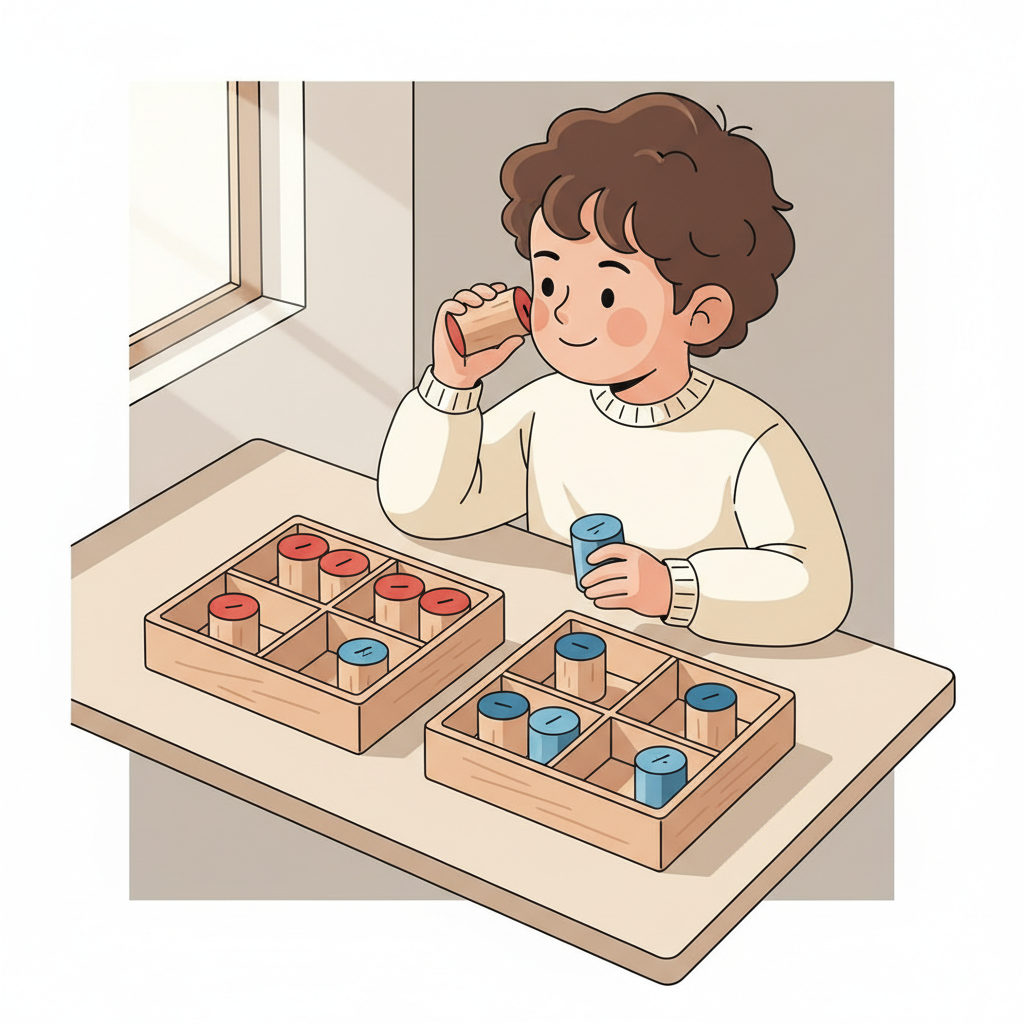
Exploring Sound: The Montessori Sound Cylinders
In the Montessori classroom, the Sound Cylinders (also called Sound Boxes) are a beloved sensorial material that isolates the sense of hearing. Children shake paired cylinders and match them by the sounds they make — from soft whispers to loud rattles. This deceptively simple exercise sharpens auditory discrimination, builds concentration, and lays groundwork for music appreciation.
Materials You'll Need
- Montessori Sound Cylinders — a set of 12 wooden cylinders (6 with red caps, 6 with blue caps), each pair filled with different materials to produce distinct sounds. LEADER JOY Montessori Sound Cylinders or Elite Montessori Sound Boxes are both solid choices.
- A quiet workspace — a rug or table away from background noise works best.
- Optional: a blindfold for older children ready for an extra challenge.
Age Range
3–6 years (with extensions for older children)
Presentation
- Introduce the material. Carry the two boxes (red-capped and blue-capped) to the table. Place them side by side.
- Demonstrate shaking. Pick up one red cylinder, hold it near your ear, and shake gently. Pause. Show interest on your face — let the child see you listening.
- Find its match. Pick up blue cylinders one at a time, shake each near your ear, and compare. When you find the matching sound, place the pair together to the side.
- Invite the child. "Would you like to try?" Let them work through the remaining pairs independently.
- Grading extension. Once matching is mastered, invite the child to arrange all six red cylinders from softest to loudest — a challenging exercise in fine auditory discrimination.
Control of Error
The matching pairs produce identical sounds. If a child's pair doesn't match, they hear the difference immediately — no adult correction needed. This self-correcting design is a hallmark of Montessori sensorial materials, just like the Pink Tower and Knobbed Cylinders.
Extending the Lesson: Montessori Bells
For children ready to move from sound discrimination to music-making, the Montessori Bells are the natural next step. A chromatic bell set lets children match tones, learn pitch names, and compose simple melodies. A budget-friendly alternative is a Rainbow Diatonic Desk Bell Set — perfect for home use.
DIY Sound Cylinders
No budget for the material? Make your own! Fill six pairs of identical opaque containers (film canisters, small jars with lids) with different materials: rice, dried beans, sand, small pebbles, salt, and cotton balls. Mark each pair with matching colored dots on the bottom for self-checking.
Connections Across the Curriculum
- Sensorial: Sound Cylinders sit alongside the Pink Tower, Brown Stair, Knobbed Cylinders, and Knobless Cylinders in the sensorial curriculum.
- Science: Discuss why different materials make different sounds — vibration, density, and volume. Older children can explore our Sea Glass and Tides lesson for more hands-on science.
- Language: Introduce vocabulary: loud, soft, high, low, pitch, tone, vibration. Connect to the Moveable Alphabet for writing sound words.
- Practical Life: Pouring and transferring materials to make DIY cylinders ties into Practical Life for Toddlers.
Tips for Parents
Work in a quiet room — dishwashers and TVs make matching harder! Start with just 3 pairs for younger children and add more as they gain confidence. And remember: this is the child's work. Resist the urge to correct — the material does that job beautifully.