Lesson of the Day 39: Sea Glass and Tides — A Beach Science Adventure
Published on: April 18, 2026
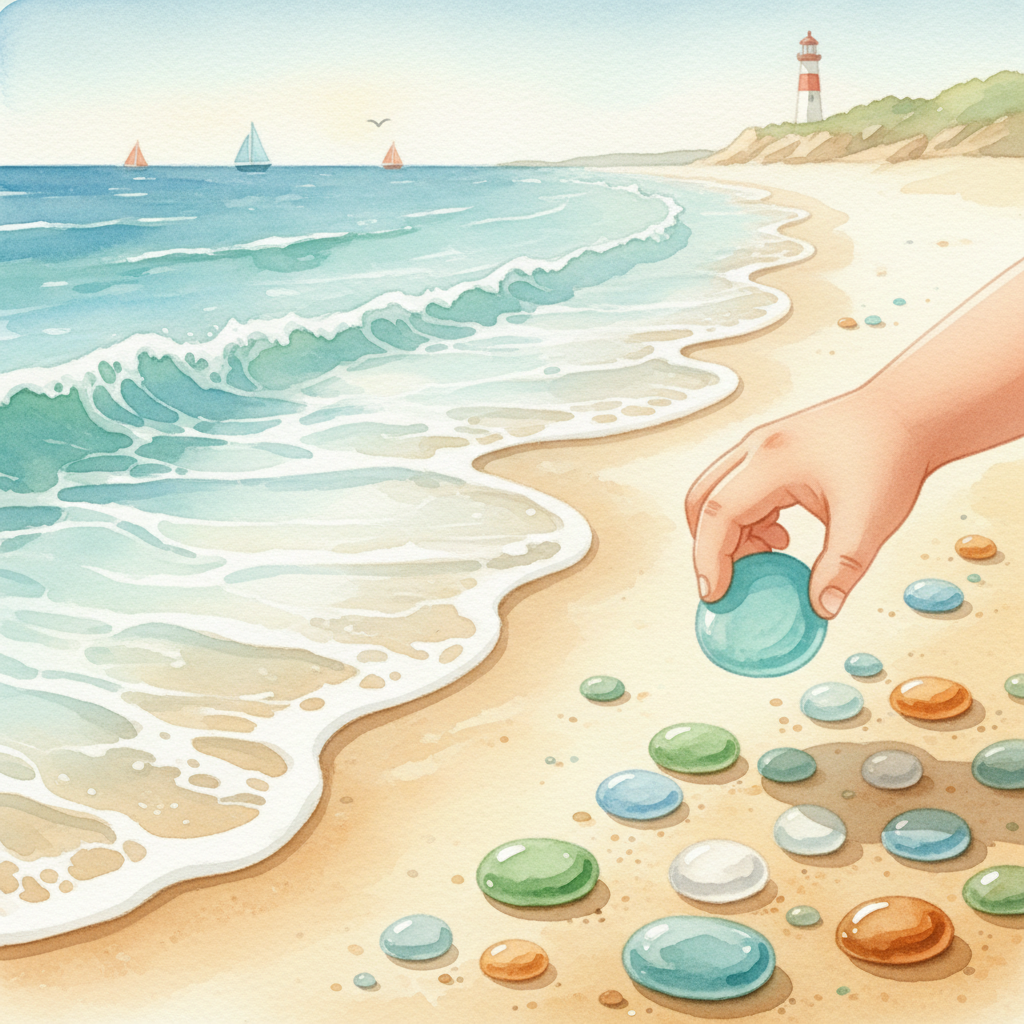
"The land is where we live, but the sea is where we dream."
Children are naturally drawn to the beach — the rhythm of the waves, the smooth treasures hidden in the sand, the mystery of where the water goes when the tide pulls back. In this lesson, we combine two beloved beach topics: sea glass (nature's own sensorial material) and tides (the moon's invisible hand on the ocean). Together, they offer a rich Montessori experience spanning sensorial exploration, science, geography, and art.
🎒 Materials You'll Need
- Sea glass pieces in assorted colors and sizes — collect your own at the beach, or use craft sea glass (Sea Glass for Crafts – Assorted Colors on Amazon)
- Ocean science kit for hands-on exploration (National Geographic Ocean Animal Dig Kit on Amazon)
- A shallow tray or felt mat for sorting
- Color tablets or paint chips for matching
- A globe or world map
- A large bowl of water, a small ball (for tide demonstration)
- Paper, watercolors, and glue for art extension
🔎 Free Printouts
Use these free printable resources to extend the lesson:
- 📄 Tides Printout — Learn about high tide and low tide
- 📄 Oceans of the World — Geography of Earth's five oceans
- 📄 Seashells Identification — Classify shells by type
- 📄 Seashells Activity Page
- 📄 Ocean Food Chain — Explore marine ecosystems
- 📄 Ocean Food Chain Answer Key
- 📄 Hermit Crab Nomenclature Cards — Identify and classify the parts of a hermit crab
🌊 Part 1: Sea Glass — Nature's Sensorial Treasure
What Is Sea Glass?
Sea glass begins as ordinary broken glass — a bottle, a jar, a window pane — that tumbles in the ocean for years, sometimes decades. The waves, sand, and salt water smooth its edges and frost its surface until it becomes something entirely new: a small, jewel-like treasure with no sharp edges at all.
This transformation is a wonderful lesson in itself. Nature takes something broken and, with patience and time, turns it into something beautiful. Children love this idea.
Activity 1: Sea Glass Sorting (Sensorial)
Spread a collection of sea glass pieces on a felt mat or tray. Invite the child to explore them freely first — feeling the smooth, frosted surfaces and holding them up to the light.
Then guide sorting activities:
- Sort by color: Group all the greens, blues, whites, and ambers together. Name the colors using Montessori three-period lessons ("This is sea-foam green. Show me sea-foam green. What color is this?")
- Sort by size: Arrange pieces from smallest to largest, just like grading with the Pink Tower or Brown Stair
- Sort by transparency: Which pieces let the most light through? Hold each one up to a window or flashlight
- Sort by texture: Some pieces are more frosted than others — can the child feel the difference with eyes closed?
Activity 2: Sea Glass Counting (Math)
Use sea glass pieces as beautiful, tactile counters:
- Place numeral cards (or sandpaper numerals) in a row and ask the child to place the correct number of sea glass pieces below each one
- Practice addition: "If you have 3 blue pieces and I give you 2 green pieces, how many do you have altogether?"
- Create patterns: blue, green, blue, green — what comes next?
Activity 3: Sea Glass Art (Creative Extension)
Provide paper, glue, and sea glass pieces. Children can create mosaics, mandalas, or pictures using the glass. A simple project: draw a fish outline and fill it in with sea glass pieces glued in place. Or arrange pieces on a piece of driftwood for a nature display.
🌙 Part 2: Tides — The Moon's Pull on the Ocean
What Causes Tides?
Tides are one of nature's most reliable rhythms. Twice each day, the ocean rises (high tide) and falls (low tide) along most coastlines. But why?
The answer is gravity — specifically, the moon's gravitational pull on Earth's water. The moon tugs on the ocean, creating a bulge of water on the side of Earth closest to the moon. There's also a bulge on the opposite side (caused by centrifugal force). As Earth rotates, different coastlines pass through these bulges, experiencing high and low tides.
The sun's gravity also affects tides, though less strongly. When the sun and moon align (during new and full moons), we get extra-high spring tides. When they're at right angles, we get gentler neap tides.
Activity 4: Tide Demonstration (Science)
Fill a large, shallow bowl with water. Place a small ball (representing the moon) near one edge. Gently tilt the bowl toward the "moon" to show how water is pulled toward it. This is a simplified model, but it helps children visualize the concept.
For older children: Use a globe and a flashlight (sun) plus a smaller ball (moon). Show how the moon orbits Earth and how the alignment of sun, moon, and Earth creates spring and neap tides.
Activity 5: Tide Pool Exploration (Nature Study)
If you live near the coast, a trip to a tide pool at low tide is an unforgettable experience. Children can observe:
- Sea anemones that open and close with the water
- Hermit crabs carrying their borrowed shells
- Starfish gripping rocks with tiny tube feet
- Seaweed in different colors and textures
If you're not near the coast, use books, videos, or the ocean printouts linked above to bring tide pools into your home classroom.
Activity 6: Tide Journal (Language & Science)
For children who can write, start a tide journal. If you visit the beach regularly, record:
- The date and time
- Whether it's high tide or low tide
- What the waterline looks like
- What creatures or treasures were found
This builds observation skills, scientific recording habits, and beautiful descriptive writing — all at once.
🧠 Montessori Connections
- Sensorial: Sea glass sorting by color, size, texture, and transparency connects directly to the Montessori sensorial curriculum
- Math: Counting, patterning, and grading with sea glass pieces
- Science: Understanding gravity, the moon's effect on Earth, and marine ecosystems
- Geography: Oceans of the world, coastlines, and tidal patterns
- Language: New vocabulary (tide, gravity, translucent, frosted, erosion), journaling, and descriptive writing
- Cosmic Education: The interconnectedness of moon, ocean, sand, glass, and living creatures — everything is connected
💡 Tips for Parents and Teachers
- Safety first: Use tumbled craft sea glass with smooth edges rather than freshly broken glass. Always supervise younger children around small pieces.
- Follow the child: Some children will be drawn to the sorting and science. Others will want to create art or tell stories about where each piece of sea glass came from. Both paths are valid.
- Extend over time: This isn't a one-day lesson. Revisit the sea glass collection regularly. Add new pieces. Track tides over a week or a month. Let the learning deepen naturally.
- Connect to real life: If possible, visit a beach and let the child find their own sea glass. The search itself — eyes scanning, bending down, selecting — is a Montessori exercise in concentration and purposeful movement.
The ocean has been tumbling glass and pulling tides long before we arrived to watch. When we invite children to notice these rhythms — to sort the colors, to wonder about the moon — we're helping them find their place in a vast, beautiful, interconnected world.