Lesson of the Day 108: Phonograms — Montessori's Bridge from Single Sounds to Reading Whole Words
Published on: August 13, 2026
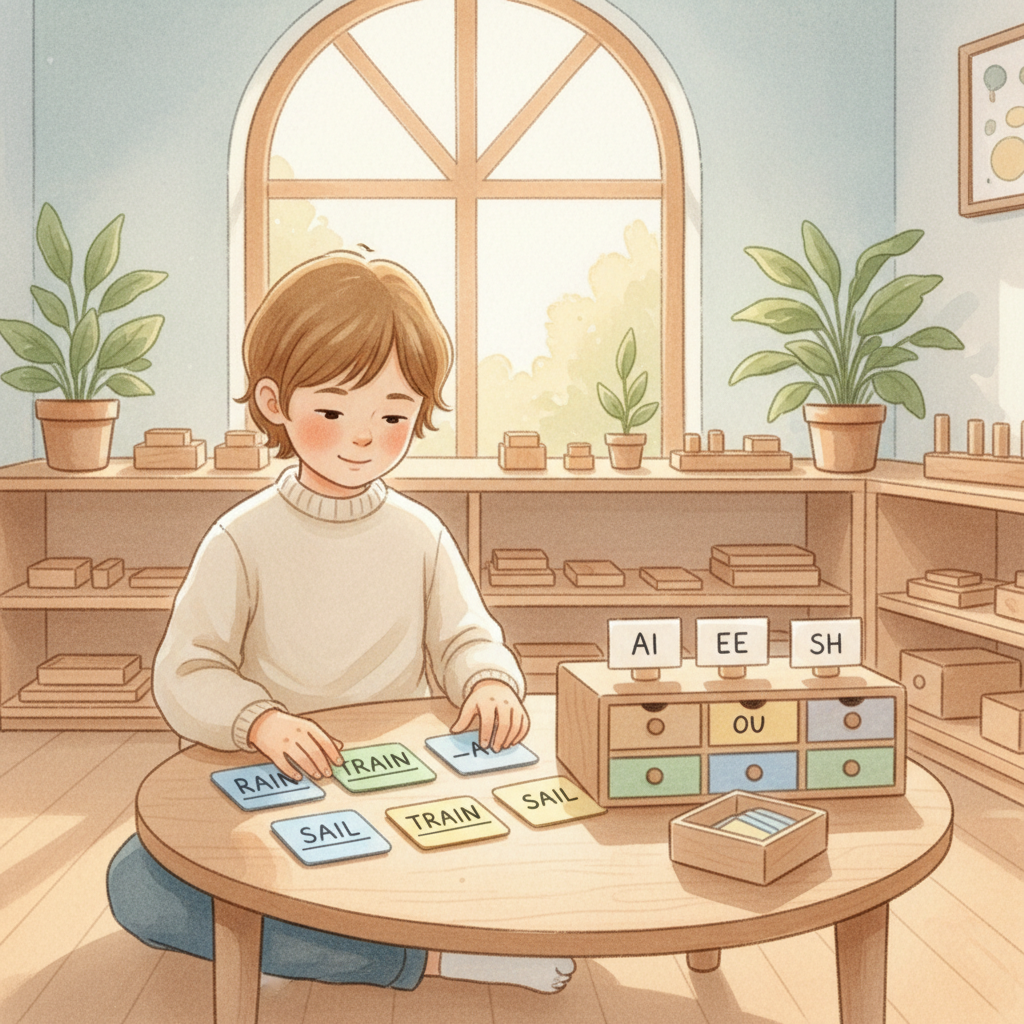
📄 Free printable: Green Reading Cards — Phonogram Word Set (PDF) — print, cut, and sort these phonogram words to give your child something real to build, read, and match once the single sounds are secure. (More sets: B and C.)
"The child who has the greatest sensitivity for language will, given the means, teach himself to read." — in the spirit of Maria Montessori
By the time a child has traced the Sandpaper Letters and built their first words with the Moveable Alphabet, a quiet discovery is waiting just around the corner: some sounds are not made by a single letter at all. The ai in rain, the oa in boat, the igh in night — these are phonograms, two or three letters that join to make one sound. Phonograms are the bridge from sounding out simple three-letter words to reading the rich, irregular language children actually meet in their favorite books.
🔤 What Are Phonograms?
A phonogram is a single sound spelled with more than one letter. Montessori classrooms introduce them after a child can comfortably read and build phonetic (one-sound-per-letter) words like cat, sun, and dog — the work your child practiced in the Sound Game (I Spy) and with the moveable alphabet. The phonograms unlock the next layer of English: sh, ch, th, ai, ee, oa, igh, ow, ou, ay, and their many friends.
The genius of the Montessori approach is that the child does not memorize rules. They meet each phonogram as a small, concrete object — a card, a sound, a word they can build with their own hands — and the pattern reveals itself through joyful repetition rather than drill.
🧺 The Materials
To explore phonograms at home, gather:
- A moveable alphabet, ideally one that includes the common phonograms printed on tiles or in a second color. This is the workhorse of word-building.
- A set of phonogram word cards — I print the Green Reading Cards and keep each phonogram family in its own little envelope.
- A small basket or tray to hold the day's words and define the workspace.
- Picture cards or small objects that match the words, so reading lands on something real.
If you'd rather buy than make, a sturdy wooden moveable alphabet gives your child a complete, correctly-colored set for building phonogram words, and a set of phonogram and vowel reading cards rounds out the matching and sorting work beautifully.
✨ How to Present the Lesson
Introduce just one phonogram at a time — never the whole set at once. Sit beside your child, move slowly, and let the words do the teaching.
- Choose a single phonogram — start with a clear one like sh. Show the two letters together and give the sound: "These two letters make one sound: /sh/."
- Build a familiar word with the moveable alphabet — ship, fish, shell — saying each sound as you place the letters, treating sh as one piece.
- Invite your child to build the next word. Guide gently; the goal is the discovery, not perfection.
- Read a small stack of word cards together for that phonogram, matching each to a picture or object.
- Let your child sort, build, and re-read as long as the interest holds. Repetition is the lesson — resist the urge to add a second phonogram too soon.
Keep early sessions short and warm. One phonogram, deeply explored, beats a dozen rushed through.
🌱 Extensions and What Comes Next
As your child collects phonograms, let them hunt for the patterns in their favorite picture books — a "phonogram scavenger hunt" turns every story into reading practice. Pair this work with the Sandpaper Letters for any single sounds still settling, and keep a running word wall of each new phonogram family. When several phonograms are secure, your child is ready for longer, more irregular words and the genuine independence of reading for meaning.
You'll find this and every other free phonogram and reading printable on our Free Printouts & Downloads page — print a fresh set whenever a new phonogram captures your child's imagination.
Happy reading,
Hente