Lesson of the Day 107: The Sandpaper Numerals — Montessori's Tactile Bridge from Counting to Writing the Symbols 0–9
Published on: June 22, 2026
📄 Free printable: Small Number Cards 0–9 (PDF) — print, cut, and pair these with your sandpaper numerals for matching, ordering, and the association of symbol to quantity.
"What the hand does, the mind remembers." — a saying close to the heart of Maria Montessori's method
There is a particular kind of pride that lights up a child's face the first time they trace a numeral and announce its name without being told. The Montessori Sandpaper Numerals are built to summon exactly that moment. They take the abstract, slippery idea of a written symbol — the shape we call "three," the curl we call "two" — and make it something the fingers can feel, follow, and remember. Long before a child can hold a pencil with control, they can run two fingertips along a rough numeral and lay down the muscle memory of how it is formed.
This lesson is the numeral twin of an old favorite — the Sandpaper Letters, which prepare the hand for writing words. Where those teach the symbols of language, the Sandpaper Numerals teach the symbols of mathematics. They sit naturally alongside the quantity work your child may already know: the Number Rods, the Spindle Boxes, and Cards and Counters. Together, quantity and symbol meet — and counting quietly becomes arithmetic.
🔢 What Are the Sandpaper Numerals?
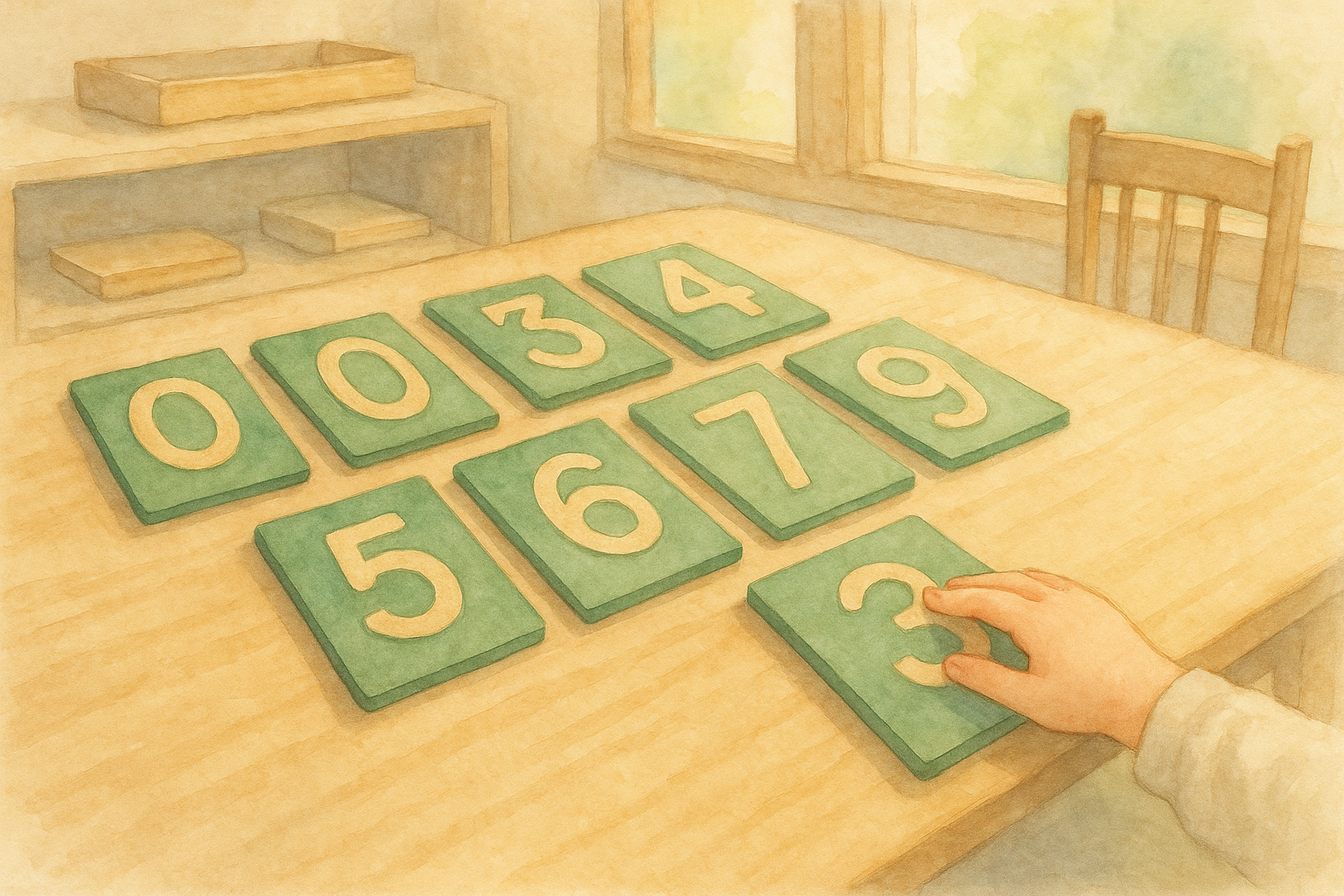
The Sandpaper Numerals are a set of smooth boards, traditionally green, each bearing a single numeral from 0 to 9 cut from rough sandpaper. The contrast is the whole point: the numeral is rough, the board around it is smooth, so a child's fingers know instantly where the symbol begins and ends. By tracing the numeral in the same direction it is written — top to bottom, the way a pencil would travel — the child absorbs not just what the numeral looks like but how it is made.
This is Montessori's genius for the indirect preparation of writing: the hand rehearses the motion of forming each figure years, sometimes, before the formal demand of "writing your numbers" ever arrives. When it does arrive, the path is already worn smooth.
🧺 The Materials
To work with the Sandpaper Numerals at home, you'll want:
- A set of ten sandpaper numeral boards, 0 through 9. You can buy a ready-made set or make your own by cutting numerals from fine sandpaper and gluing them to stiff card or thin board.
- A small basket or tray to hold the numerals and define the workspace.
- A matching set of number cards or counters for the association stage — I like to print the Small Number Cards and keep them in a little envelope.
- Good light, falling across the board, so the rough numeral catches a faint shadow and is easy to see.
If you'd rather buy than make, a Montessori sandpaper numerals and counting cards set gives you durable boards with the numerals already correctly proportioned, and a set of number cards and counters rounds out the symbol-to-quantity work beautifully.
✨ How to Present the Lesson
Present just two or three numerals at a time — never the whole set at once. Sit beside your child on their dominant side so every motion is easy to copy. Move slowly and say little; your tracing fingers do most of the teaching.
- Invite your child: "Would you like me to show you the number symbols?" Carry the basket together to a table or mat.
- Take one numeral — start with a simple one like 1. Trace it with the first two fingers of your writing hand, following the exact path a pencil would take. Then say its name clearly: "One."
- Trace it a second time, repeating the name. Invite your child: "Now you trace it." Guide their fingers gently if needed, always in the writing direction.
- Repeat with a second, contrasting numeral — say 5. Trace, name, and invite.
- Let your child trace freely, as many times as they like. The repetition is the lesson — resist the urge to rush ahead.
Keep the early sessions short and warm. Two numerals, joyfully traced, beat all ten hurried through.
🗣️ The Three-Period Lesson
The classic three-period lesson turns tracing into knowing:
- Naming: Trace and name. "This is three." Then another: "This is seven." One numeral, one word, unhurried.
- Recognizing: "Can you find three? Can you trace seven?" This is where children happily linger, choosing and tracing.
- Recalling: Offer a numeral and ask, "What is this one?" Only move here once recognition is secure — and if it isn't, simply drop back a step without comment.
🔗 Associating Symbol and Quantity
The real magic happens when the written symbol meets a real amount. Once your child can name a few numerals, bring out counters, beads, or small objects. Trace the numeral 4, name it, then count out four counters beneath it. Suddenly the abstract figure has weight and meaning — it stands for something. Pairing the Sandpaper Numerals with the Cards and Counters work is one of the most satisfying bridges in the whole math sequence, and it quietly introduces the ideas of odd and even along the way.
🔍 Control of Error
The control of error lives in the texture itself. If a child's finger strays off the numeral, it meets smooth board and the fingertip knows at once — gently steering back onto the rough path without a word from you. The sandpaper is the teacher; the child self-corrects, building independence and confidence with every trace. Your job is simply to model the motion once and then step back.
🌱 Extensions and Variations
- Trace and write. After tracing a numeral on the board, have your child reproduce it with a finger in a tray of fine sand or salt — a delightful, low-stakes step toward pencil and paper.
- Order them. Once several numerals are known, lay them in a line 0–9 and let your child arrange or "fix" a scrambled sequence.
- Match to quantity. Pair each numeral with the matching number card or a counted set of objects.
- Blindfold the work. An older child often loves tracing a numeral with eyes closed and naming it by feel alone — a charming test of how deeply the shape has been learned.
- Take it to the kitchen and the curb. Hunt for numerals on house numbers, clocks, and recipe cards. The symbols are everywhere once a child can read them.
📅 The Right Age
The Sandpaper Numerals suit children roughly three to six years old, and they work best once a child already enjoys counting real objects — the quantity work of the Number Rods and Spindle Boxes makes fertile ground. As always, follow your child: present a few numerals, watch their interest, and let the rough little symbols do their patient work. You can find this and the rest of the series among our free Montessori printouts.
Of all the early math materials, this is the one that turns an abstract mark into something a child can carry in their fingertips. Long before they write their first sum, they'll have traced its symbols a hundred happy times — and the hand, as Montessori knew, never forgets.