Lesson of the Day 104: The Number Rods — Montessori's Hands-On Bridge from Length to Counting 1–10
Published on: June 17, 2026
"The first idea the child must acquire is that of the difference between one thing and another." — Maria Montessori, The Montessori Method
If your child has already fallen in love with the Red Rods — building that long, satisfying stair from shortest to longest — then the Number Rods will feel like meeting an old friend who has learned to count. The two materials look like cousins, and that is entirely on purpose. Where the Red Rods quietly train the eye and hand to perceive length, the Number Rods take that same sensorial groundwork and attach it to something new: the names and quantities of the numbers one through ten.
This is one of the very first materials a Montessori child meets in mathematics, and it is a beautiful bridge. The child does not begin math with abstract symbols on a worksheet. They begin by holding quantity in their hands — feeling that "four" is genuinely longer and heavier than "two." That embodied understanding is the quiet secret behind why Montessori math feels so unhurried and so deep.
🔢 What Are the Number Rods?
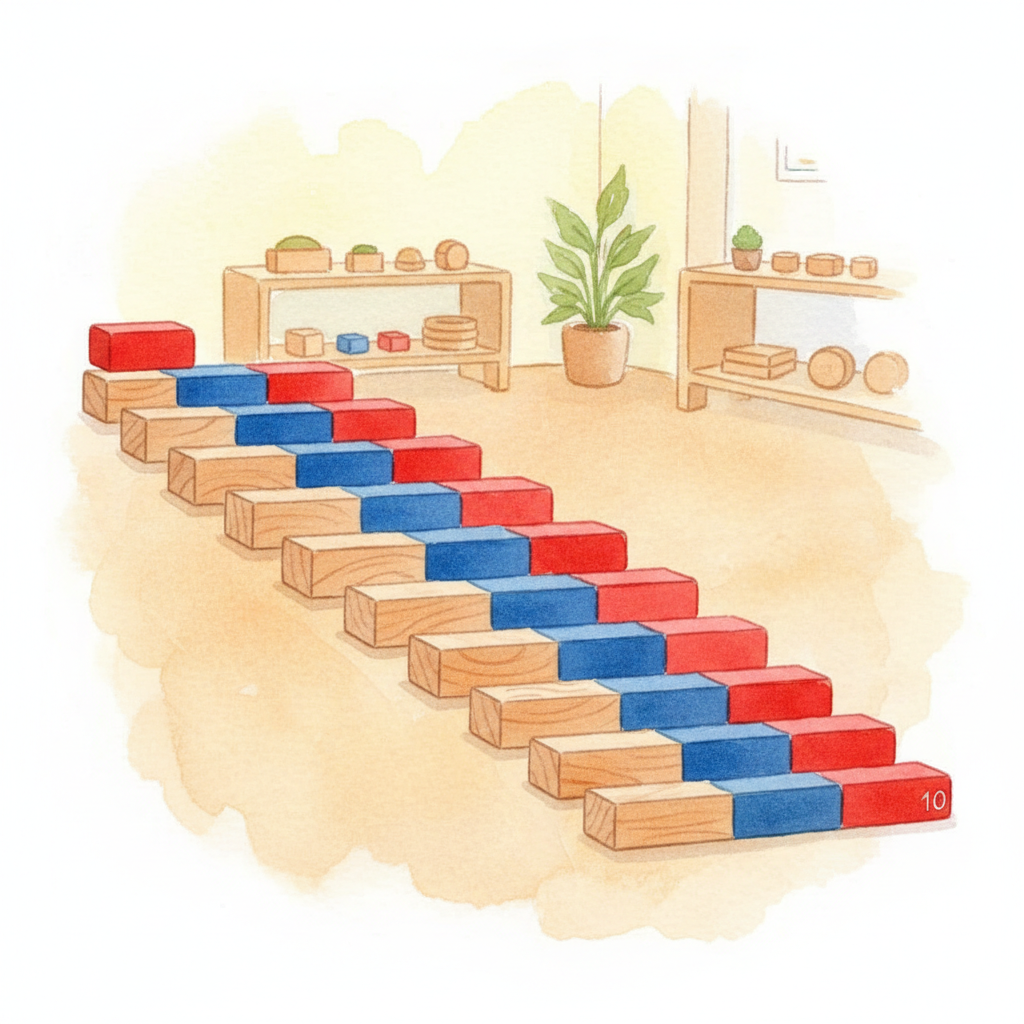
The Number Rods are a set of ten wooden rods that grow in even steps. The shortest rod is one unit long; the longest is ten units long, made of ten equal segments. Each rod is divided into alternating red and blue sections of equal length, so the very first rod is a single red segment, the second is one red and one blue, the third is red-blue-red, and so on up to ten.
Those alternating colors are doing important work: they let the child see and count the individual units that make up each rod. A child can run a finger along rod "five" and count "one, two, three, four, five" as the colors change. The rod is, quite literally, the number five made visible and touchable.
🧺 The Materials
To present this lesson at home, you'll want:
- A set of ten Number Rods with alternating red and blue segments.
- A set of number cards or numerals 1–10 for the later naming stage (you can also use the numerals from your Cards and Counters work).
- A floor mat to define the workspace and give the long rods room to stretch out.
If you'd like a ready-made set, this wooden Montessori Number Rods set is sized nicely for little hands and built to last. For families who want the matching numeral cards to go with it, these Montessori sandpaper and numeral cards pair beautifully with the rods for the naming stage.
Prefer to make your own first? You can print and assemble a set with our free printables:
- Number Rods printout (PDF) — print, color the alternating segments, and mount on card.
- Number Rods control chart / key (PDF) — a quick reference for self-checking.
✨ How to Present the Lesson
As always in Montessori, move slowly, speak little, and let your hands lead. Sit beside your child on their dominant side so they can see each gesture clearly.
- Carry the rods to the mat one at a time, holding each with two hands to feel its length and weight. Lay them out in random order.
- Build the stair together, just as with the Red Rods: find the shortest rod, then the next, aligning them at the left so the steps grow evenly.
- Choose the rod of one. Touch it and say clearly, "One." Then the rod of two: touch each segment — "one, two" — and say, "This is two." Continue through three.
- Introduce only three numbers at a time using the Three Period Lesson: name them ("This is one… this is two… this is three"), ask for them ("Show me two"), then test ("What is this?").
- Over several days, work your way up to ten — never rushing, always letting your child count the segments themselves.
Once the quantities are secure, you can introduce the written numerals, laying the matching number card beside each rod. This is the moment the child connects quantity (the rod) to its symbol (the numeral) — a quiet, powerful milestone.
🔁 Control of Error
The control of error lives in the rods themselves. When the stair is built correctly, the steps rise in perfectly even increments, and the alternating segments line up in neat columns. If a rod is out of place, the eye catches the broken pattern at once — no adult correction needed. When counting segments, the child can always re-count to check that rod "six" truly has six units. The material tells the truth, gently, every time.
🌿 Extensions and Variations
- Number Rods and numerals: Match printed numerals 1–10 to each rod, building the bridge from quantity to symbol.
- Early addition: Lay the rod of one beside the rod of nine and discover that together they make the same length as the rod of ten — the first whisper of "1 + 9 = 10."
- Toward the decimal system: When your child is ready for larger quantities, the same hands-on logic continues with the Golden Beads.
- Counting companions: Pair this work with the Spindle Boxes and Cards and Counters to deepen the idea that each number names a specific, countable quantity.
🏠 Bringing It Home
You don't need a classroom full of materials to nurture a love of number. Count the stairs as you climb them together, line up four crackers and count them before snack, or notice "two shoes, two socks" while getting dressed. The Number Rods simply give a clear, beautiful structure to the counting your child is already itching to do.
What I love most about this material is how honest it is. There is no trick, no memorized chant — just quantity made visible, held in two small hands. When your child finally looks up and says "this is ten" with quiet certainty, you'll see the very foundation of mathematics settle into place. For a fuller look at the material, you can always revisit our Number Rods activity page.
Lay out the rods, slow down, and count alongside your child. The math will take care of itself.