Lesson of the Day 99: Cards and Counters
Published on: June 09, 2026
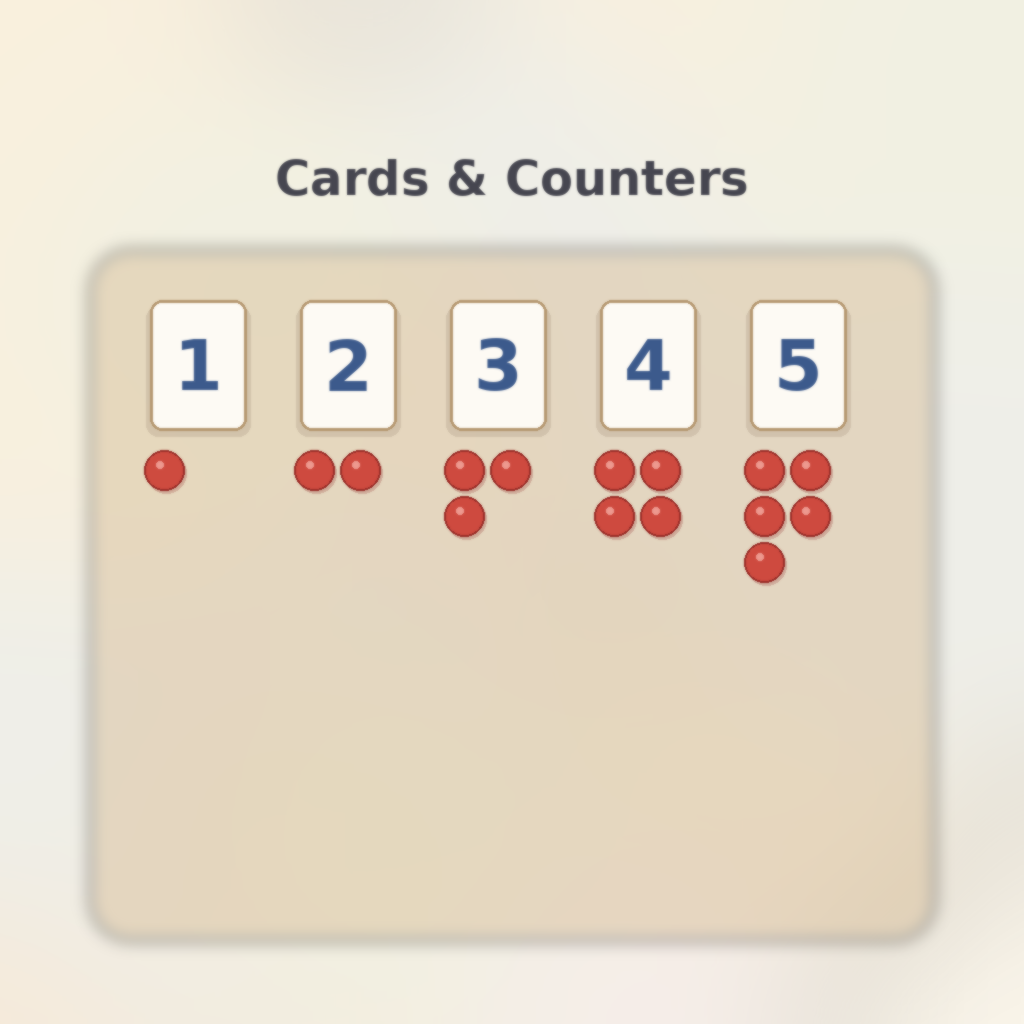
Have you ever watched a child carefully line up two rows of pebbles, or insist on splitting a snack "fair and square" between siblings? That instinct to pair, match, and divide is exactly the impulse we tap into with Cards and Counters. It's one of my favorite math materials because it looks so simple — just little number cards and a handful of red discs — and yet it accomplishes something quite remarkable. In one quiet, beautiful work, a child cements the connection between a written numeral and the quantity it represents, and stumbles upon the secret of odd and even numbers all on their own.
If you've been following along, this lesson sits right after the Spindle Boxes in the math sequence. The Spindle Boxes asked the child to gather a loose quantity into a single hand; now we slow things down and ask for precision, order, and a discovery hidden in the arrangement itself.
Ages
Cards and Counters is typically presented to children around 4 to 5 years old, once they can reliably recognize and name the numerals 1 through 10 and have had experience counting concrete quantities. This is not a first counting lesson — it's a consolidating one. Before this work, your child should be comfortable with the Sandpaper Numbers (recognizing the symbols by sight and touch) and with counting a quantity carefully, as they practiced with the spindles.
The Material
The material is wonderfully minimal:
- A set of printed number cards showing the numerals 1 through 10, one numeral per card. A ready-made wooden set bundles the cards and 55 counters together:
- A collection of 55 identical counters — usually small red discs or buttons. (Why 55? Because 1+2+3+4+5+6+7+8+9+10 = 55 — exactly the right number to lay out every quantity with none left over.)
- A small basket, tray, or box to hold the counters, plus a workspace — a table or a floor mat with plenty of room.
That's it. The counters are deliberately uniform in color and size so that nothing distracts from the one thing we're isolating: quantity.
🔎 Free Printouts
Don't have a wooden set yet? You can begin today with my free printable number cards — print them on cardstock, cut them apart, and pair them with any small counters you have on hand (dried beans, buttons, or coins all work beautifully):
Purpose and Aims
The direct aim is to firmly associate each numeral with its corresponding quantity, reinforcing the sequence of numbers 1 through 10 and the concept that each number is "one more" than the last.
The indirect aims are where the magic lives:
- Discovering the concept of odd and even numbers through the visual arrangement of the counters — without a single rule being memorized.
- Refining one-to-one correspondence and careful counting.
- Preparing the mathematical mind for later concepts like division, multiples, and pairing.
- Reinforcing left-to-right ordering, a foundation for both math and reading.
Presentation
Sit beside your child, on their dominant-hand side, so they can see your hands clearly. Move slowly and speak little — let the work do the talking.
- Bring the material to the workspace. Carry the cards and the counters to the table or mat, naming the work: "This is Cards and Counters."
- Lay out the cards in order. Place the numeral cards across the top of your workspace, left to right, from 1 to 10. Invite your child to help read each one as you go. This is a lovely quick review of the numerals they already know.
- Begin with 1. Take a single counter and place it neatly beneath the card marked "1," centered under the numeral.
- Move to 2. Count out two counters. Here is the key: place them side by side in a pair, in two columns. Count aloud as you place each one — "one, two."
- Continue with the pattern. For each number, place the counters in two vertical columns, working from the top down. For 3, place a pair and then one counter alone below. For 4, two pairs. For 5, two pairs and a single counter at the bottom. Continue this way all the way through 10.
- Count carefully. Touch and count each counter as you set it down. The deliberate rhythm matters — it models the care you want your child to bring to the work.
- Pause and observe. When all ten quantities are laid out, sit back with your child and simply look. Run your finger down the bottom of each column. Some numbers have a counter standing "alone" at the bottom; others have all their counters neatly paired with a partner.
- Name the discovery (later). On a return presentation, you can introduce the language: numbers whose counters all have a partner are even; numbers with a lonely counter at the bottom are odd. You might run a finger down the middle of an even number — it slides straight through — but it bumps into the solitary counter of an odd one.
- Invite the child. Mix up the counters, return the cards, and offer the work: "Would you like a turn?"
Resist the urge to rush to the vocabulary of odd and even. The first few times, the goal is simply the matching and the careful counting. The pattern reveals itself; your child's "Look — this one has an extra!" is far more powerful than anything you could announce.
Control of Error
The beauty of this material is that it is largely self-correcting. Because there are exactly 55 counters, if a child miscounts somewhere along the line, they'll either run out before finishing 10 or have counters left over at the end. The arrangement itself offers feedback too: a child who knows the layout will notice when the columns don't look right. As always, let the material — not your voice — point out the mistake. A gentle "Shall we count this one again together?" preserves the child's concentration and dignity.
Points of Interest
Children are drawn to the tidy geometry of the two columns, and to the satisfying click of placing each counter in its spot. The real point of fascination, though, is that "lonely" counter at the bottom of the odd numbers. Many children delight in discovering which numbers have a partner for everyone and which leave someone standing alone. The red of the counters against the workspace, and the orderly march of quantities growing one at a time, give the work a quiet visual rhythm that invites repetition.
Extensions
- Odd and even sorting: Once the language is established, offer the cards and ask your child to sort them into two groups — odd and even — laying out the counters to check their thinking.
- Memory game: Place the cards face down. The child draws one, reads it, fetches the matching quantity of counters from across the room, and arranges them. Carrying the number "in the mind" while crossing the room is wonderful for memory and concentration.
- Mixed cards: Shuffle the numeral cards and have the child put them back in order before laying out the counters — a nice review of sequence.
- Real-world hunts: Look for odd and even out in life — pairs of socks, an odd shoe, even rows of windows. Children love spotting the concept once it's theirs.
A Note for the Parent
What I love about Cards and Counters is how unassuming it is. There's no flashy apparatus, no elaborate setup — just a child, some discs, and an idea that has been quietly waiting to be discovered. Trust the simplicity. Your job is to present clearly, then step back and let your child make the discovery their own. That moment of "Oh! This number doesn't have a partner!" is the whole point — and it belongs to them.
Related Montessori Lessons
- Spindle Boxes — the prior counting lesson, where children gather loose quantities and meet zero for the first time.
- Sandpaper Numbers — learning the numeral symbols by sight and touch, an essential foundation before this work.
- Golden Beads — the next great step, opening the door to the decimal system and numbers beyond ten.