Lesson of the Day 94: Sandpaper Numbers — Teaching Numerals Through Touch
Published on: May 25, 2026
There's a moment in every young child's mathematical journey that is nothing short of magical — the moment when a squiggly line on a page stops being just a shape and becomes a number. The moment when a child looks at the symbol "3" and knows, deep in their bones, that it means three — that it stands for the quantity they've held in their hands, counted on the rods, felt in their fingers. In the Montessori classroom, that moment doesn't happen through flashcards or rote drilling. It happens through touch. It happens through the Sandpaper Numbers.
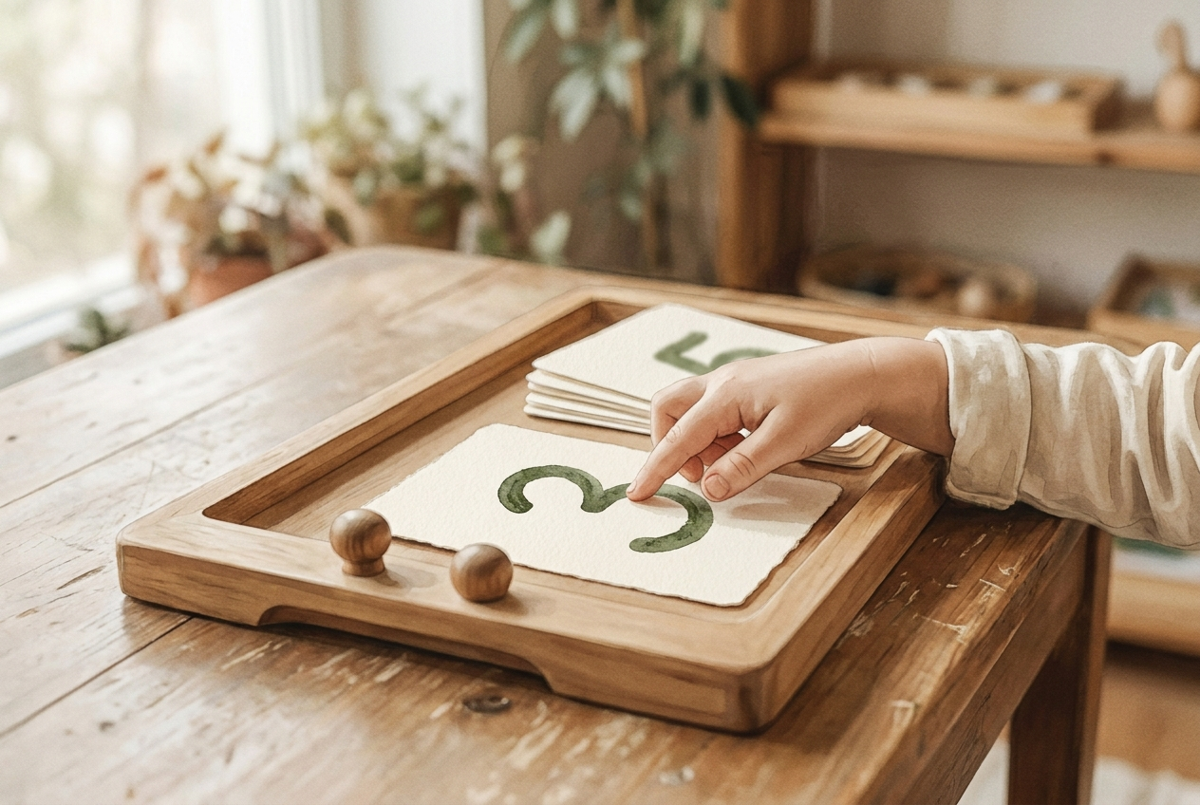
In Lesson of the Day #94, we turn our attention to one of the most beautiful and essential materials in the Montessori math curriculum: the Sandpaper Numbers, also known as Sandpaper Numerals. If you've been following this series and have explored the Number Rods, Spindle Boxes, or Cards and Counters, you already know that Montessori mathematics is built in careful, deliberate steps — each material preparing the child for the next. The Sandpaper Numbers occupy a pivotal place in that sequence. They are the bridge between the child's concrete experience of quantity and the abstract world of symbols. And if you've ever watched your child trace the Sandpaper Letters, you already have a sense of just how powerful this simple, tactile approach can be.
Whether you're a Montessori teacher deepening your understanding, a homeschooling parent preparing to introduce numerals for the first time, or a curious mom or dad who wants to understand what your child is doing at school, this guide will walk you through everything — the what, the why, the how, and the many beautiful extensions that grow from this one humble material.
What Are the Sandpaper Numbers?
The Sandpaper Numbers are a set of ten smooth wooden boards, each with a single numeral — 0 through 9 — cut from fine-grained sandpaper and affixed to the surface. The boards are typically painted a soft green (though you'll occasionally see them on natural wood or other colors), and the sandpaper numerals are rough to the touch, standing out clearly against the smooth background. Each board is small enough for a child to hold comfortably, usually about 6 by 4 inches.
That's it. Ten boards. Ten numerals. No bells, no batteries, no screens. And yet within this deceptively simple material lies a profoundly effective learning tool that engages the child's visual sense, tactile sense, muscular memory, and auditory sense all at once.
The child traces the numeral with their fingertips — typically the index and middle fingers of their dominant hand — while saying the numeral's name aloud. This multi-sensory approach means the child is not merely looking at a number. They are feeling its shape, hearing its name, and training their hand in the exact movement they will later use to write it. The rough texture of the sandpaper provides immediate tactile feedback: the child knows instantly if their fingers have strayed off the numeral's path, because the smooth wood feels distinctly different from the gritty sandpaper. No adult correction needed. The material itself guides the child.
Why Sandpaper? The Genius of Tactile Learning
Maria Montessori understood something that modern neuroscience has since confirmed: the hand is one of the primary instruments of the intellect. When a child traces a shape with their fingers, they are not just learning what it looks like — they are encoding its form into their muscular memory. This is why a person who has learned to ride a bicycle never truly forgets how, even decades later. The body remembers what the conscious mind may not.
By tracing the Sandpaper Numbers, the child builds a kinesthetic memory of each numeral's shape. Later, when they pick up a pencil to write the number "5" for the first time, their hand already knows the movement. The pencil follows a path the fingers have traced dozens — perhaps hundreds — of times before. Writing becomes not a struggle to remember an abstract shape, but a natural expression of something the body has already internalized.
This is the same principle at work in the Sandpaper Letters, where children trace letter shapes before writing them. The Sandpaper Numbers and Sandpaper Letters are, in many ways, siblings — parallel materials serving parallel purposes in language and math. And in a beautifully integrated Montessori classroom, a child might be working with both around the same age, building literacy and numeracy through the same tactile pathway.
Where Do the Sandpaper Numbers Fit in the Montessori Math Sequence?
This is one of the most important things to understand about this material — and, indeed, about Montessori math in general. The Sandpaper Numbers do not appear in isolation. They are one step in a carefully designed sequence, and understanding that sequence helps you understand why each material works the way it does.
Here is the foundational progression for early Montessori mathematics:
- Number Rods — The child learns to associate quantities (1 through 10) with their names. The rods are concrete, physical objects that the child can see, hold, and compare. At this stage, there are no written symbols at all — only quantities and spoken words.
- Sandpaper Numbers — The child learns the written symbols (0 through 9) and their names. Now the child is connecting a visual/tactile symbol to a name they already know.
- Number Rods + Sandpaper Numbers combined — The child matches the written symbol to the quantity, placing the correct Sandpaper Number card beside the corresponding rod. This is the critical moment of association — quantity, symbol, and name all come together.
- Spindle Boxes — The child practices associating symbols with quantities using loose objects (spindles), reinforcing the concept and introducing the idea of zero as "none."
- Cards and Counters — Further practice with symbol-quantity association, plus an introduction to odd and even numbers.
- Golden Beads — The child enters the decimal system, working with units, tens, hundreds, and thousands.
- Seguin Boards — The child learns the teen numbers and tens (11–99).
Notice the beautiful logic of this progression. The child first understands what a number is (a quantity). Then they learn how it is written (a symbol). Then they connect the two. Only when that connection is secure do they move on to more complex work. The Sandpaper Numbers are the essential second step — the point at which abstract symbols enter the child's world, but in the most concrete, touchable way possible.
Prerequisites: When Is a Child Ready?
The Sandpaper Numbers are typically introduced around age 3½ to 5, but as always in Montessori, age is only a rough guide. Readiness matters more than a birthday. Here are the signs that a child is ready for this material:
- Familiarity with quantities 1–10. The child should have worked with the Number Rods (or a similar concrete quantity material) and be able to count with understanding — not just rote recitation, but genuine comprehension that "four" means a group of four things.
- Experience with Sensorial materials. The child's senses have been refined through work with materials like the Knobbed Cylinders, Color Tablets, and others. They are accustomed to noticing fine differences and have developed concentration and focus.
- Interest in symbols. Many children begin to show curiosity about numbers and letters — pointing to them on signs, asking "What does that say?" — often around age 3 or 4. This natural curiosity is the ideal springboard.
- Fine motor readiness. The child should be able to trace with two fingers in a controlled manner. If they've been working with the Sandpaper Letters, they already have this skill.
There is no rush. A child who has not yet worked sufficiently with the Number Rods will not benefit fully from the Sandpaper Numbers, because the symbols will have no meaning — they'll just be shapes. The power of this material lies precisely in the fact that the child already knows what "three" means. Now they're learning what "three" looks like when written down.
Presenting the Sandpaper Numbers: A Step-by-Step Guide
The Sandpaper Numbers are presented using the classic Three-Period Lesson, one of Montessori's most elegant and effective teaching techniques. If you've used this approach with the Sandpaper Letters or any other Montessori naming material, you'll feel right at home. If it's new to you, don't worry — it's beautifully simple.
Before You Begin
Select three Sandpaper Numbers to present. For the first lesson, many guides recommend starting with numerals that are visually distinct from each other — for example, 1, 3, and 7 or 2, 5, and 9. Avoid presenting numbers that look similar (like 6 and 9) in the same lesson. You want the child to succeed and feel confident.
Invite the child to the table (or mat). Place the three boards face-up in front of you. Sit beside the child, on their dominant-hand side if possible, so they have a clear view of your tracing hand.
Period One: Naming (Introduction)
Pick up the first board — let's say it's the number 1. Hold it gently with one hand. With the index and middle fingers of your dominant hand held together, slowly and deliberately trace the numeral on the sandpaper, following the correct direction of writing. As you trace, say clearly and warmly:
"This is one."
Trace it again, saying the name again. Then offer the board to the child:
"Now you trace it. One."
Watch as the child traces. If their fingers wander off the sandpaper onto the smooth wood, gently guide them back — or, more often, the child will self-correct, because the change in texture is unmistakable. The child traces and says the name: "One."
Repeat this process with the second numeral, then the third. Take your time. There is no hurry. Let the child trace each numeral several times. Some children will want to trace a favorite numeral many times over — that's wonderful. Repetition is the engine of mastery.
Period Two: Recognition (Association)
Now that the child has been introduced to all three numerals, place all three boards on the table. Ask the child to identify them — but notice the clever structure of this period. You are saying the name and asking the child to find it:
"Can you show me three?"
"Which one is seven?"
"Point to one."
"Trace three for me."
"Put seven on the mat."
This period is the heart of learning, and it's where most of the time should be spent. The child doesn't have to produce the name yet — they only have to recognize it. This is much easier than recall, and it builds confidence. You can make this period dynamic and playful: "Can you carry the five to the shelf and bring it back?" or "Put the two under the table!" Children love the movement and the game-like quality of these requests.
If the child hesitates or picks up the wrong numeral, don't correct with "No, that's wrong." Simply say, "This is three," and trace it again. Then continue. The tone is always warm, always encouraging, always matter-of-fact.
Period Three: Recall (The Test)
Only when you're confident the child is secure in Period Two do you move to Period Three. Now you point to a numeral and ask the child to name it:
"What is this?"
The child says, "Three!"
If the child names it correctly, move on to the next. If they hesitate or get it wrong, simply go back to Period Two for that numeral. No fanfare, no stress. This is assessment, but it's woven so naturally into the lesson that the child rarely feels "tested."
A Note About Zero
The numeral 0 is a special case. Most Montessori guides recommend introducing zero after the child knows the other numerals (1–9), and often in connection with the Spindle Boxes, where the concept of "zero means nothing — no spindles in the compartment" is introduced concretely. You can certainly include zero in the Sandpaper Numbers set, but wait to present it until the child is ready for the concept. Zero is an abstraction that is genuinely difficult for young children. It deserves its own thoughtful introduction.
Tips for a Beautiful Presentation
- Slow your tracing down. Adults tend to trace far too quickly. Move your fingers slowly, almost meditatively. The child needs to see the path clearly. Think of it as drawing the number in slow motion.
- Use the correct stroke direction. Trace each numeral the way it is properly written — top to bottom, in the correct sequence of strokes. You are laying the foundation for handwriting. If you're unsure of the correct formation for a particular numeral, check a Montessori handwriting guide or your album.
- Keep your voice warm and clear. Say the name of the numeral with clarity and a touch of warmth. You're not barking commands — you're sharing something wonderful.
- Present only three at a time. This is fundamental to the Three-Period Lesson. Three is the magic number. It's enough to be interesting, but not so many that the child becomes overwhelmed.
- Introduce new numerals gradually. Once the child has mastered the first three, introduce one or two new ones, mixing them with one or two already-known numerals. This builds review into every lesson naturally.
- Follow the child. Some children will race through all ten numerals in a week. Others will spend a month on the first three. Both are perfectly normal and perfectly fine. Trust the child's pace.
Extensions and Variations
Once the child is comfortable recognizing and naming the Sandpaper Numbers, the doors open to a whole world of extensions. These are where the real joy begins — where the child starts to use their knowledge in new contexts and build deeper understanding.
Matching Sandpaper Numbers to Number Rods
This is one of the most important early extensions. Lay out the Number Rods in order from 1 to 10. Give the child the Sandpaper Number boards (or, if you have them, a set of printed numeral cards). The child places the correct numeral beside each rod. This exercise is the moment of synthesis — quantity and symbol are united. It's thrilling to watch a child do this for the first time, carefully matching each numeral to its rod with focused deliberation.
Sandpaper Number Tracing with Sand Tray
After tracing the Sandpaper Number, the child traces the same numeral in a tray of fine sand or salt. This adds another sensory layer and gives the child a sense of "writing" the numeral freely, without the constraint of the sandpaper shape. Many children find this deeply satisfying — the sand is forgiving, and they can simply shake the tray to erase and start again.
Numeral Writing on Chalkboard or Paper
When the child's hand is ready, they can begin writing the numerals with chalk on a small chalkboard, or with a large crayon on unlined paper. This is a natural next step from the sand tray. The muscular memory built through Sandpaper Number tracing means that writing often emerges beautifully and almost effortlessly.
Memory Games
Spread the Sandpaper Numbers face-down on a mat. The child turns one over, traces it, says its name, then turns it back. Can they remember where each numeral is? This adds a memory component and is a favorite with many children.
Matching to Quantity Sets
Place groups of small objects (buttons, beads, shells) on a mat — groups of 1 through 9. The child places the correct Sandpaper Number beside each group. This extends the Number Rod matching exercise with loose quantities, reinforcing the symbol-quantity connection in a new context.
Integration with Sandpaper Letters
If the child is working with Sandpaper Letters at the same time, you can occasionally present a mixed lesson — perhaps a few letters and a few numbers — to help the child distinguish between the two. Some children initially confuse certain letters and numbers (like "S" and "5" or "l" and "1"), and gentle practice with both helps clarify the differences.
The Control of Error
As with all Montessori materials, the Sandpaper Numbers contain a built-in control of error that allows the child to self-correct without adult intervention. Here, it is the texture itself. When the child's fingers are on the sandpaper, they feel the rough, gritty surface. When their fingers slip off the numeral onto the smooth wood, the change in texture is immediate and unmistakable. The child knows — through their fingertips — that they have gone off course, and they can correct themselves.
This is a hallmark of Montessori design: the material teaches. The adult demonstrates, but the material corrects. This preserves the child's dignity and independence while ensuring accurate learning.
What to Observe
As the child works with the Sandpaper Numbers, watch for these signs of development:
- Confidence in naming. Does the child quickly and happily name the numerals in Period Three? This indicates solid learning.
- Correct tracing direction. Is the child tracing the numerals in the correct stroke sequence? If not, gently re-demonstrate. This matters for later writing.
- Spontaneous connections. Does the child start noticing numerals in the environment — on clocks, license plates, books, signs? This is a beautiful sign that the learning has taken hold.
- Desire to write. Does the child start attempting to write numerals on their own — in sand, with chalk, with a finger on a foggy window? This is the muscular memory expressing itself and is cause for quiet celebration.
- Readiness for the next step. When the child knows all ten numerals confidently, they are ready for the combined Number Rods and Numerals exercise, and soon after, the Spindle Boxes.
Common Questions Parents Ask
My child already knows their numbers from counting books. Do they still need this?
Yes! There is a significant difference between recognizing a numeral on a page and having a deep, multi-sensory understanding of its form. Many children can recite "one, two, three" and even recognize the written numerals from picture books or educational shows. But the Sandpaper Numbers do something fundamentally different — they build muscular memory of the numeral's shape, prepare the hand for writing, and connect the symbol to a quantity the child has experienced concretely through the Number Rods. Recognition is good. Embodied understanding is better.
Does my child need to trace with two fingers, or can they use one?
The traditional Montessori presentation uses the index and middle fingers together. This is deliberate — it engages a broader area of tactile sensation and approximates the grip that will later hold a pencil. However, if a child naturally uses one finger, gently encourage two, but don't make it a battle. The tracing itself is what matters most.
What if my child wants to work with the Sandpaper Numbers before they've done the Number Rods?
In a Montessori environment, we generally follow the sequence because it builds understanding in a logical order. However, if a child is drawn to the material, you can allow them to explore it — just be aware that without prior quantity work, they may learn the names of the numerals without deeply understanding what those numerals represent. Plan to circle back to quantity work soon.
Can I make my own Sandpaper Numbers?
Absolutely! Many homeschooling families create beautiful homemade sets. You'll need smooth wooden or cardboard rectangles, fine-grit sandpaper, scissors, and glue. Print or draw the numerals (in correct Montessori formation), trace them onto the back of the sandpaper, cut them out, and glue them to the boards. It's a lovely project, and the result is perfectly functional. Just ensure the sandpaper has a noticeably different texture from the board surface — that tactile contrast is the whole point.
Where to Find the Sandpaper Numbers
If you prefer a professionally made set (and there's a lot to be said for the precision and beauty of a well-crafted Montessori material), here are two excellent options:
- Elite Montessori Sandpaper Numbers — A beautifully crafted set with clear, well-cut numerals on smooth green boards. The sandpaper texture is excellent and the sizing is appropriate for small hands. A great choice for both home and classroom use.
- Adena Montessori Sandpaper Numbers with Box — This set comes with a lovely wooden storage box, which is a nice touch for keeping the boards organized and teaching the child to care for their materials. The quality is solid, and the box makes it easy to bring to a work mat.
When shopping for Sandpaper Numbers, look for: a clear texture contrast between the sandpaper and the board, numerals formed in the correct writing direction, boards that are sturdy enough to withstand repeated handling, and a size comfortable for small hands.
Free Printouts and Supplementary Materials
If you'd like to supplement the Sandpaper Numbers with additional practice materials, there are several free printable resources available. Numeral tracing cards, number-quantity matching worksheets, and numeral formation guides can all reinforce the work your child is doing with the physical material. Check our Free Printables page for Montessori-aligned number resources that complement this lesson.
Remember, though, that printables are supplements, not substitutes. The physical, three-dimensional, textured Sandpaper Number board does something that a printed page simply cannot — it engages the sense of touch in a way that creates deep, lasting memory. Use printables as extensions, but let the real material be the foundation.
The Bigger Picture: Why This Material Matters
It would be easy to look at the Sandpaper Numbers and think, "It's just a way to teach kids their numbers." And in the most basic sense, yes, that's what they do. But in the Montessori context, they do so much more.
They teach a child that abstract symbols can be understood through the body — that the hand and the mind work together. They build independence, because the control of error is in the material, not in the adult's corrections. They develop concentration, because careful tracing requires focused attention. They prepare the hand for writing. And perhaps most importantly, they give the child a sense of ownership over the world of numbers — these symbols aren't mysterious marks that only grown-ups understand. They are shapes a child can feel, trace, name, and eventually write for themselves.
Maria Montessori wrote that the hand is the instrument of the mind. In the Sandpaper Numbers, we see this principle made tangible. The child's fingers move over the rough surface of a numeral, and in that simple act, something extraordinary happens: an abstract idea becomes a physical experience. A symbol becomes knowledge. A child becomes a mathematician.
If you're introducing the Sandpaper Numbers at home or in your classroom for the first time, take a breath, slow down, and enjoy the process. Trace the numerals yourself before presenting them — feel the sandpaper under your own fingertips, notice the shape of each number as if you were encountering it for the first time. Then sit beside your child, pick up that first board, and say, with warmth and wonder: "This is one." You are handing them a key — small, simple, and rough to the touch — that opens a door to the entire world of mathematics. What a gift.