Why Can't My Child Read?
Published on: June 30, 2007
Your child may have one or more of these issues that prevent her or him from reading. Before you worry, it helps to walk through the common stumbling blocks one at a time. Reading is built on a foundation of many smaller skills, and sometimes a single missing piece is all that stands in the way.
Common Reasons a Child Isn't Reading Yet
Ask yourself the following questions. Each one points to a skill or circumstance that may be holding your child back:
- Does your child have a strong grasp of the alphabet and its phonetic sounds? A solid foundation in the Alphabet Phonetic Sounds is essential before reading can take off.
- Does he or she know the exceptions to pure phonics, such as silent "e"? Sight-reading, or memorizing words instead of phonetic rules, has drawbacks, because a child isn't able to sound out new words.
- Is your child unable to write well? The elements of writing, from penmanship to writing sentences and stories, pave the way for reading. See our notes on building Writing Skills.
- Is your child unable to spell, even phonetically? This is another important part of writing, which precedes reading. Your child doesn't need perfect spelling, but he or she should be able to approximate how words should be spelled.
- Does your child have delayed or poor large motor skills? Some children miraculously learn to read after taking karate or gymnastics for six months.
- Did your child crawl as a baby? Crawling is crucial for developing hand-eye coordination and large motor skills. If your child didn't crawl much as an infant, you may find that working on these skills improves her reading.
- Was your child born prematurely? We found that our students who were premature often had difficulty hearing the sounds of letters. These children need extra attention with their listening skills.
- Do you read to your child too much? I am guilty here. I read so much to my children that they didn't have to read. Take turns and read together, even if your child can only read one word to begin with.
- Is your child a logical thinker? It is difficult for deductive thinkers to generalize when approaching all the inconsistencies of the English language. These kids are usually great in math and science, but may take longer to get the hang of reading.
- Is your child visual? Many of these children love the shapes and colors of books. They love the illustrations and even the shape of the letters, while the text is usually the least important aspect of the book. These kids will eventually learn to read, but they have different priorities when reading. Visual children tend to be very creative.
- Does your child watch too much television? When I lived in Germany in the 1970's, there was very little to watch on television. As a result, the children read far above their grade levels.
- Does your child have a learning disability? It is very important that your child is given the right program to teach him or her coping skills for reading. If your child has a learning disability, don't get discouraged. I believe that almost every child can be taught to read.
- Has your child been placed in a low reading group? Reading groups can be very discouraging to children who are already struggling, and lower-level groups can track your child into classes that limit his or her potential. Although your school's teacher may feel confident placing your child in a certain group, speak with them. Perhaps you can have your child tutored by a classroom volunteer, teacher's aide, or older student. Reading groups can take away self-confidence and self-esteem.
- How old were you or your spouse when you started to master reading? Sometimes late readers run in families. There isn't a magic age when we all start to read.
- How does the school approach reading? Are the classrooms overcrowded? Is there a reading curriculum that parents can study? Do the teachers take into account different learning styles and needs for their students?
- Are you listening to your child? Often the person who knows how to help is your own child. Ask questions and try to understand what your child is saying. Sometimes the solution is right in front of you.
Montessori Materials That Help
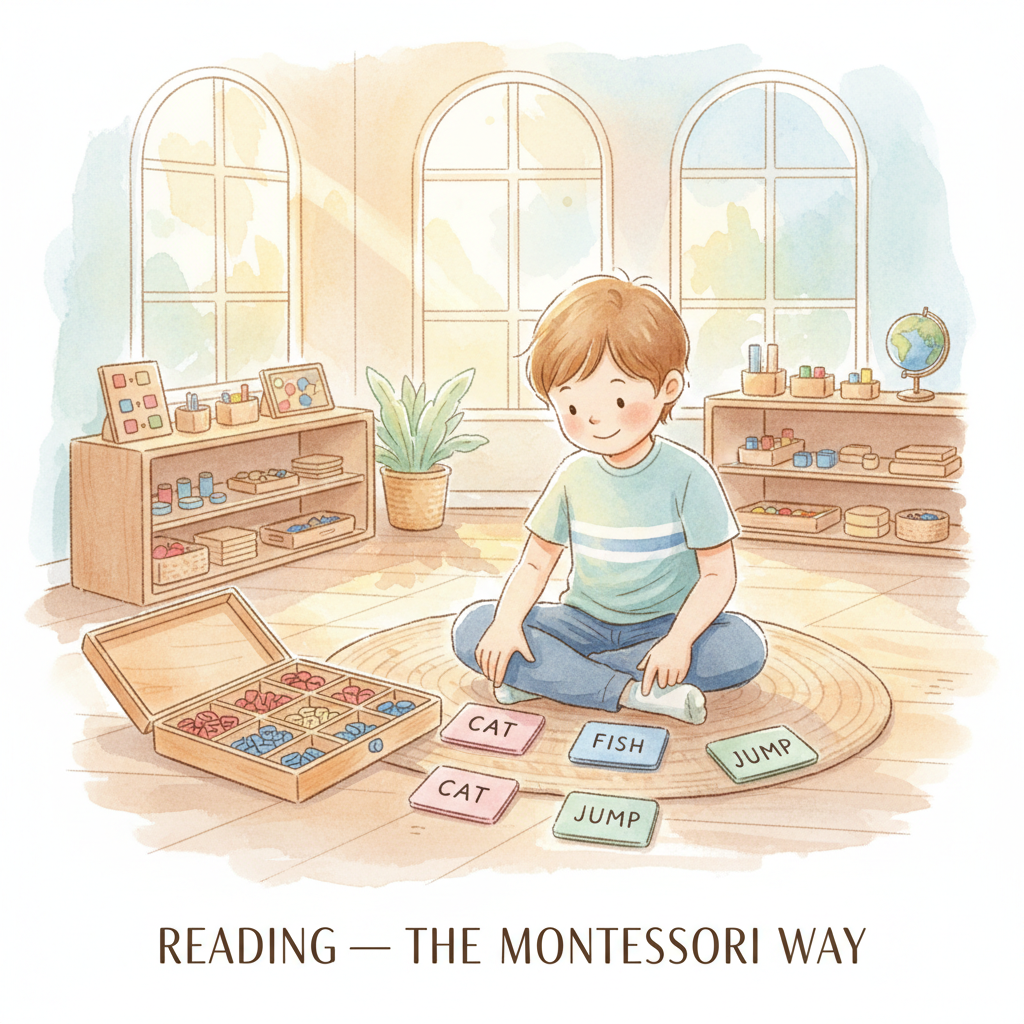
Two classic Montessori materials make a wonderful difference for children who are just beginning to read. The Sandpaper Letters let a child trace each letter while saying its sound, linking touch, sight, and hearing all at once. Once those sounds are familiar, the Movable Alphabet allows your child to build words without the added challenge of handwriting — a perfect bridge between spelling and reading.
If you'd like to bring these materials home, these are the sets I recommend:
For more on how all of this fits together, read How We Teach Reading the Montessori Way, and once your child knows the consonant and vowel sounds, move on to our Reading Vowel Lessons. You can also practice decoding with our Phonetic Word List and the Reading Cards.
Free Printable
To get started right away, download these printable Pink Series reading cards (PDF). They pair beautifully with the Movable Alphabet and give your child simple, phonetic words to sound out and build.
Whatever is slowing your child down, take heart. Reading does not happen on a single timetable, and almost every child can be taught to read with patience, the right materials, and a parent who is listening. Keep reading together, celebrate every small word, and trust that the pieces will come together in time.