Newsletter (Squirrels)
Published on: December 26, 2008
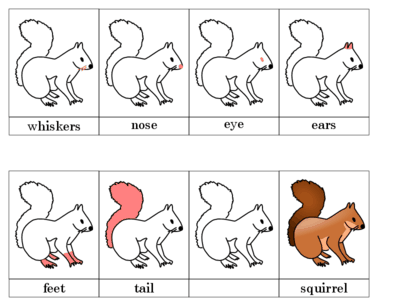
This is a fun biology activity for children of all ages. It's easy to study wildlife and habitats in your own neighborhood.
Check out the free anatomy science and reading cards.
Why Study Squirrels? A Perfect Montessori Nature Lesson
If there's one animal that practically every child can observe from their own backyard, porch, or neighborhood park, it's the squirrel. These energetic, acrobatic little creatures are endlessly fascinating to young learners, and they offer a wonderful gateway into the study of biology, animal anatomy, habitats, and seasonal behavior. In the Montessori approach, we follow the child's natural curiosity, and squirrels have a way of capturing attention like few other backyard animals can.
Nature study is one of the cornerstones of a Montessori science curriculum. Maria Montessori believed deeply that children should spend time outdoors observing the natural world, and that direct experience with living things fosters both intellectual growth and a sense of wonder. Squirrels give us a year-round subject to observe. In autumn, children can watch them gathering and burying acorns. In winter, they can track their footprints in the snow. In spring, they might spot baby squirrels venturing out for the first time. Every season brings new questions and new discoveries.
Using Nomenclature Cards for Squirrel Anatomy
Montessori nomenclature cards, sometimes called three-part cards, are a beautifully simple tool for teaching children scientific vocabulary and reading at the same time. For this squirrel unit, the cards introduce the parts of a squirrel's body: the bushy tail, the sharp claws, the incisors, the ears, the hind legs, and more. Younger children can match the picture cards to a control chart, building visual discrimination skills. Older children can read the labels independently and pair them with definition cards that describe each body part's function.
This is where biology and language arts come together so naturally. A child who learns that a squirrel's incisors never stop growing isn't just memorizing a fact — they're building vocabulary, practicing reading, and developing a framework for understanding how animals adapt to their environments. If your children enjoyed our Turkey Fun, Tessellations, and Dolly Makeover activity, they'll love this squirrel anatomy study just as much.
Exploring Habitats and Ecosystems
Squirrels also open the door to a broader study of habitats and ecosystems. Where do squirrels live? What do they eat? What animals share their habitat? Who are their predators? These questions lead children into rich discussions about food chains, symbiotic relationships, and the interconnectedness of living things. You can extend this study beautifully by exploring how different environments support different forms of life, much like we explored in our Newsletter (Geography) unit.
For hands-on learners, consider setting up a nature observation station near a window. Provide a journal for sketching, a pair of child-sized binoculars, and a simple field guide. A wildlife sorting and matching activity set can also help younger children classify animals by habitat, diet, or physical characteristics.
Connecting to the Bigger Picture
One of the things I love most about the Montessori approach to science is how one topic naturally leads to another. A squirrel study can lead into lessons about trees and forests, the water cycle, soil composition, or even geology. If your family enjoyed our Montessori Newsletter (Plate Tectonics), you already know how exciting it is when children begin to see connections between the living world and the physical earth beneath it.
You might also enjoy supplementing your nature study with a children's illustrated guide to backyard wildlife, which makes a lovely addition to your reading basket.
Getting Started
Download the free squirrel nomenclature cards, print them on cardstock, and laminate them for durability. Introduce the cards during a quiet work period, then head outside together to observe real squirrels in action. Let your child lead the exploration. This is Montessori science at its most joyful — rooted in the real world, driven by curiosity, and accessible to every family.