Montessori Reading: A Complete Guide to Teaching Your Child to Read
Published on: May 15, 2026
Reading the Montessori Way: A Complete Guide
Teaching your child to read is one of the most rewarding journeys in Montessori education. Unlike conventional approaches that jump straight into phonics drills and sight words, the Montessori method builds reading readiness through a carefully sequenced progression of sensorial experiences, hands-on letter work, writing, and finally reading itself. If you've been following the Montessori path with your child, you may be delighted to discover that much of the groundwork for reading has already been laid through earlier lessons.
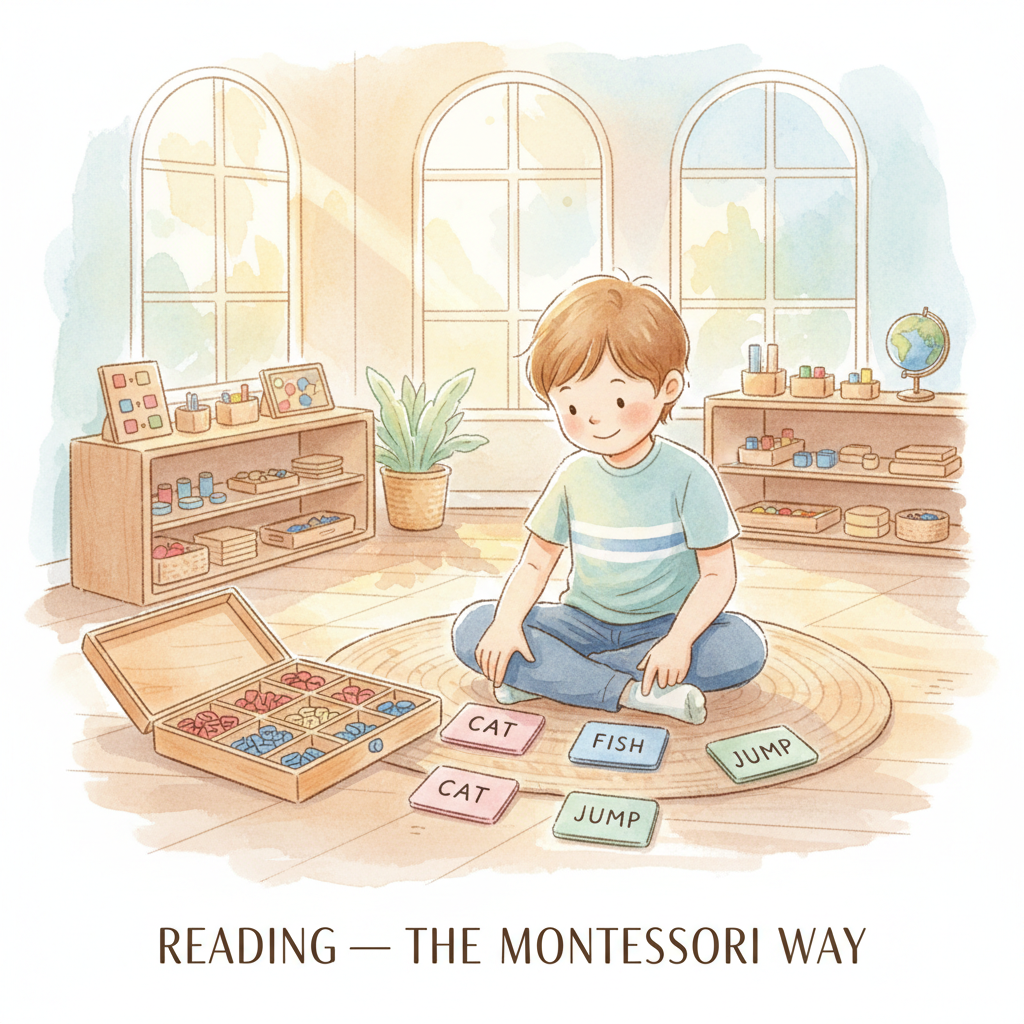
This guide walks you through the full Montessori reading sequence, from the sensorial foundations all the way to independent reading. Whether you're a homeschooling parent or a classroom teacher, you'll find practical, hands-on activities to support your child every step of the way.
The Sensorial Foundation for Reading
Before your child ever picks up a book, the sensorial lessons have been quietly preparing the mind for the complex work of reading and writing. Through sensorial education, your child has already practiced the essential cognitive skills of comparing, contrasting, and grading — skills that are fundamental to distinguishing one letter from another and one sound from the next.
Consider how much groundwork has already been accomplished:
- Size and shape discrimination: The Pink Tower teaches your child to compare and grade by size, developing the visual discrimination needed to notice the subtle differences between letters like "b" and "d" or "p" and "q."
- Color grading: The colored spools teach your child to distinguish shades and grade from lightest to darkest, sharpening the visual attention that reading demands.
- Geometric shapes: Tracing and drawing basic shapes — squares, triangles, circles, and rectangles — strengthens hand control for writing and builds the ability to recognize the geometric forms hidden within letters.
- Vocabulary building: All of these concepts are named and practiced using the Three Period Lesson, which gives your child a reliable method for learning and retaining new words.
Each of these exercises contributes to a mind that is organized, attentive, and ready for the more abstract work of decoding written language. When your child sits down to read, they are drawing on months or even years of sensorial preparation.
Letter Knowledge: Sandpaper Letters and Alphabet Mastery
Once your child has a strong sensorial foundation, it's time to introduce the letters of the alphabet. In Montessori education, we begin with Sandpaper Letters — textured letter forms that your child traces with their fingers while saying the corresponding sound. This multi-sensory approach engages the visual, tactile, and auditory pathways simultaneously, creating a deep and lasting connection between each letter's shape and its sound.
A few important guidelines for this stage:
- Teach sounds, not letter names. Your child learns that the letter "m" says /m/, not "em." This makes the transition to blending and reading much smoother.
- Start with short vowel sounds and hard consonant sounds. These are the most regular and predictable sounds in English, giving your child early success.
- Use the Three Period Lesson. Introduce two or three letters at a time using the Three Period Lesson format: "This is /m/," "Show me /m/," and "What is this?"
- Allow plenty of repetition. Your child should feel confident and fluent with each set of letters before new ones are introduced.
Since the English language has 26 symbols but approximately 44 different sounds, Dr. Montessori recommended introducing only about 20 isolated sounds initially. Her research showed that four- to five-year-old children could reliably remember around 20 different sounds. The remaining sounds and spelling patterns are introduced gradually once your child has a solid foundation and genuine enthusiasm for reading.
Spelling with the Moveable Alphabet
Once your child knows a good number of letter sounds, the next step is building words. The Moveable Alphabet is one of the most brilliant tools in the Montessori language curriculum. It's a box of individual letter tiles — typically lowercase letters in a contrasting color — that your child uses to "write" words without needing the fine motor control that pencil-and-paper writing demands.
Here is the typical progression for exercises with the Moveable Alphabet:
- Spelling with phonetic objects: Place a small object — such as a toy cat, mat, or pig — on the table and invite your child to spell the word using the moveable alphabet tiles. These first words should be simple, three-letter phonetic words (consonant-vowel-consonant).
- Spelling with phonetic pictures: Once your child is comfortable with objects, transition to picture cards showing items with simple phonetic names.
- Spelling rhyming word families: Encourage your child to discover word patterns by spelling families of rhyming words: pig, wig, jig, dig; or hat, cat, mat, sat. This builds phonemic awareness and helps your child see the predictable patterns in English spelling.
An important thing to understand at this stage: even though your child can spell a word with the moveable alphabet, many children cannot yet read the word they have just spelled. This is completely normal. In Montessori education, writing (encoding) typically comes before reading (decoding). Trust the process and keep offering opportunities for spelling practice.
The Bridge from Writing to Reading
And now, we are ready for writing and reading — child willing!
Dr. Montessori understood that reading is not a single skill but a constellation of abilities that includes writing, grammar, spelling, and comprehension. As your child becomes more confident with the moveable alphabet, you may notice them beginning to compose simple sentences. Some children will eagerly want to write out their sentences with paper and pencil. This is a wonderful sign of readiness.
Here are some ways to support this transition:
- Introduce common non-phonetic words. Words like "the," "is," and "was" don't follow regular phonetic rules and must be learned by sight. Introduce these using the Three Period Lesson so your child can incorporate them into sentences.
- Provide small blank booklets. Small blue or colored booklets are a Montessori favorite. Children love writing their own sentences and stories in these little books.
- Offer art materials for illustration. Let your child draw pictures to accompany their written words. This deepens comprehension and makes the work personally meaningful.
- Include punctuation with the moveable alphabet. Make sure periods, commas, question marks, and exclamation points are available so your child can begin to understand how punctuation shapes meaning.
- Explore grammar naturally. As your child begins composing sentences, you can gently introduce grammar exercises that help them understand the roles that different words play in a sentence.
The small booklets tend to be very popular. Children who want to simply write individual words and illustrate them can use the booklets too. There's no single "right" way to use them — follow your child's interest and energy.
First Reading Exercises with Objects and Labels
Dr. Montessori used toys and real objects with labels for her very first reading exercises, and this remains one of the most effective approaches available to us today.
In The Montessori Method, she writes:
"We then put away the toys and set ourselves to make hundreds of written labels — names of children, of objects, of cities, of colours and of qualities made known through exercises of the senses. We placed them in more boxes and let the children search as they pleased among them. I expected that at least they would hunt indiscriminately and without any order in one box and in another, but no, every child finished emptying the box which he had under his hand, and only after that did he go on to another, truly insatiable for reading."
Later she explains simply: "So we had nothing more to do but present them with a book; in fact they read the words in it."
Picture Matching and Label Reading Activity
Some children by this point already know how to read and recognize all the sounds of the alphabet. Other children will need a review of all 26 letters and sounds. Either way, this activity provides excellent practice.
You will need:
- A set of moveable alphabet letters (one copy of the 26 letters is sufficient for early exercises)
- Three different pictures, with two copies of each (for example, two pictures of a pig, two pictures of a cat, and two pictures of an elk)
- Written labels with the name of each item
Here's how to present the activity:
- Set out the letters you'll need (p-i-g-c-a-t-e-l-k) and place them to the side.
- Have your child match the identical pictures, spacing them apart so there is room underneath each picture for a label and for moveable alphabet letters.
- Under the first set of pictures, have your child place the pre-written labels. Your child reads each label and matches it to the correct picture.
- Under the second set of identical pictures, have your child take letters from the set-aside pile and spell out each word independently.
If this proves difficult, you can simplify: attach the label directly to the first picture (like a nomenclature card) and let your child spell the word with moveable alphabet letters on the unlabeled copy. This provides a model without removing the challenge entirely.
Labeling the Environment
Another powerful exercise is to make labels for familiar objects in the room — dog, mat, hat, rug, cup, and so on. Place the objects in one group and the labels in another, then let your child read each label and match it to the correct object. This is reading in its most concrete, meaningful form: your child is decoding words and connecting them to real things in the world.
Progressing Through Phonograms and Spelling Patterns
Once your child has experienced the excitement and success of reading simple phonetic words, you can begin introducing groups of words organized by spelling patterns, also known as phonogram words.
Dr. Montessori offers this insightful guidance:
"In a word, one must proceed in the first instance with the aim of rousing keen interest in reading, and afterwards the way will be prepared for the long journey necessary to overcome the various difficulties of spelling. Then arises the necessity for research in grouping material objects and words corresponding to objects, making up a series of successive exercises. This leads the children to pure interest in reading words."
In Discovery of the Child, she describes how English Montessori schools developed small chests with drawers, each drawer containing a group of objects and labels organized by a specific spelling pattern. The original schools used beautiful small wooden chests, but you can easily replicate this with shoe boxes, small plastic drawer organizers, or any containers you have on hand.
Word Groups for Box Exercises
Each box or drawer should contain small objects (or pictures of objects) along with their written labels, all sharing the same phonogram pattern. Here are some suggested groupings to get you started:
- Words ending in -ll: doll, bill, pill (use a play pill, like a candy shape), gull
- Words ending in -ck: duck, rock, sock, lock
- Words ending in -ss: kiss (a candy kiss), cross, moss
- Words ending in -ff: muff, puff, cuff
- Words ending in -ing: king, wing, ring, sling
- Challenge words: button, cotton, mutton
Place both the objects and labels in the same box. Your child takes out a box, removes all the objects, reads each label, and matches it to the correct object. When finished, everything goes back in the box, and your child can choose another drawer or box.
As your child progresses and gains confidence, you can combine different word groups into a single exercise to increase the challenge. This naturally extends into more advanced moveable alphabet exercises where your child is building and reading words from multiple phonogram families.
How Long Does It Take a Child to Learn to Read?
You might be surprised by Dr. Montessori's answer. According to her research, the passage from writing to reading during the sensitive period takes an average of about fifteen days:
"Experience tells us that, counting from the moment at which the child can write, the passage from this lower form of written language to the higher one of reading is an average about fifteen days."
However, she also notes an important nuance:
"Accuracy in reading, however, almost always comes later than perfection in writing. In most cases the child writes very well and reads just fairly well."
This is a helpful reminder for parents and teachers: don't worry if your child's reading seems to lag behind their writing. This is the natural order in Montessori education. Writing is encoding — putting sounds together into words — while reading is decoding — pulling meaning from someone else's written words. Decoding requires an additional layer of abstraction that takes time to develop.
Dr. Montessori also acknowledged that children learn to read at different ages. Most Montessori children can read fluently by the end of second grade, though many read much earlier. The key is to follow your child's readiness and interest rather than adhering to an arbitrary timeline.
Pink, Blue, and Green Reading Schemes
The Montessori reading curriculum is traditionally organized into three color-coded levels that progress in difficulty:
- Pink Level: Simple three-letter phonetic words with short vowel sounds (cat, pig, sun, bed, hop). This is where most children begin their reading journey.
- Blue Level: Longer phonetic words, including consonant blends and four- to five-letter words (frog, stamp, blend, crisp). These words are still phonetically regular but require more sophisticated blending skills.
- Green Level: Words containing phonograms and more complex spelling patterns (rain, boat, night, chair). At this stage, your child is learning that certain letter combinations create specific sounds that differ from the individual letter sounds.
Each level includes a variety of activities: word cards, picture-word matching, lists for spelling practice, and small readers. As your child masters one level, they move naturally into the next, always building on what they already know.
Supporting Comprehension and Grammar
Reading is not just about decoding — it's about understanding. As your child's reading ability grows, Montessori grammar exercises help them understand the structure of language and deepen their comprehension.
Some ways to support comprehension at this stage include:
- Sentence cards: Write simple sentences on cards and have your child read and act them out. For example, "Hop to the door" or "Put the cup on the mat." This connects reading to action and meaning.
- Command cards: Similar to sentence cards, these give your child a written instruction to follow. Children love the playfulness of this activity, and it reinforces that reading carries real meaning.
- Bookmaking: Encourage your child to continue writing and illustrating their own small books. This integrates writing, reading, spelling, and creative expression into a single joyful activity.
- Grammar symbol work: Montessori uses a set of colored symbols to represent the parts of speech (noun, verb, adjective, and so on). This concrete approach makes grammar accessible and even fun for young children.
Tips for Success
As you guide your child through the Montessori reading journey, keep these principles in mind:
- Follow the child. Some children are ready to read at four; others at six or seven. Trust your child's timeline and watch for signs of readiness and interest.
- Build on success. Start with easy, phonetic words and gradually introduce more complex patterns. Your child should feel confident and successful at each stage before moving on.
- Keep it concrete. Real objects, picture cards, and hands-on materials make reading tangible and meaningful. The more senses you engage, the deeper the learning.
- Don't rush past writing. In Montessori education, writing and spelling are pathways to reading, not separate subjects. Give your child plenty of time with the Moveable Alphabet and Sandpaper Letters before expecting fluent reading.
- Rouse keen interest. As Montessori herself said, the first goal is to awaken a passionate desire to read. Once that spark is lit, the "long journey" of mastering English spelling becomes an adventure rather than a chore.
- Accept imperfection gracefully. Your child's early reading will be halting and imperfect, even if their writing is quite good. This is normal. Offer encouragement and gentle support, and fluency will come in time.
Free Printable Reading Materials
To support your child's reading journey at home or in the classroom, we've created a collection of free printable resources. These materials align with the Montessori pink, blue, and green reading schemes and can be used alongside the activities described in this guide.
- Pink Reading Cards — Simple three-letter phonetic words for beginning readers
- Blue Reading Cards — Longer phonetic words with consonant blends
- Green Reading Cards — Words with phonograms and complex spelling patterns
- Reading Cards — A general set of reading practice cards for mixed-level review
- Grammar Symbols — Printable Montessori grammar symbols for sentence analysis activities
Print these on cardstock and laminate them for durability. Store each set in a labeled envelope or small basket so your child can choose their own work independently.
Recommended Materials
Having the right materials on hand makes a tremendous difference in the Montessori reading experience. Here are two of our favorite resources available online:
- Montessori Moveable Alphabet — A complete set of lowercase letter tiles for word building, spelling, and early sentence composition. This is one of the most essential materials in the Montessori language curriculum.
- Montessori Phonetic Reading Objects — A collection of miniature objects with simple phonetic names, perfect for the spelling and labeling exercises described in this guide. Children love working with real three-dimensional objects rather than pictures alone.
You don't need to purchase everything at once. Start with a moveable alphabet and a collection of small phonetic objects (you can gather many of these from around your home or from craft and toy stores), and add to your collection as your child progresses through the reading levels.
The Joy of Reading
There is something truly magical about the moment when a child realizes they can read. In Montessori classrooms around the world, this moment arrives not through pressure or drilling, but through a carefully prepared environment that meets the child exactly where they are. The sensorial work, the sandpaper letters, the moveable alphabet, the labeling exercises — each step builds naturally on the one before it, until reading emerges as the joyful, almost inevitable result of everything your child has already learned.
Trust the process, follow your child, and celebrate every step of this remarkable journey. Whether your child is tracing their first sandpaper letter or reading their first chapter book, they are doing the extraordinary work of unlocking the written word — and you are their guide.