Lesson of the Day 97: The Stamp Game — From Concrete Beads to Abstract Arithmetic
Published on: May 25, 2026
"The child who concentrates is immensely happy." — Maria Montessori
If your child has been working with the Golden Beads, you've already witnessed something beautiful — the way those shimmering golden materials make numbers real. Your child has held a thousand-cube in their hands and felt the weight of a big number. Now it's time for the next leap: the Stamp Game. Think of it as arithmetic's secret passageway, leading your child from the concrete world of beads to the more abstract world of written math — without losing the joy of hands-on discovery.
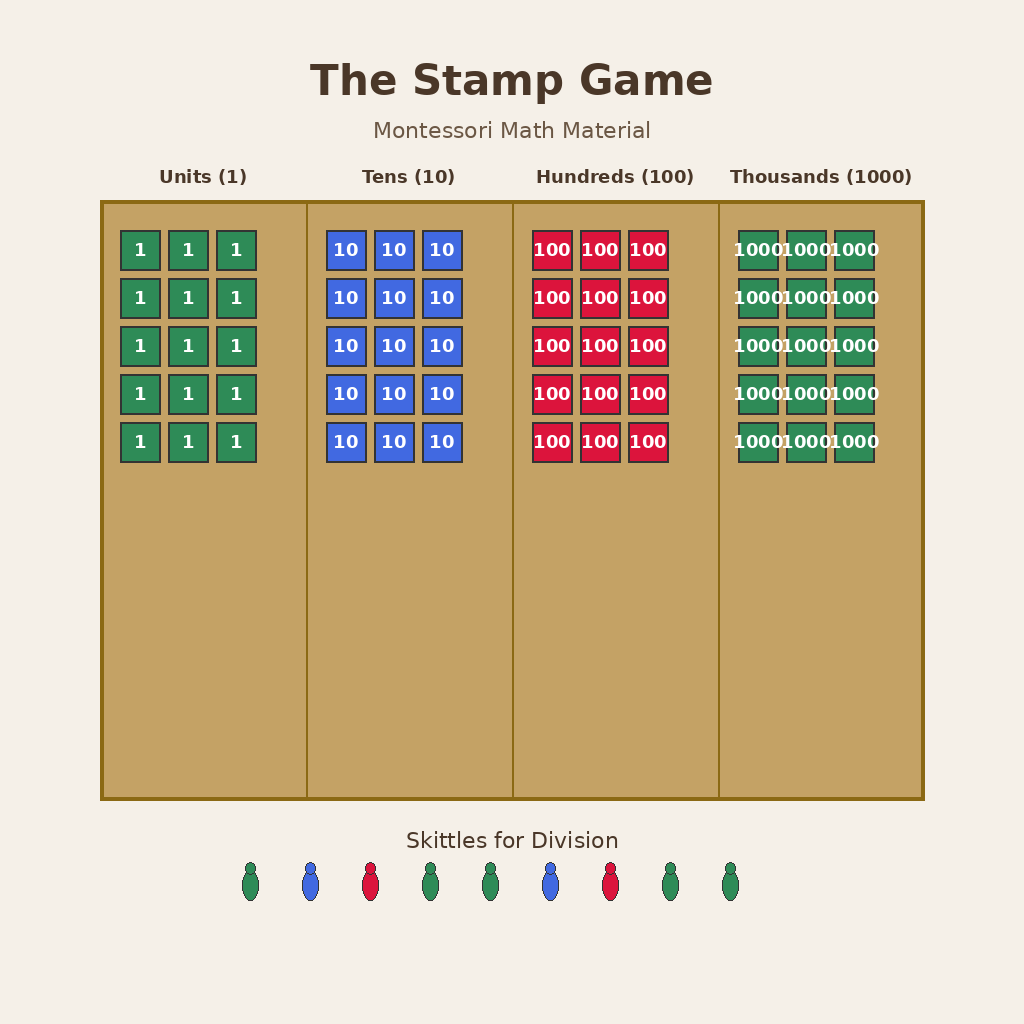
In the Stamp Game, large bead quantities are replaced by small, color-coded wooden tiles (stamps). A tiny green tile marked "1" represents a unit. A blue tile marked "10" represents a ten. A red tile marked "100" represents a hundred. And a green tile marked "1000" (often with a special border or detail) represents a thousand. The colors match the Montessori bead hierarchy, so your child already has a mental map. What changes is the level of abstraction — instead of counting out 300 individual beads, your child counts out three red stamps. It's elegant, efficient, and deeply empowering.
Today we'll walk through how to present the Stamp Game at home, covering all four operations — addition, subtraction, multiplication, and division. Don't worry about tackling everything in one sitting! Follow your child's interest and pace. Some children spend weeks happily adding before they're ready for subtraction. That's perfectly Montessori.
🎒 Materials You'll Need
- Montessori Stamp Game set — includes color-coded stamps (green units, blue tens, red hundreds, green thousands), a divided wooden box, and colored skittles for division (Montessori Stamp Game on Amazon)
- Small pencil and paper — for writing out equations
- A work mat or small rug — to define the workspace
- Number cards or slips — optional, for presenting problems (you can write these yourself)
- Green, blue, and red colored pencils — for color-coding written work
- 👉 Montessori Golden Beads + Stamp Game Bundle on Amazon — great if you're building your math shelf
🟢 Activity 1: Introducing the Stamps — Know Your Tiles
Before diving into operations, your child needs to become friends with the stamps themselves. This is a short, joyful presentation.
- Invite your child to the workspace. Say, "I have something new to show you today. Do you remember working with the Golden Beads? This material is related — it's called the Stamp Game."
- Open the stamp box and lay out one stamp from each category. Place them in a row from right to left: green "1," blue "10," red "100," green "1000."
- Point to each stamp and name it: "This green stamp says 1 — it represents one unit, just like a single golden bead. This blue stamp says 10 — it represents one ten-bar. This red stamp says 100 — it represents one hundred-square. And this green stamp says 1000 — it represents one thousand-cube."
- Invite your child to sort all the stamps by color and value, placing them back into their compartments. This builds familiarity and fine motor control.
- Play a "show me" game: "Can you show me the stamp that means one hundred? Can you show me three tens?" Let your child gather the correct stamps.
- Build a number together. Write "2,345" on a slip of paper. Ask your child to lay out 2 thousands stamps, 3 hundreds stamps, 4 tens stamps, and 5 units stamps. Count together to verify.
💡 Tip: If your child hasn't worked with Golden Beads yet, spend more time on this introductory step. The Stamp Game assumes familiarity with place value and the decimal system. Consider revisiting our Golden Beads lesson first.
➕ Activity 2: Addition with the Stamp Game
Addition is the natural first operation. Start with problems that don't require exchanging (carrying), then progress to those that do.
Static Addition (No Exchanging)
- Write the problem on a slip of paper — for example, 3,214 + 2,543.
- Build the first number: Have your child lay out 3 thousands stamps, 2 hundreds stamps, 1 tens stamp, and 4 units stamps in a row near the top of the mat.
- Build the second number: Below the first, lay out 2 thousands stamps, 5 hundreds stamps, 4 tens stamps, and 3 units stamps.
- Combine: Say, "Now we're going to put them all together. Let's start with the units." Slide all the unit stamps together. Count: "4 and 3 is 7 units." Move to tens: "1 and 4 is 5 tens." Continue through hundreds and thousands.
- Read the answer: 5 thousands, 7 hundreds, 5 tens, 7 units = 5,757. Have your child write the answer on the paper.
Dynamic Addition (With Exchanging)
- Write the problem: 1,648 + 2,475.
- Build both numbers as before.
- Combine the units: 8 + 5 = 13 units. Say, "We have 13 units! Do we have enough to make a ten? Yes — every time we get 10 of one kind, we exchange them for 1 of the next." Have your child count out 10 green unit stamps, set them aside, and replace them with 1 blue tens stamp. Three green units remain.
- Continue with tens: 4 + 7 + 1 (from the exchange) = 12 tens. Exchange 10 tens for 1 hundred. Two tens remain.
- Hundreds: 6 + 4 + 1 = 11 hundreds. Exchange 10 hundreds for 1 thousand. One hundred remains.
- Thousands: 1 + 2 + 1 = 4 thousands.
- Read the answer: 4,123. Record it.
💡 Tip: The exchanging process is the heart of the Stamp Game. It's the same concept as "carrying" in written arithmetic, but your child is physically doing it — picking up ten stamps and trading them for one stamp of the next value. This tactile experience builds deep understanding.
➖ Activity 3: Subtraction with the Stamp Game
Once your child is comfortable with addition, introduce subtraction. Again, start static before moving to dynamic.
Static Subtraction (No Borrowing)
- Write the problem: 6,847 – 3,215.
- Build only the first number (the minuend): 6 thousands, 8 hundreds, 4 tens, 7 units.
- Take away: "We need to subtract 3,215. Let's start with the units. Take away 5 units." Your child removes 5 green stamps. "Now take away 1 ten." Remove 1 blue stamp. Continue through hundreds (remove 2) and thousands (remove 3).
- Count what remains: 3 thousands, 6 hundreds, 3 tens, 2 units = 3,632.
Dynamic Subtraction (With Borrowing)
- Write the problem: 5,321 – 2,456.
- Build the first number: 5 thousands, 3 hundreds, 2 tens, 1 unit.
- Start with units: "We need to take away 6 units, but we only have 1. What can we do?" Guide your child: "We can exchange 1 ten for 10 units!" Remove 1 blue stamp, add 10 green stamps. Now there are 11 units. Take away 6. Five units remain.
- Tens: We now have 1 ten (had 2, exchanged 1). We need to take away 5. Not enough! Exchange 1 hundred for 10 tens. Now 11 tens. Take away 5. Six tens remain.
- Hundreds: We now have 2 hundreds. Need to take away 4. Exchange 1 thousand for 10 hundreds. Now 12 hundreds. Take away 4. Eight hundreds remain.
- Thousands: 4 thousands remain. Take away 2. Two thousands remain.
- Answer: 2,865.
💡 Tip: Some children find borrowing confusing at first. Slow down and let your child handle each exchange physically. Say, "This one ten is worth ten units — watch, I'll trade it," and make the swap dramatic and clear. With practice, it clicks beautifully.
✖️ Activity 4: Multiplication with the Stamp Game
Multiplication with the Stamp Game is introduced as "taking a number multiple times." Keep early problems simple — a multi-digit number multiplied by a single digit.
- Write the problem: 2,314 × 3.
- Explain: "This means we take 2,314 three times." Build 2,314 with stamps three separate times on the mat, one set below the other, spaced apart.
- Combine: Push all three sets together, starting with the units. Count 4 + 4 + 4 = 12 units. Exchange 10 for 1 ten. Two units remain.
- Continue combining tens: 1 + 1 + 1 + 1 (from exchange) = 4 tens.
- Hundreds: 3 + 3 + 3 = 9 hundreds.
- Thousands: 2 + 2 + 2 = 6 thousands.
- Answer: 6,942.
💡 Tip: Multiplication with larger multipliers (two digits) comes later and uses the stamps in combination with the colored skittles to represent the multiplier. For now, single-digit multipliers build confidence and reinforce the concept beautifully.
➗ Activity 5: Division with the Stamp Game
Division uses the colored skittles (small figurines) that come with the Stamp Game set. These represent the divisor — the number of groups you're distributing into.
- Write the problem: 6,842 ÷ 2.
- Set up 2 skittles at the top of the mat — these represent the two groups.
- Build the dividend: 6 thousands, 8 hundreds, 4 tens, 2 units.
- Distribute the thousands: "We're sharing equally between 2 groups." Give 3 thousands stamps to each skittle. All 6 are distributed evenly.
- Distribute the hundreds: Give 4 hundreds to each skittle. All 8 distributed.
- Distribute the tens: Give 2 tens to each skittle. All 4 distributed.
- Distribute the units: Give 1 unit to each skittle. All 2 distributed.
- Read the answer from one group: 3 thousands, 4 hundreds, 2 tens, 1 unit = 3,421.
For problems requiring exchanging during division (e.g., 5,735 ÷ 5, where you can't distribute 5 thousands evenly into 5 groups without first working through it), the process involves exchanging a stamp that can't be evenly distributed for 10 of the next smaller stamp, then continuing to share. It follows the same borrowing logic your child learned in subtraction.
🌟 Extensions
- Create a Stamp Game journal: Have your child pick a problem card each day, solve it with the stamps, then record the equation and answer in a dedicated math notebook using colored pencils (green for units, blue for tens, red for hundreds, green for thousands).
- Story problems: Turn arithmetic into narrative. "There are 3,456 acorns in the forest. The squirrels gathered 1,278 more. How many are there now?" Let your child set up and solve with the stamps.
- Race to the answer: For two children, give each a problem of similar difficulty. Who can solve it accurately first? (Emphasize accuracy over speed.)
- Bridge to abstraction: Once your child is fluent with the Stamp Game, begin asking them to predict the answer before working it out. Then verify with stamps. This builds mental math skills.
- Connect to the Bead Frame: If you have a Montessori Small Bead Frame, show your child how the same problem can be solved on both materials. This reinforces that mathematics is consistent across representations.
- Remainders in division: Introduce problems that don't divide evenly (e.g., 7,453 ÷ 3). Let your child discover what happens when stamps are left over. Introduce the word "remainder" naturally.
🔗 Cross-Links
- 🟡 Golden Beads — Introduction to the Decimal System — The concrete foundation that precedes the Stamp Game
- 🔢 Place Value & the Decimal System — Reinforce the hierarchy of units, tens, hundreds, and thousands
- 🧮 The Small Bead Frame — The next step toward abstraction after the Stamp Game
- 📝 Long Addition on Paper — Where the Stamp Game ultimately leads
- 📐 Four Operations Overview — How addition, subtraction, multiplication, and division connect across Montessori materials