Lesson of the Day 14: Fractions with Paper-Plate Pie Wedges
Published on: June 11, 2011
"The hands are the instruments of man's intelligence." — Maria Montessori
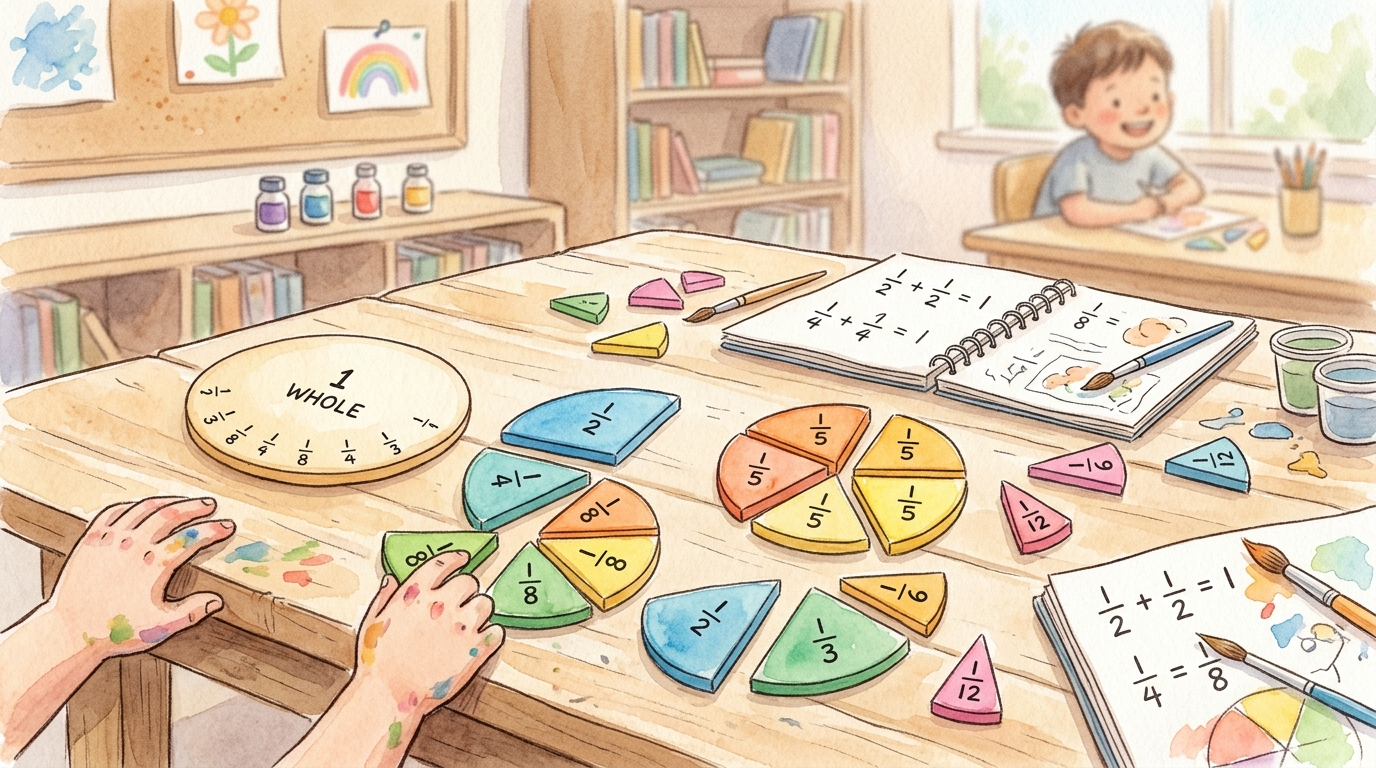
Fractions can feel abstract to young learners — but when you hand a child a paper plate and a pair of scissors, something magical happens. Suddenly, "one half" isn't just a number on a page; it's a real piece they can hold, turn over, and fit back into the whole. In this lesson, we use simple pie wedges to introduce the concept that fractions are parts of a whole — starting with halves and building up to eighths. It's hands-on, it's visual, and best of all, it's fun!
🎒 Materials You'll Need
- Paper plates (plain white, several per child) — or large circles cut from cardstock
- Scissors (child-safe)
- Montessori fraction circles for more advanced exploration (Montessori Fraction Circles on Amazon)
- Colored pencils or markers for labeling wedges
- A small bag or basket (for the Complex Fraction Game)
- Colored tape (for the Everyday Fractions extension)
- Printout of the fraction game (see Free Printouts below)
- 👉 Fraction Skittles and Insets on Amazon
- 👉 hand2mind Connecting Fraction Circles on Amazon
🔎 Free Printouts
Use these free printable resources to extend the lesson:
- 📄 Fraction Game Printout — Pie wedge fraction matching game
- 📄 Fraction Cards — Fraction identification and matching cards
- 📄 Fraction Labels — Labels for your fraction pieces
- 📄 Fraction Labels Set 2 — Additional fraction labels
🥧 Part 1: Fractions Are Part of the Whole
Introducing the Concept
Sector shapes — or wedges — make an easy and intuitive fraction game. Think of cutting a pie into even pieces: each piece is a fraction. For example, if you cut a pie into 8 pieces, each piece is 1/8 of the pie. This concrete, visual approach helps children grasp the abstract idea that fractions represent parts of something whole.
Activity 1: The Paper Plate Pie Game
Start by cutting plain paper plates or large circles into even pieces. You can create sets divided into:
- 2 pieces (½)
- 3 pieces (⅓)
- 4 pieces (¼)
- 5 pieces (⅕)
- 6 pieces (⅙)
- 8 pieces (⅛)
Tip for younger children: The even pieces (½, ¼, ⅙) are easier to visualize. Start with introducing the concept of ½ and build from there.
Step-by-Step Presentation
- Show the whole. Hold up the uncut circle or paper plate. Say, "This is a whole piece."
- Cut and compare. Cut the circle in half. Show your child the whole circle alongside the two pieces. Say, "I cut this circle in half. Each piece is one-half (½) of the circle."
- Demonstrate the fit. Show how each half fits back onto the whole circle — this is the key moment where the concept clicks!
- Three-Period Lesson. Use the Montessori three-period lesson with the half circle and whole circle to teach the concepts of "whole" and "half":
- Period 1 (Naming): "This is one half."
- Period 2 (Recognition): "Show me one half."
- Period 3 (Recall): "What is this?"
- Move to fourths. Repeat this activity using the concept of ¼ (4 pieces) and continue with the three-period lesson.
📈 Part 2: Advanced Fraction Lesson
Once your child is comfortable identifying halves and fourths separately, combine the ½ and ¼ pieces together to make the three-period lesson more challenging. This helps children begin to compare fraction sizes and understand the relationship between different fractions.
🎲 Part 3: Complex Fraction Game
This is a wonderful cooperative game for two or more children!
- Prepare 2 or 3 whole pie circles and various fraction pieces, such as ½, ¼, and ⅛.
- Put all the fraction pieces in a bag.
- Have each child randomly draw 3 pieces from the bag.
- Take turns placing fraction pieces onto the whole circles, trying to fill them in.
- After each turn, draw another fraction piece from the bag.
- Play until the pieces won't fit anymore!
💡 Play this in teams to make it a cooperative game. And remember — it's perfectly okay to change the rules of any game to make it more fun and engaging for your children!
🍎 Part 4: Everyday Fractions
The beauty of fractions is that they're everywhere in daily life. Here are some simple ways to reinforce the concept throughout your day:
- Sharing food: Splitting a cookie, banana, or apple in half is a natural and delicious way to show how fractions work in everyday life.
- Dividing spaces: Use colored tape to divide a room into halves, fourths, sixths, or eighths. Children love seeing their play space transformed into a math lesson!
- Finding fractions everywhere: Because fractions are parts of the whole, you can find them almost everywhere — a pizza cut into slices, an orange separated into sections, or a chocolate bar broken along its lines.
Keep your eyes open together, and your child will start spotting fractions in the world around them. That's when you know the concept has truly taken root! 🌱