How to Prepare Your Classroom
Published on: June 30, 2007
How to Prepare Your Classroom
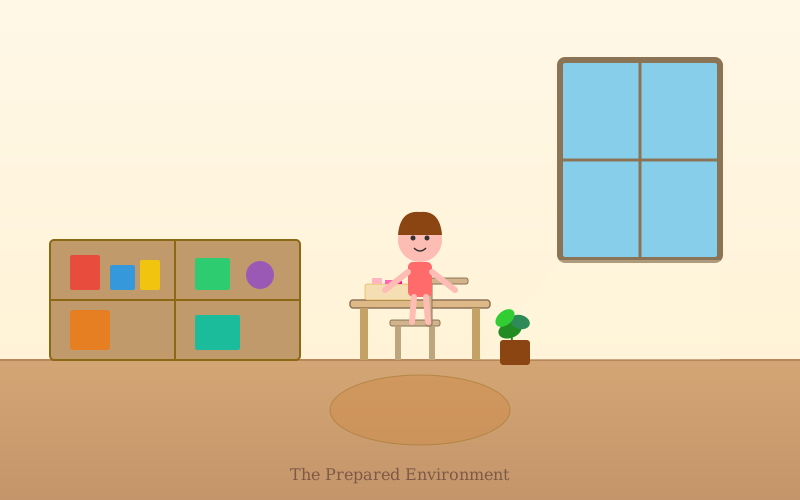
The Montessori environment is a combination of the classroom, teacher, outdoor classroom and garden, and all other facilities. It should be welcoming, attractive, and orderly — set up for thinking and learning activity.
Montessori understood that a child's environment develops a child's brain. It is perhaps one of the most important aspects of Montessori's approach and philosophy. Whether you are setting up a classroom or preparing the environment for your child at home, these principles will guide you in creating a space that fosters independence and a love of learning.
Furniture
- The furniture should be low enough to accommodate a child's height and body proportions. Tables and chairs should come in varying sizes and heights to represent the various sizes of children.
- Tables and chairs — in fact, all the furniture — should be light and easy enough for the child to move. There is a control of error built into movable furniture: the child realizes he or she has been careless when the furniture moves or is knocked over.
- Light furniture and table tops that show dirt and spills allow a child to easily see soiled surfaces and clean them.
- Furniture should be left to make noise. Montessori classrooms don't put felt pads on the bottom of chairs or tables. The noise of pushing a chair under a table shows a child how to carefully and quietly push a chair under a table.
Chairs
- Chairs should have large seats and short legs. There should be a variety of sizes.
- Provide different styles of chairs — chairs with arms, chairs without arms, wide stools, etc.
- Chairs should be made of wood that is wood grain or light colored so they show dirt marks. The chairs should be made for scrubbing.
Rugs
- Rugs are provided for activities such as the Pink Tower, broad or brown stair, red rods, and number rods.
- Provide a rack or a large rubber band to roll up the rugs. Rugs that are not too soft roll the best. You can fold the softer rugs and place them in a basket or cupboard.
Tables
- Take into consideration the apparatus and the shape of the room when picking out tables. The tables should match the chairs so that there is the proper space between the chairs and the table for sitting purposes.
- Provide different tables suitable for different activities. Some tables can be for individual work and others for group work.
- Tables should be wood grain or light colored material that can be washed.
- Children should be able to move the tables, so they should be light enough.
Shelves and Cupboards
- Shelves and cupboards should be low enough for children to reach items from the very top. They should be able to dust from the bottom to the top of the shelves and cupboards.
- They should be lightweight enough for children to move and clean behind them.
- The spaces should be the correct size for the apparatus, which is always kept in the same spot.
- They should be light in color and look attractive.
- You can make curtains instead of heavy doors for your cupboards.
Artwork and Paintings
- Beautiful artwork and reproductions are important for children under the age of five. Remember to hang the pictures at eye level. You can purchase artwork such as reproductions in postcards, posters, or sculptures.
- Change the pictures and artwork periodically. Just have a few paintings or sculptures at a time.
- Provide vases and flowers for the children to arrange and care for. You can use dried flowers, branches, and other types of flora when flowers are no longer abundant in the winter months.
- Use dishes and glasses made of china and glass. It's important for a child to learn how to use breakables with care. Start slowly with a teacup, and work up to more breakable tableware. Small china pitchers are also a good beginning for practical life skills.
Cleaning Materials
- Buy or adapt to the right child size: brooms, scrubbing brushes, dish brushes, dust pans and whisk brooms, dusters, sponges, spray bottles, etc. Keep the cleaning materials in an attractive caddy. You can cut off brooms and sand the tops. Make sure the items are of good and attractive quality.
- Cleaning products: I like to use natural products for cleaning. Health food stores have wonderful natural cleaning products — soaps made from peppermint, lavender, almond, etc. Also, baking soda is a good, safe abrasive cleaner. Diluted vinegar is also a wonderful cleaning product. Cleaning should be done to keep the living area tidy. For young children, use only clean water for cleaning. Of course, children will clean the same item more than once!
- Brass, Copper, and Silver: I like to use natural cleaners for these as well. Brass and copper can be cleaned with tomato ketchup. Silver can be cleaned by lining the bottom of a pan with aluminum foil (shiny side down), adding warm water, a teaspoon of salt, and three tablespoons of baking soda. Soak, rinse, and buff with a clean cloth. Another way to clean silver is to use chalk dust.
These washing and cleaning activities are wonderful ways to incorporate practical life into the daily routine of your classroom.
Other Items Needed in the Classroom
According to your children's ages and development, you will want to include:
- Sensorial apparatus for children under the age of six.
- Cultural material according to age and development.
- A complete library or access to a library. Books such as story, picture, reference, science, art illustrations, and poems. Also educational videos or DVDs and music CDs, records, or tapes.
- Material in the room should be at the developmental level of the children. Remove material they have outgrown. Also, it is important not to put in material that is above their level.
- Art supplies — crayons, scissors, paint, brushes, pencils, paper, and chalk. See our guide to art supplies basics to buy for more ideas.
- Chalk board or white board.
- Materials for taking care of the environment.
Restroom and Closets
If you don't have low toilets and sinks, have a safe step stool for reaching the sink and toilet. A full-length mirror helps a child see himself or herself to make sure they are properly dressed. Have a container for personal hygiene products, such as a toothbrush, toothpaste, comb, etc.
Provide low coat hooks and pegs, or a lowered bar in the closet, along with small hangers for clothes. Again, everything should have its place and items kept in order.
Garden and Play Area
The garden area should ideally be next to the classroom. It should be small enough for the children to take care of the area. At home supply stores you can purchase small spades with short handles, rakes, watering cans, etc. Also, an outdoor broom for sweeping the paths is useful.
The play area can include a sand pit with sand shovels, containers, sieves, and ideally trees for climbing or climbing equipment, as well as building materials — wood, nails, hammers, etc.
Teacher/Parent
One of the most important aspects of the Montessori classroom is the teacher. She or he is a part of the attractive environment and should be well groomed. The teacher's role is to show how the equipment is used through careful presentation of materials.
Also, a large part of the teacher's job is to keep the classroom well maintained. There should be perfect order; the children and the teacher should try to maintain this together. They should even mend items together that are in disrepair. Anything that can't be repaired by the students and teacher needs to be taken out of the room until it can be mended.
The children's prepared environment promotes freedom, work, and inspiration for learning. It always allows for activity.
Recommended Materials
- Wooden Kids Cleaning Set for Toddlers, 8 Pieces Montessori — A beautifully made, child-sized cleaning set perfect for practical life activities in your prepared environment.
- ECR4Kids 24in x 48in Rectangular Hardwood Table with 20in Legs — A sturdy, child-height hardwood table ideal for Montessori classrooms and homeschool settings.