Scent Bottles
Published on: June 30, 2007
Scent Bottles
Ages
3 to 6 years old
About the Scent Bottles
The sense of smell is remarkably acute in young children, yet it is one of the senses least often refined through deliberate exercises. In the Montessori sensorial curriculum, the Scent Bottles (sometimes called the Smelling Bottles or Olfactory Bottles) isolate the sense of smell and invite the child to notice, compare, and match different scents. Maria Montessori included this work alongside exercises for the visual, auditory, tactile, and gustatory senses — believing that careful training of each sense sharpens the child's ability to observe and understand the world.
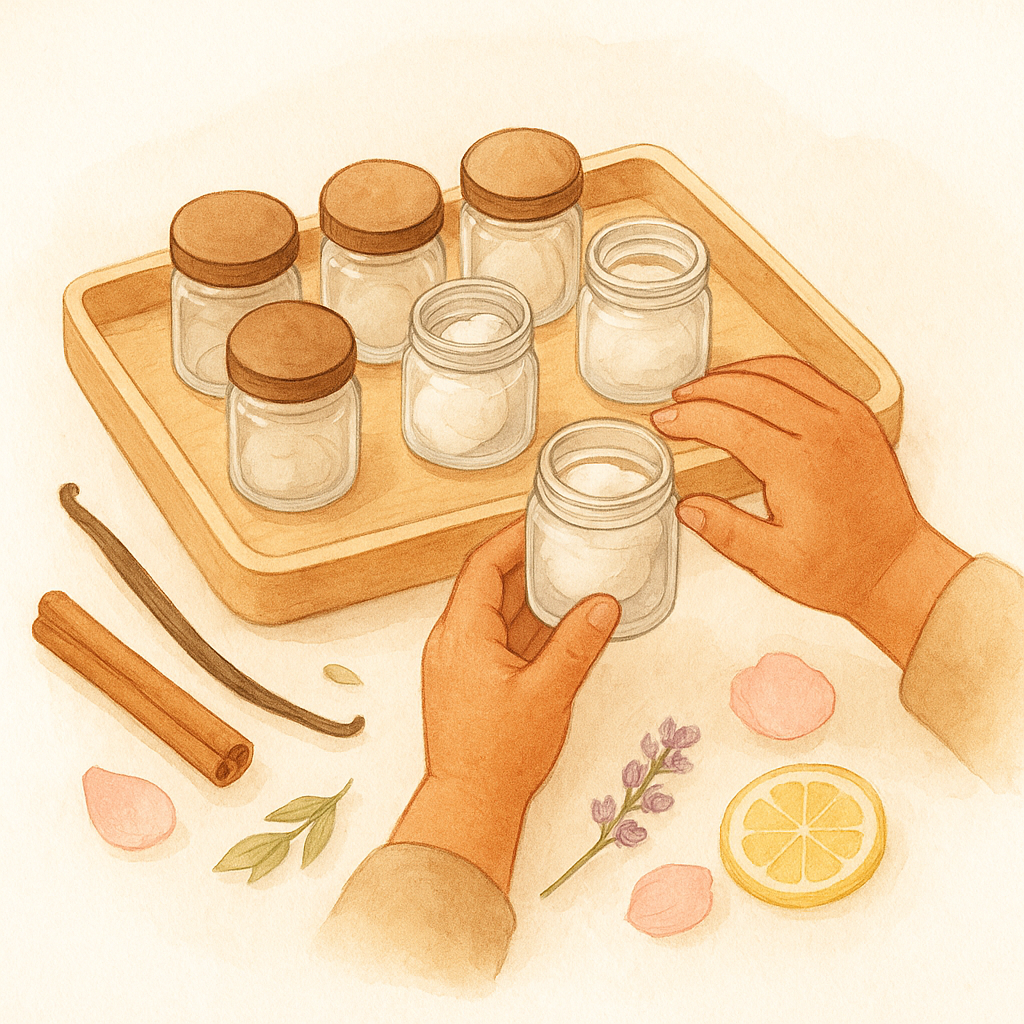
The exercise is beautifully simple: the child is presented with pairs of identical-looking bottles, each containing a distinct scent, and must match them using smell alone. This work builds concentration, refines olfactory discrimination, and expands the child's vocabulary as they learn to name and describe what they smell. It also lays a quiet foundation for later studies in botany, cooking, and the natural sciences.
The scent bottles are easy and inexpensive to make at home, and children love helping to prepare them — which is itself a wonderful practical life activity.
Materials
- 12 to 16 identical small containers with lids — old baby food jars, spice jars, small medicine bottles, or metal bandage tins all work well. The key is that every container looks the same so the child cannot distinguish pairs by sight.
- Cotton wool or cotton balls
- A small amount of vegetable oil (to help hold and diffuse the scent)
- 6 to 8 distinct, non-toxic scents — for example:
- Spices: cloves, cinnamon, nutmeg, ginger
- Liquid flavorings or essential oils: vanilla, almond, peppermint, lemon
- Flower petals or potpourri: lavender, rose, chamomile
- Other household scents: coffee grounds, orange peel, eau de cologne
- Muslin or cheesecloth (optional, for dry scents like potpourri or whole spices)
- Contact paper or opaque tape (if your containers are clear and the scent materials are visually different)
- A small tray, basket, or box for storing the bottles
If you would prefer ready-made supplies, these work well:
- Juvale 12 Pack Mini Glass Bottles with Cork Stoppers — ideal small glass jars for making your own scent bottles.
- Ankrs Essential Oil Set of 10 Natural Pure Aroma Oils — a convenient set of pure essential oils that provides a wide variety of scents for this exercise.
How to Make the Scent Bottles
- Take a small piece of cotton wool and place about a teaspoon of vegetable oil on it. The oil helps the cotton absorb and slowly release the scent.
- Add a few drops of your chosen scent (essential oil, liquid flavoring, or extract) to the oiled cotton.
- Cover the scented cotton with another small piece of cotton wool so the scent source is hidden inside.
- Place the cotton into one of your containers and seal the lid tightly.
- Prepare a second, identical bottle with the same scent — this is the matching pair.
- Repeat the process for each scent until you have 6 to 8 matched pairs (12 to 16 bottles total).
- For dry scents such as whole spices, dried herbs, or potpourri, you can sew small muslin bags to enclose the material, or simply cover the outside of clear jars with contact paper so the child cannot see the contents.
- Make sure that all bottles are visually identical. The child must rely entirely on the sense of smell to find the pairs.
- Store all the bottles together in a small basket, tray, or box on the sensorial shelf.
Tip: Refresh the scents periodically — cotton balls absorb odors over time and the scents will fade. Essential oils tend to last longer than liquid flavorings. You might keep a small notebook with the scent in each bottle so you can verify the child's work.
Presentation
- Invite the child to the lesson. Carry the tray of scent bottles to a table together.
- Begin with just two or three pairs (4 to 6 bottles). Remove the lids and set them aside.
- Mix the open bottles so they are no longer next to their pairs.
- Pick up one bottle. Hold it near your nose — not pressed against it — and inhale gently. Show the child how to waft the air above the opening toward the nose with a slow, gentle motion of the hand. This is the proper way to smell an unknown substance and is a skill they will use in science later on.
- Now pick up a second bottle. Smell it the same way. If it does not match, set it aside. Continue until you find the matching scent.
- Place the matched pair side by side and replace their lids.
- Invite the child to try. Let them work at their own pace, smelling and comparing until all pairs are matched.
- When the child is comfortable with two or three pairs, gradually add more pairs to increase the challenge.
Control of Error
The control of error is built into the material itself. When the child has matched all but the final pair, the two remaining bottles must share the same scent. If they do not smell the same, the child knows that an earlier pairing was incorrect and can go back and try again. This self-correcting feature is a hallmark of Montessori materials — it allows the child to work independently and learn from the material without needing an adult to say "right" or "wrong."
You can also place a small colored dot or number on the bottom of each pair so the child can turn the bottles over to verify after completing the exercise.
Purpose
- Direct aim: Refinement of the olfactory sense — the ability to discriminate, compare, and match scents.
- Indirect aims:
- Development of concentration and focused attention
- Building vocabulary — naming scents (lavender, cinnamon, peppermint) and using descriptive language (strong, faint, sweet, spicy, fresh)
- Developing logical thinking through the matching and pairing process
- Preparation for later work in botany, cooking, and science
Three-Period Lesson for Naming Scents
Once the child can match the bottles with confidence, you can introduce the names of the scents using the classic Montessori three-period lesson:
- Naming (Introduction): "This is lavender. This is cinnamon." Let the child smell each one as you name it.
- Recognition: "Can you show me the lavender? Which one is cinnamon?"
- Recall: Hold up one bottle and ask, "What is this?"
Begin with just two or three scents at a time and add more as the child masters them.
Extensions
- Grading by intensity: Prepare bottles of the same scent at different strengths (fewer or more drops of oil). Invite the child to arrange them from faintest to strongest. This parallels the grading work done with the Pink Tower, Cylinder Blocks, and Colored Tablets.
- Blindfold work: For the older child who is very comfortable with the exercise, offer a blindfold to further isolate the sense of smell and deepen concentration.
- Herb garden: Plant an herb garden with your child. Aromatic herbs such as rosemary, lavender, basil, thyme, and mint provide a living, hands-on way to exercise the sense of smell every day. The child can compare fresh herbs to dried ones, or use harvested herbs to make new scent bottles.
- Cooking connections: Use the herbs and spices from the scent bottles in real cooking lessons. Let the child smell the cinnamon before adding it to applesauce, or crush a basil leaf before tossing it into a salad. This connects the sensorial exercise to meaningful, everyday life — a core Montessori principle. See more ideas in our Washing Up and Early Practical Life articles.
- Nature walks: Take a walk outdoors and invite the child to notice and describe different natural scents — pine needles, damp earth after rain, flowers in bloom, fallen leaves. Bring small samples home to add to your scent collection.
- Scent memory game: Let the child smell a bottle, then set it aside. After a short wait, present several bottles and ask, "Can you find the one you smelled before?" This exercises olfactory memory.
- Making potpourri: Dry flower petals and herbs with your child to create homemade potpourri — a lovely practical life project that combines fine motor work, patience, and the sense of smell.
Montessori Context
The Scent Bottles belong to the sensorial area of the Montessori classroom. While exercises like the Sound Boxes train the auditory sense and the Color Nomenclature Cards refine visual discrimination, the Scent Bottles train the olfactory sense — often the most neglected in traditional education. Montessori believed that every sense deserves careful, systematic refinement during the sensitive period for sensorial development (roughly ages 2½ to 6). When a child can distinguish and name subtle differences in smell, they are not only sharpening a single sense — they are building the habits of careful observation, comparison, and classification that underlie all later intellectual work.
This is a joyful exercise. Children delight in the surprise of each scent, in the satisfaction of finding a match, and in the growing richness of language they gain as they learn to describe what their noses tell them. It is also a wonderful exercise to do at home — easy to prepare, endlessly variable, and a lovely way to slow down and pay attention to the small, fragrant details of daily life.