Montessori Reading
Published on: March 20, 2026
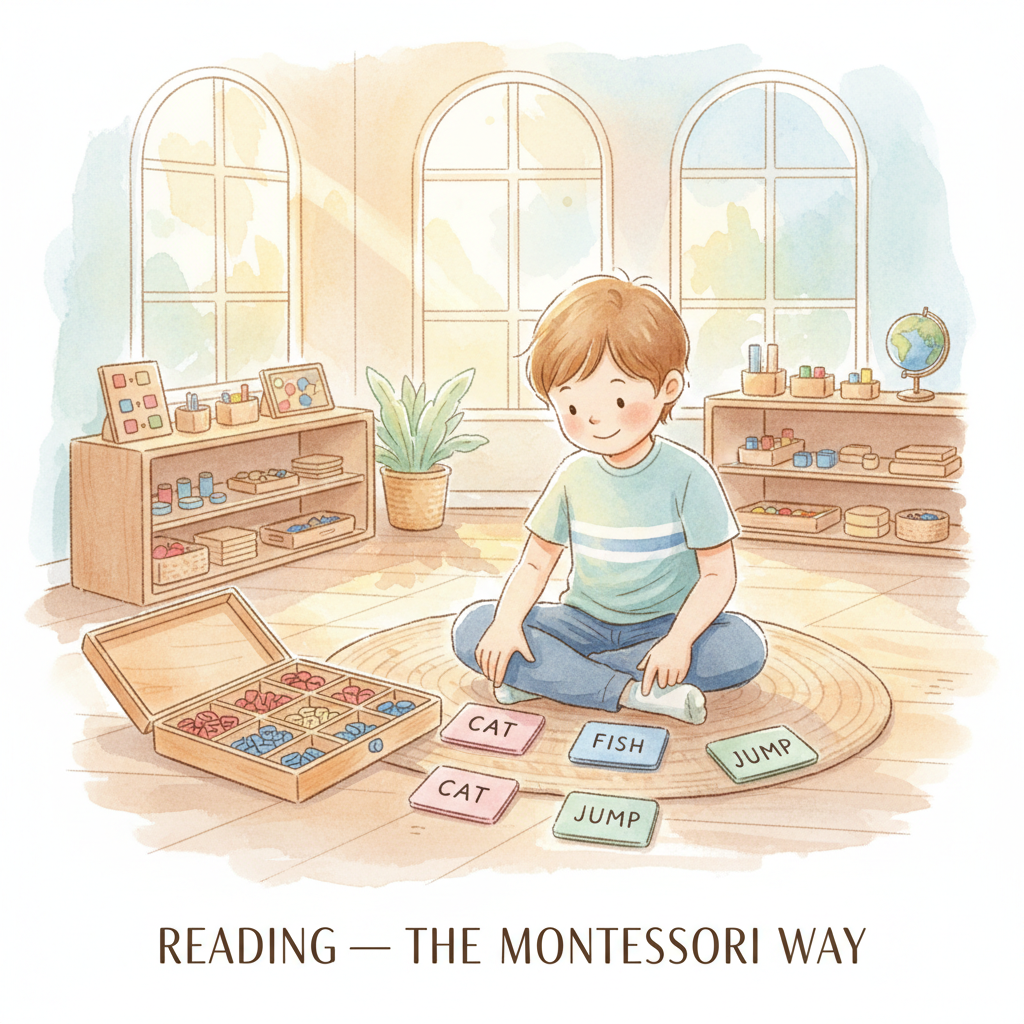
Reading — The Montessori Way
The sensorial lessons prepare your child for writing and reading. Comparing and contrasting shapes, colors, and ideas have been introduced and understood. The Sandpaper Letters or regular alphabet should be mastered, using all the short vowel sounds and hard consonant sounds. Spelling using the Moveable Alphabet usually follows — first spelling phonetic words with objects (cat, mat, pig), then with pictures.
And now, we are ready for writing and reading — child willing!
Materials
- Moveable Alphabet
- Pink, Blue, and Green reading cards (see free printouts below!)
- Small objects for labeling exercises
- Labels for objects and pictures
- Small booklets for writing sentences
Recommended:
- Montessori Pink Series Workbook — Introduction to reading 3-letter phonetic words with engaging activities and progressive exercises.
- Montessori Blue Series Workbook — The next step: blends, digraphs, and longer phonetic words.
Free Reading Card Printouts
Pink Reading Cards (Beginning — CVC Words)
Pink cards are for the first stage of reading: simple 3-letter phonetic words (consonant-vowel-consonant).
- Pink Reading Cards Set A
- Pink Reading Cards Set B
- Pink Reading Cards Set C
- Pink Reading Cards Set D
- Pink Reading Cards Set E
Blue Reading Cards (Intermediate — Blends & Digraphs)
Blue cards introduce consonant blends, digraphs, and longer phonetic words.
- Blue Reading Cards Set A
- Blue Reading Cards Set B
- Blue Reading Cards Set C
- Blue Reading Cards Set D
- Blue Reading Cards Set E
- Blue Reading Cards Set F
- Blue Reading Cards Set G
- Blue Reading Cards Set H
Green Reading Cards (Advanced — Phonograms)
Green cards cover phonograms and more complex spelling patterns.
Additional Reading Cards
How Montessori Reading Works
Step 1: Reading with the Moveable Alphabet
Some children already know how to read by this point. Others will need a review of all 26 letters and sounds. Start with matching exercises:
- Use 26 letters and 3 different picture cards (2 copies of each)
- Have your child match the identical pictures, spacing them apart
- Put labels under one set of pictures
- Have your child spell out the word on the unlabeled picture using moveable alphabet letters
Step 2: Labeling Exercise
Dr. Montessori used toys with labels for first reading exercises. As she wrote in The Montessori Method:
"We placed them in boxes and let the children search as they pleased among them. Every child finished emptying the box which he had under his hand, and only after that did he go on to another, truly insatiable for reading."
Make labels for familiar objects in the room (dog, mat, hat). Let your child match labels to objects. Start with phonetic words only.
Step 3: Box Exercises (Spelling Patterns)
Use small boxes or drawers, each containing objects and labels grouped by spelling pattern:
- Words ending in -ll: doll, bill, pill, gull
- Words ending in -ss: kiss, cross, lass, moss
- Words ending in -ff: muff, puff
- Words ending in -ing: king, wing, ring, sling
- Words ending in -ck: duck, rock, sock
- Challenge words: button, cotton, mutton
How Long Does It Take?
According to Dr. Montessori, about 15 days from when a child can write to when they begin reading! She noted: "Accuracy in reading almost always comes later than perfection in writing." Most Montessori children can read by the end of 2nd grade.
The Pink, Blue, and Green Reading System
Montessori reading progresses through three color-coded levels:
- Pink Series: Simple 3-letter phonetic words (CVC) — cat, dog, pen, mug
- Blue Series: Consonant blends and digraphs — step, clock, brush, ship
- Green Series: Phonograms and complex patterns — rain, boat, light, phone
Each level includes reading cards, word lists, and matching exercises. The free printouts above cover all three levels!
What This Develops
- Phonemic awareness — connecting sounds to written symbols
- Decoding skills — sounding out words independently
- Spelling — understanding spelling patterns and phonograms
- Comprehension — matching words to real objects builds meaning
- Love of reading — children become "truly insatiable for reading" as Montessori observed
See also: The Moveable Alphabet — the prerequisite spelling exercise, and Sandpaper Letters — for learning letter sounds.