Montessori Physical Education
Published on: May 14, 2026
Montessori Physical Education
Ages
2 to 6 years old
Montessori's Philosophy on Physical Education
Dr. Maria Montessori was deeply concerned with the physical development of young children. She observed that preschool children, whose body proportions are still larger in the upper body, should be spared the rigors of strict physical workouts. She believed that a young child's legs could be damaged by forced physical activity and that children should never be pushed beyond what their developing bodies were ready for.
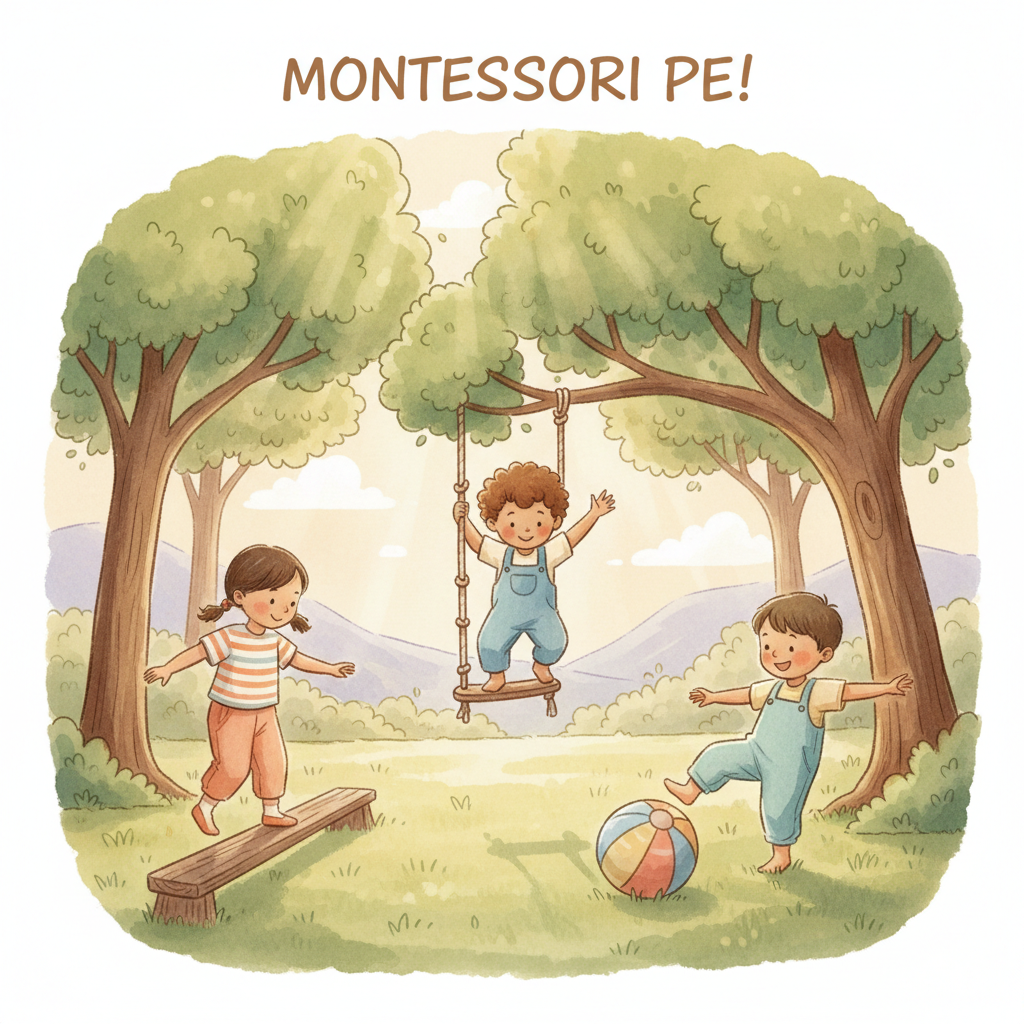
Montessori essentially believed in free play as a wonderful way to help a child develop muscles, coordination, and release extra energy. She did not require a gymnasium for preschool children, though she was initially criticized for providing physical education equipment in her schools. Her guiding principle was that the main physical activities should be the ones a child would continue to do later in life — such as hiking, swimming, and cycling.
Montessori also noted that one of the first objects of physical activity was to help a child breathe properly, which would eventually help the child pronounce words correctly. It is interesting to note that recent research links breathing and stuttering — part of the therapy for stuttering involves introducing proper breathing techniques, confirming Montessori's early observations.
Montessori's Observations on Young Children's Movement
Dr. Montessori observed that babies and small children crawled because their heavy upper bodies and large heads made it difficult to walk upright. She also noticed that preschool children often lay on their backs and moved their arms and legs about because it was an easy way to exercise their limbs without the stress of standing in an upright position. She believed benches should be provided for young preschool children to sit on whenever they were tired. The child's own body and rhythm should guide the activity — never the demands of an adult-imposed exercise routine.
This approach is very much in harmony with the Practical Life area of the Montessori classroom, where children develop coordination, concentration, and independence through purposeful movement at their own pace.
Montessori Physical Activities
Here are some of the physical activities Montessori recommended and used in her schools:
- Kites — flying kites encourages children to run, look up, and coordinate their hand movements with the wind
- Balls — rolling, throwing, and catching balls develops hand-eye coordination and gross motor skills
- Ladders — Montessori used rope ladders, but many modern slides and jungle gyms have excellent ladders for climbing
- Trampolines — Montessori's original version was a swing with a long bottom that kept the legs straight; the child would literally bounce off the walls, which helped strengthen the knees
- Low balance beams — with a railing for a young child to walk sideways, developing balance and spatial awareness
- Hanging ball — a plastic ball with a string attached, hung from the ceiling for the child to hit with a hand or a paddle, building coordination and timing
- Round stairs — marked with a pattern for a child to practice going up and down in a straight line, refining control of movement
- Stairs with a loft and slide — combining climbing with the joy of sliding down
- Tree houses with ladders — encouraging adventurous climbing in a natural setting
- Swimming — a lifetime activity that develops the whole body
- Cycling — building leg strength, balance, and independence
- Monkey bars and jungle gyms — developing upper body strength and grip
Many of these activities also connect beautifully with Sensorial Education, as children take in rich sensory impressions through movement — feeling the wind while flying a kite, sensing balance on a beam, or experiencing the texture of a rope ladder under their hands.
The Walking on the Line Exercise and The Silence Game
In the Montessori classroom, the Walking on the Line exercise is a cornerstone of physical education. Children walk carefully along an ellipse taped or painted on the floor, carrying objects such as a bell, a glass of water, or a flag. This exercise develops balance, coordination, and concentration — all without the stress of forced physical activity. It is a perfect example of Montessori's belief that purposeful, child-led movement is the best form of physical education.
The Silence Game is another beautiful Montessori activity that connects body awareness with self-control. Children learn to quiet their bodies completely, becoming aware of every small movement — a powerful exercise in both physical and emotional regulation.
Materials
Here are some wonderful materials that bring Montessori physical education to life at home:
- Pikler Triangle Climbing Set (7-in-1) — includes a ladder, slide, and climbing ramp, perfect for developing gross motor skills in a safe, child-sized environment
- Montessori Indoor Playground (8-in-1) — includes a climbing wall, monkey bars, and slide, offering a variety of physical challenges that align with Montessori's recommendations
Related Articles
- Practical Life — learn how purposeful movement activities build coordination and independence
- Early Practical Life — activities for the youngest children that develop gross and fine motor skills
- The Silence Game — a Montessori exercise in body awareness and self-control
- Sensorial Impressions vs Sensorial Education — how children learn through their senses and movement
- Toddler Scope and Sequence & Lesson Ideas — a guide to planning Montessori activities for toddlers