Lesson of the Day 36: The Five Great Lessons — Montessori Cosmic Education
Published on: April 11, 2026
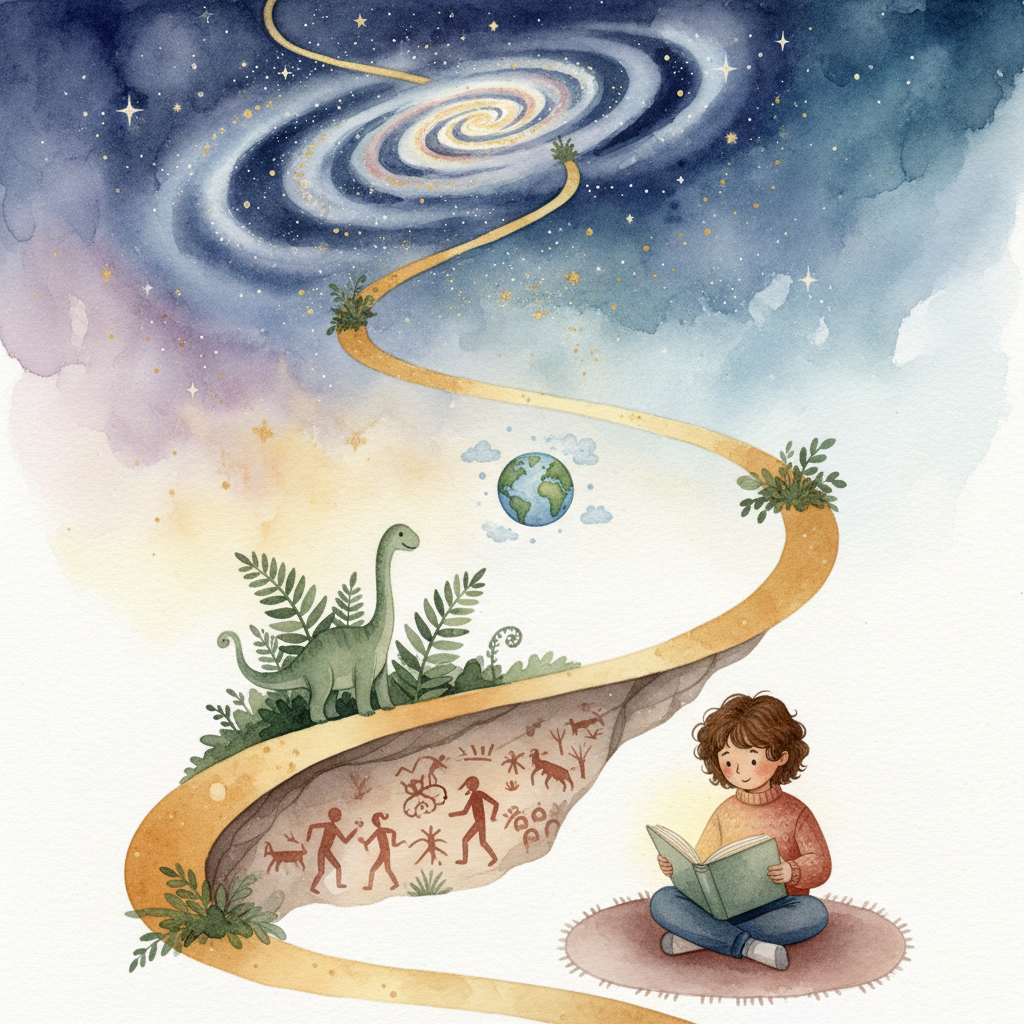
The Five Great Lessons — Montessori Cosmic Education
...u, u, u the universe sound, U makes a universe sound!
Cosmic Education is one of the most beautiful and ambitious ideas in Montessori elementary education. Maria Montessori believed that the elementary years (ages 6-12) are a sensitive period for absorbing vast amounts of information. She used the Five Great Lessons to ignite children's imagination and show them how all subjects — science, math, language, history, geography — are interconnected parts of one great story.
"The secret of good teaching is to regard the child's intelligence as a fertile field in which seeds may be sown, to grow under the heat of flaming imagination." — Maria Montessori
Recommended Reading
- Children of the Universe: Cosmic Education in the Montessori Elementary Classroom by Michael & D'Neil Duffy — The first complete book on Cosmic Education, explaining Maria Montessori's overall plan for the elementary curriculum.
- The Coming of the Universe: A Montessori Story — The First Great Lesson — A beautifully illustrated journey through cosmic history, from the Big Bang through the formation of galaxies, stars, and planets.
Why Cosmic Education?
Montessori believed that if you introduced advanced math, grammar, writing, reading, science, geography, languages, and history during the elementary years, children would build a strong foundation for all later learning. She observed that the most difficult academic years are the middle school years — and that children who had a rich elementary foundation could weather those challenges far better.
The Five Great Lessons provide a "Big Picture" that shows how all subjects fit together. Through these stories, children become aware that the universe evolved over billions of years, and that everything — from the smallest atom to the largest galaxy — follows patterns of law and order.
The Five Great Lessons
Lesson 1: The Story of the Universe (The Coming of the Universe)
This first and most dramatic lesson tells the story of how the universe began — from the Big Bang through the formation of galaxies, stars, and our solar system, to the cooling of the Earth and the formation of its layers.
What it introduces: Geology, geography, physics, astronomy, chemistry
Key demonstrations:
- Experiments showing the states of matter (solid, liquid, gas)
- Crystallization experiments
- Demonstrations of gravity and the expansion of matter when heated
- A simulated volcanic eruption
This connects to our Earth Science lesson, Space and Geography lesson, and Dinosaurs and Rocks lesson.
Lesson 2: The Coming of Life
This lesson tells the story of how life appeared on Earth — from the first single-celled organisms through the great diversity of life in the oceans, on land, and in the air. Children explore the Timeline of Life, seeing how different species appeared and disappeared over hundreds of millions of years.
What it introduces: Biology, zoology, botany, ecology, evolution
This connects to our Nature Studies lesson, Sprouts and Grow It Again lesson, and Dinosaurs and Rocks lesson.
Lesson 3: The Coming of Human Beings
This lesson tells the story of how humans appeared on Earth and how they used their unique gifts — their hands for making tools and their minds for thinking — to create civilizations. Children explore early human history, tools, shelter, clothing, art, and the development of culture.
What it introduces: History, civilizations, anthropology, archaeology
Activity idea: Let each child pick a civilization to study — research, write a script for a play, or create art that reflects that culture. One classroom used the play "The Golden Apple" to study Greek culture in a hands-on way.
This connects to our Earth Day and Folk Art lesson about cultural expression.
Lesson 4: The Story of Writing (Communication)
This lesson tells the story of how humans developed writing and communication — from cave paintings and pictographs through the invention of alphabets and the printing press. Children discover that writing evolved from the human need to communicate across distance and time.
What it introduces: Language, reading, writing, grammar, communication history
This connects to our Sandpaper Letters, Moveable Alphabet, Phonogram Words, and Montessori Reading articles.
Lesson 5: The Story of Numbers
This lesson tells the story of how humans developed mathematics — from the earliest counting systems through different number bases, measurement, and the great mathematical discoveries. Children learn that numbers arose from practical needs like counting livestock, measuring land, and tracking the passage of time.
What it introduces: Number theory, number systems, measurement, mathematics history
This connects to our Counting Chains and Bead Stair lesson, Number Rods, Golden Bead Material, and Calendars and Clocks lesson.
How to Present the Great Lessons
The Great Lessons are meant to be told as stories — dramatic, engaging narratives that spark the imagination. Here are key principles:
- Tell them at the beginning of each school year — even children who have heard them before enjoy them again, and each retelling takes them on deeper paths of exploration
- Use demonstrations and experiments — the First Great Lesson traditionally includes chemistry demonstrations (dissolving, crystallization, volcanic eruption)
- Give children time to ponder — after hearing the stories, children should have time to reflect, ask questions, and choose follow-up research topics
- Let the stories lead to all subjects — the genius of the Great Lessons is that every academic subject connects back to these five stories
The Big Idea: Everything Is Connected
The most powerful insight of Cosmic Education is that everything is connected. The universe story leads to the earth story, which leads to the life story, which leads to the human story, which leads to the stories of writing and numbers. Each child is part of this great cosmic narrative.
When a child studies geology, they're continuing the First Great Lesson. When they study biology, they're continuing the Second. When they learn to read and write, they're part of the Fourth Great Lesson — the ongoing story of human communication. This gives every subject meaning and context.
Look at how many of our Lessons of the Day connect to the Great Lessons — from Dinosaurs and Rocks to Space and Geography to Calendars and Clocks. Each one is a thread in the great cosmic tapestry!
Disclosure: Some links on this page are affiliate links. As an Amazon Associate, MontessoriMom earns from qualifying purchases. This costs you nothing extra.