Lesson of the Day 35: Counting Chains and the Bead Stair — Montessori Math Adventures
Published on: April 10, 2026
Counting Chains and the Bead Stair — Montessori Math Adventures
...c, c, c the counting sound, C makes a chain sound!
Counting is such an important part of math skills, and young children love to count! One day, Maria Montessori was introducing older children to the colored bead chains to teach them square roots. The younger children loved the long chain for the 1000 cube so much that they started counting the beads by tens. Later, the children used arrows to mark the count. This beautiful moment — where children spontaneously discovered linear counting — is one of the most famous stories in Montessori education.
Recommended Materials
- BOHS Montessori Bead Stair Set (1-10) — Color-coded bead bars with a sorting tray. Each bar represents a number from 1 to 10 in the traditional Montessori colors. Perfect for counting, addition, and understanding number quantities.
- BOHS Montessori Bead Chains & Squares — Colored bead chains for skip counting, multiplication, and square number learning. Includes arrow markers for marking the count along the chain.
Free Printouts
This lesson includes a rich collection of counting and bead stair printables:
- 1000 Chain Counting Arrows — Arrow markers for the counting chain exercise
- Blank Counting Arrows — For children to write their own numbers
- Short Bead Stair Coloring Page — Color the bead stair in the traditional Montessori colors
- Bead Stair Reference
- Counting 1-10
- Counting Cards Set 1, Set 2, Set 3, Set 4
- Number Tiles
The Short Bead Stair
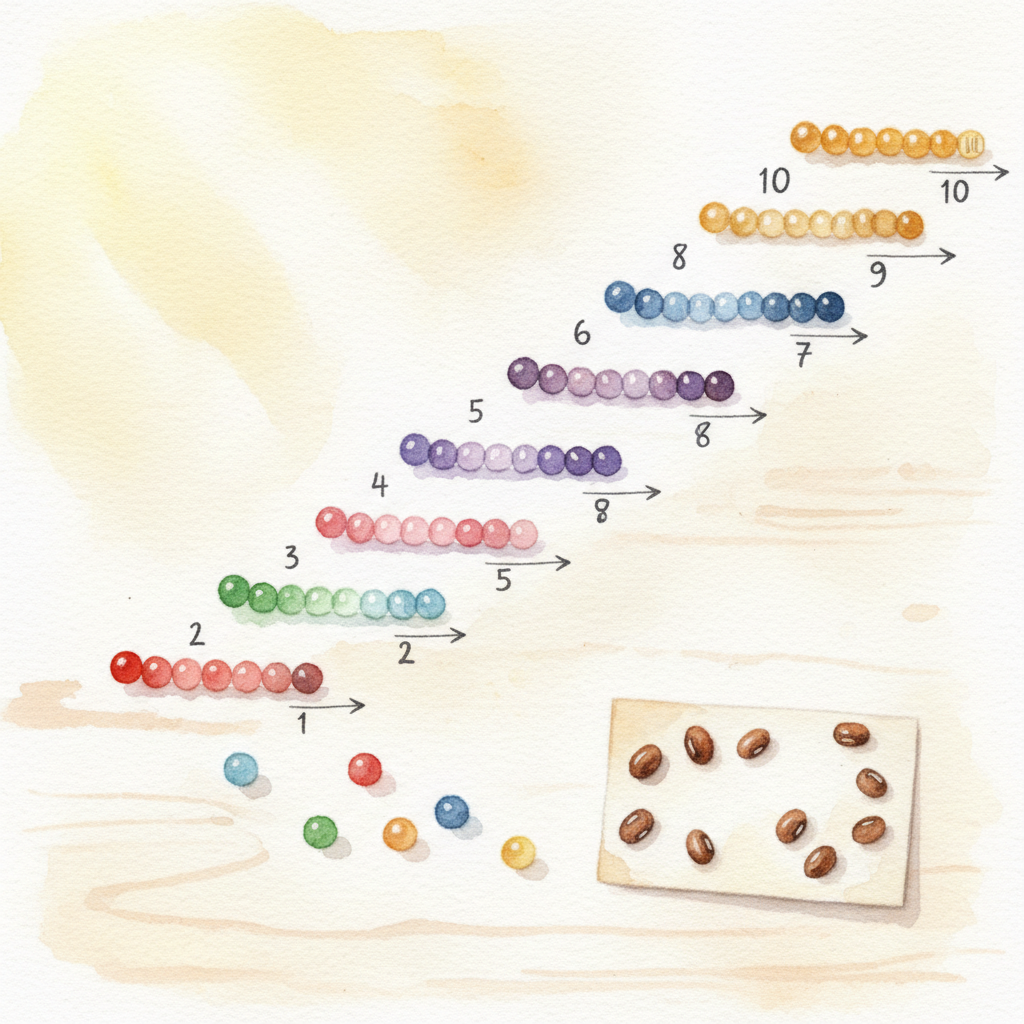
The short bead stair is one of the most beautiful Montessori math materials. It consists of colored bead bars from 1 to 9, each in a specific color:
- 1 — Red (one bead)
- 2 — Green (two beads)
- 3 — Pink (three beads)
- 4 — Yellow (four beads)
- 5 — Light blue (five beads)
- 6 — Purple (six beads)
- 7 — White (seven beads)
- 8 — Brown (eight beads)
- 9 — Dark blue (nine beads)
- 10 — Golden (ten beads — the "ten bar")
Children arrange these from shortest to longest, creating a "staircase" that makes the concept of increasing quantity beautifully visible. Print our Bead Stair Coloring Page for children to color using the traditional Montessori bead colors!
Activities with the Bead Stair
- Ordering: Arrange the bead bars from 1 to 10 to form the stair
- Addition: Combine two bead bars to make a ten bar (1+9, 2+8, 3+7, 4+6, 5+5)
- Comparing: Which is more — 4 or 7? Line up the bead bars to see!
- Number names: Use the three-period lesson to connect each bead bar to its numeral
The Counting Chain
The counting chain is a long chain of beads used for linear counting. The 100 chain has 10 sets of 10 beads, and the 1000 chain has 100 sets of 10 beads! Children lay the chain out in a long line and place numbered arrow markers along it to mark the count.
Make Your Own Counting Chain
You don't need to buy expensive bead chains — here's how to make your own!
What you need:
- 100 note cards (for a 1000 chain) or 10 cards (for a 100 chain)
- 1000 beans or other small objects (100 for the 100 chain)
- Glue
- Yarn or twine
- Hole punch
Steps:
- Glue 10 beans on each note card, arranged in a vertical row
- Punch a hole at each end of the card
- Tie the cards together with yarn or twine
- Print out the counting arrows and place them alongside the chain
- Count together — 10, 20, 30, 40... all the way to 100 (or 1000)!
Tip: You can also purchase garlands of beads during the holiday season — they make wonderful counting chains!
Skip Counting
The counting chain naturally teaches skip counting — counting by 2s, 5s, 10s, and beyond. This is the foundation for multiplication!
- Count by 10s: Use the 100 or 1000 chain with arrow markers at every 10th bead
- Count by 5s: Place arrows at every 5th bead on a shorter chain
- Count by 2s: Touch every other bead on the chain
When children count "10, 20, 30, 40, 50..." along the chain, they are discovering multiplication without even knowing it. Later, they'll connect this to "10 × 1 = 10, 10 × 2 = 20, 10 × 3 = 30..."
Connection to Other Math Materials
The counting chain and bead stair connect to many other Montessori math materials:
- Number Rods — Both teach quantity in a linear way, but rods are for younger children
- Golden Bead Material — The ten bars from the bead stair are the same golden beads used in the decimal system
- Addition Snake Game — Uses the short bead stair for addition practice
See also: Lesson 32: Calendars and Clocks for more math connections with time, and Lesson 30: Space and Geography for the coordinate system that uses numbers to locate places.
Disclosure: Some links on this page are affiliate links. As an Amazon Associate, MontessoriMom earns from qualifying purchases. This costs you nothing extra.