Snake Game (Addition) — Montessori's Hands-On Path to Addition and Composing Ten
Published on: June 30, 2007
Snake Game (Addition)
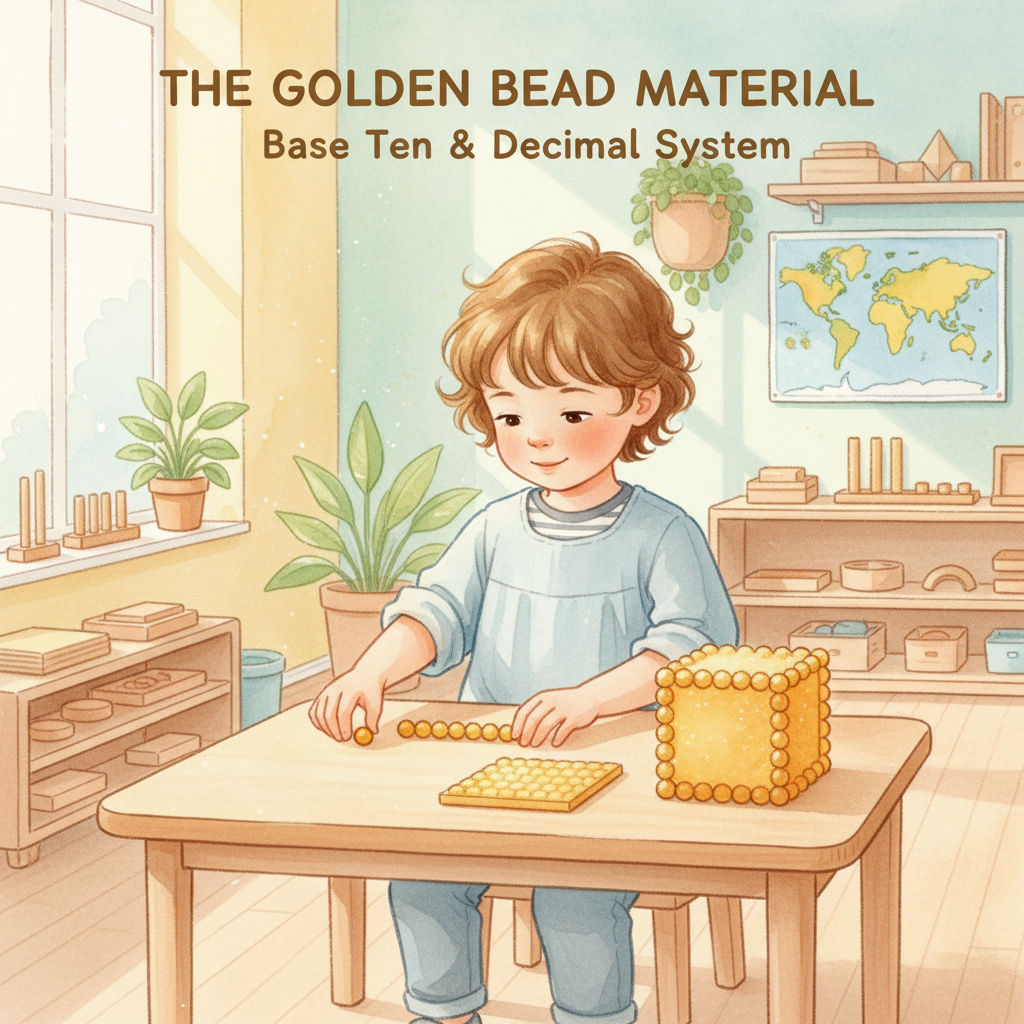
Ages
5½ years and older — once the child knows the Short Bead Stair and the Golden Bead Material.
Free Printouts
Download the Colored Bead Stair printout (PDF) — print and cut your own colored bead bars 1–9 if you don't yet own the material.
Download the Golden Bead Material printout (PDF) — ten-bars and units for building the golden chain.
Purpose
The Snake Game teaches the addition tables while giving the child a concrete, sensorial experience of composing ten and changing number systems. Working with the golden beads, the child internalizes base ten, lays the groundwork for multiplication and division, and meets the law of equality that underpins later algebra — all through hands-on play.
Materials Needed
- Colored short bead stairs — at least 3 sets (bars 1 through 9, each a different color)
- Golden ten-bead bars — at least 7
- A black-and-white bead stair — bars 1 through 9 (1–5 all black; the 6-bar is 5 black + 1 white, the 7-bar 5 black + 2 white, and so on)
- An empty box for exchanged bars and a felt mat or heavy cloth place mat
If you'd like ready-made materials for home or classroom, the Montessori Colored Bead Stairs (5 sets) and the Montessori Golden Bead Bars are both well-reviewed and durable.
Presentation
Place the mat on a table. Using the colored short bead stairs, build a "snake" of bead bars, laid straight from left to right to avoid confusion. Technically the bars can go in any order, but it helps to plan the snake so the bars pair up to make tens — this makes the checking exercise easier later. For example, pair a 9-bar with a 1-bar elsewhere in the snake, an 8-bar with a 2-bar, a 7-bar with a 3-bar, a 6-bar with a 4-bar, and a 5-bar with another 5-bar.
Here is an example first snake:
1 + 6 + 2 + 8 + 2 + 5 + 4 + 6 + 5 + 3 + 9 + 7 + 9 + 4 + 1
Set the black-and-white bead bars in a triangle stair from 1 to 9 at the edge of the mat.
Now count the beads along the snake, starting at one end and stopping each time you reach 10. (With the example above, the first ten lands one bead into the 8-bar.) A sharp pencil makes a handy pointer — let the pencil lead hold the "ten" place. Each time you complete a ten, replace those colored bars with a golden ten-bar, and use a black-and-white bar for the remainder. Continue down the whole snake until it has become a row of golden ten-bars with a single black-and-white remainder bar — in the example, 7 golden ten-bars and 1 black 2-bar.
Checking Your Work
Take the colored bead bars back out of the box and pair them into tens (8 + 2, 9 + 1, 7 + 3, 6 + 4, 5 + 5, and so on). Lay these pairs against the row of gold bars to confirm the totals match, using a green 2-bar to stand in for the black remainder bar. If your child is left with bars that don't pair neatly — say two 6-bars and an 8-bar — show how the 8-bar can be exchanged for two 4-bars, so the two 6-bars and two 4-bars make two more golden tens.
Try This
- Make ten: Gather all the 9-bars. Place one in front of your child, count to nine together, and ask them to find "one more to make ten." Sort the rest of the bars into groups and keep composing tens until every bar is used.
- Easier snake: Build a snake whose total is an exact multiple of ten (no remainder) for a gentler first success.
Where to Go Next
Once the addition Snake Game feels comfortable, move on to the Negative Snake Game (Subtraction), or extend counting work with the Counting Chain Arrows and the Pink Tower and Counting activity. For more printable math materials, visit our Math Printouts page.