Lesson of the Day 17: Clouds and Weather
Published on: March 13, 2012
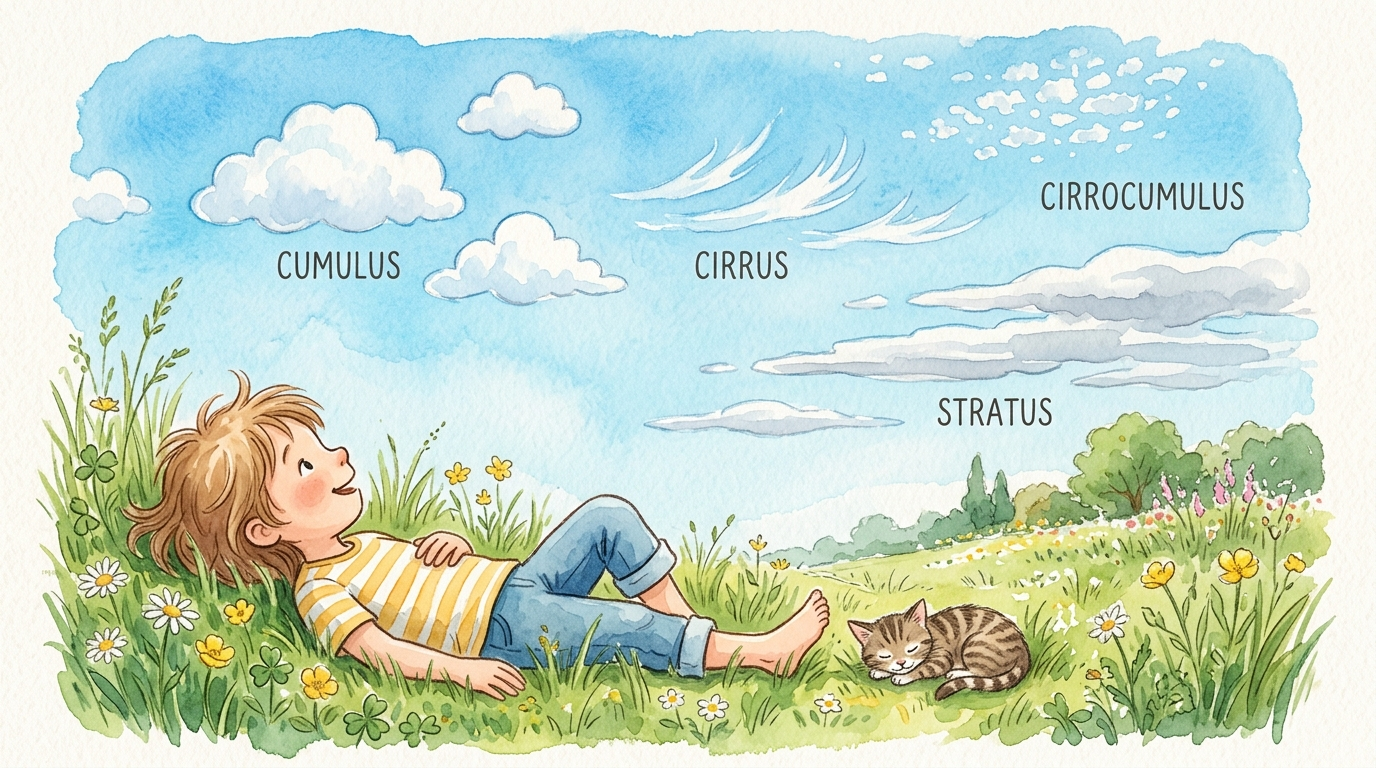
"The sky is the daily bread of the eyes." — Ralph Waldo Emerson
Weather is a constant in our environment — something you can observe and study with your children every single day. Clouds, in particular, are one of nature's most dramatic and ever-changing displays. They drift, build, darken, and dissolve right before our eyes. In this lesson, we'll explore how clouds form, what their colors tell us, and how to identify the three main types. Step outside with your little ones and look up — the sky is your classroom!
🎒 Materials You'll Need
- A cloud identification chart or poster (Cloud Identification Chart on Amazon)
- A weather observation journal or plain notebook for sketching clouds
- Cotton balls, glue, and blue construction paper (for cloud art)
- A glass jar, hot water, ice, and hairspray (for the cloud-in-a-jar experiment)
- Colored pencils or crayons
- A blanket for outdoor cloud watching
- 👉 Weather Chart and Calendar Set on Amazon
- 👉 Weather Station Kit on Amazon
🔎 Free Printouts
Use these free printable resources to extend the lesson:
- 📄 Hurricane Printout — Learn about this dramatic weather event connected to clouds and storms
☁️ Part 1: How Do Clouds Form?
Clouds are part of our atmosphere — the sky around us — where there are many gases, such as oxygen, nitrogen, carbon dioxide, and water vapor.
When water evaporates, it becomes water vapor and rises up into the atmosphere because it is lighter than the air around it. As it goes higher, the temperature gets colder. The water vapor condenses — turning back into tiny water droplets or ice crystals — and those droplets gather together to form clouds.
Here's the magical part: when water is a gas, you can't see it in the sky. Once it turns back to liquid or ice, it becomes visible as a cloud!
🔬 Try This: Observe the Bottom of Clouds
Go outside with your child and look up at the clouds together. Ask these guiding questions:
- Do the bottoms of the clouds look like the bottom of an egg carton? These clouds have a large amount of rain and are ready to drop lots of water.
- Are the clouds thin and wispy? These clouds have very little water in them — expect fair weather!
🎨 Part 2: The Color of Clouds
Usually clouds are white, but sometimes they look gray. Clouds turn gray when they are full of water. A very dark gray cloud is called a thundercloud.
Have you ever heard thunder? Thunder happens after lightning. Here's a fun observation activity for your child:
Counting the Storm: If you see lightning, count slowly until you hear the thunder. Each number you count tells roughly how many miles away the lightning was. If you counted to 6, that means the lightning was about 6 miles away from you!
A greenish cloud usually has hail in it. When hail falls, it's like round ice cubes hitting the ground, cars, and even your house. Children are fascinated by hail — if you ever experience it safely, collect a few pieces on a tray for observation!
🌧️ Part 3: What Happens to Clouds?
After a cloud's water falls to the ground as rain, the cloud turns back into a gas (water vapor) and seems to disappear. This is all part of the beautiful water cycle — evaporation, condensation, precipitation — happening right above our heads every day.
🌫️ What Is Fog?
Fog is simply a cloud that sits on the ground! You can actually walk through a cloud when it's foggy outside. Children love this idea — next time it's foggy in the morning, step outside together and tell them they're walking inside a cloud.
🌙 How Clouds Help Our Weather
Clouds act like a blanket at night, covering the earth and keeping it warm. During the day, clouds help keep us cooler by blocking some of the heat from the sun. They are nature's own temperature regulators!
🌤️ Part 4: The Three Main Types of Clouds
There are at least 30 names for different kinds of clouds, but the three main types are a wonderful place to start with young learners:
- Cirrus (SEER-us) — These clouds are the highest in the sky. The word "cirrus" means curl, which describes these wispy, feathery clouds perfectly. They look like delicate white brushstrokes painted across the sky.
- Stratus (STRAT-us) — These clouds sit at the middle level of the sky. "Stratus" means layers. They often spread out like a smooth gray blanket covering the sky.
- Cumulus (KYOOM-you-lus) — These clouds are closest to the ground. "Cumulus" means swelling or heap. These are the big, fluffy, cotton-ball clouds children love to find shapes in!
☁️ Activity: Cloud Watching & Identification
Spread a blanket in your yard or at a park and lie down together. Look at the clouds and try to determine what type they are:
- Are they low to the ground or up high?
- What shape is the cloud?
- Are they thick and fluffy, or thin and wispy?
- What color are they — white, gray, or dark?
Encourage your child to sketch what they see in their weather journal and label each cloud with its type. Even very young children can learn the three names with a little practice!
🎨 Extension Activity: Cotton Ball Cloud Art
Using blue construction paper, cotton balls, and glue, your child can create each type of cloud:
- Cirrus: Pull cotton balls into thin, wispy strands and place them high on the paper
- Stratus: Flatten cotton balls into layers and spread them across the middle of the paper
- Cumulus: Use fluffy, round cotton balls near the bottom of the paper
Label each cloud type together — this makes a lovely addition to a nature notebook or classroom wall!
💡 Montessori Connection
Weather observation is a cornerstone of Montessori's approach to cosmic education. By watching clouds daily, children develop their powers of observation, learn scientific vocabulary naturally, and begin to see themselves as connected to the larger world around them. Keep a simple weather chart by the door and make cloud-watching part of your morning routine. Over time, your child will begin predicting the weather just by looking up at the sky — what a gift!
Also be sure to check out Lesson of the Day 3 for more cloud and weather activities!