Lesson of the Day 15: Shapes in Architecture and the World Around Us
Published on: July 11, 2011
"The hands are the instruments of man's intelligence." — Maria Montessori
Shapes are truly everywhere — in the buildings we walk through, the bridges we cross, the furniture we sit on, and even in our own faces and fingers! In this lesson, we take the geometric shapes your child has been exploring in previous lessons (circles, rectangles, triangles, and fractions) and bring them into the real world through architecture and art. Montessori used geometric shapes to teach the basics of math, reading, and writing, and these beautiful forms are also the building blocks of the structures and artwork all around us.
This lesson is a wonderful family-friendly activity — everyone can join in the building fun! 🏗️
🎒 Materials You'll Need
- Printed geometric shape cutouts — circles, rectangles, triangles (see free printouts below)
- Straight edge or ruler, compass, and protractor
- Old CDs — for tracing circles, arches, half circles, and spirals
- Old CD cases — for tracing squares (can be cut into rectangles, triangles, and other shapes)
- Saucepan lids — great for younger children to trace
- Scissors (child-safe)
- Glue and tape
- Assorted recyclable boxes and containers (see Construction Containers list below)
- Crayons, markers, or paint for decorating
- 👉 Montessori Geometric Cabinet Puzzles on Amazon
🔎 Free Printouts
Use these free printable resources from previous geometry lessons to support this activity:
- 📄 Geometric Cards – Circles — Circle shapes for cutting and building
- 📄 Fraction Game – Pie Wedges — Great for arches, domes, and decorative elements
- 📄 Curved Shapes — Explore curved geometric forms
- 📄 Curved Shapes (Solid) — Solid curved shapes for tracing and cutting
- 📄 Cylinder Cards — Learn about 3D cylindrical forms
- 📄 Fraction Cards — Additional fraction shapes for building
🏛️ Part 1: Discovering Architectural Shapes
Shapes in the Built World
Some architectural shapes are easily spotted in buildings, shopping malls, furniture, light fixtures, fireplaces, windows, columns, and bridges. Some of these shapes are three-dimensional — like cubes, rectangular prisms, ovals, and spheres — while others are two-dimensional polygons: squares, triangles, circles, and rectangles.
Take a moment with your child to look around your home or neighborhood. Can they spot rectangles in windows? Circles in doorknobs? Triangles in rooftops? Cylinders in columns? This kind of observation is pure Montessori — connecting the abstract to the concrete world.
Shapes in Art & Nature
Sculptures and paintings also display various shapes — circles, triangles, rectangles, and squares appear in artwork across every culture and era.
And here's something delightful to explore with your child: nature, our faces, fingers, and toes sometimes mirror architectural shapes and designs! Fingers resemble columns, eyebrows look like curved windows, lips are shaped like a couch, and some rock formations are nature's own skyscrapers. Encourage your child to find these connections — it builds observation skills and sparks creative thinking. 🌿
✂️ Part 2: Making Architectural Shapes
Activity 1: Cut & Create Geometric Forms
Print out the geometric shape printouts linked above. Have your child cut out the circles, rectangles, and triangles in their original forms. You can add more dimension by cutting the shapes in halves or quarters — this reinforces fraction concepts from previous lessons!
Activity 2: Tracing & Designing Custom Shapes
Use a straight edge or ruler, a compass, and a protractor to create unique shapes together. Here are some fun tracing ideas:
- Old CDs: Trace to make circles, arches, half circles, and spiral-type shapes
- Old CD cases: Trace to make squares, then cut those squares into rectangles, triangles, and other interesting forms
- Saucepan lids: Perfect for younger children — easy to hold and trace
Activity 3: Body Tracing Designs
Trace your child's hands, arms, legs, feet, and toes to make interesting architectural-inspired designs. How do fingers look like columns? Can a traced hand become the frame of a building? Let your child's imagination lead! ✋
📦 Part 3: Box Art — Building with Shapes
Constructing with Recyclables
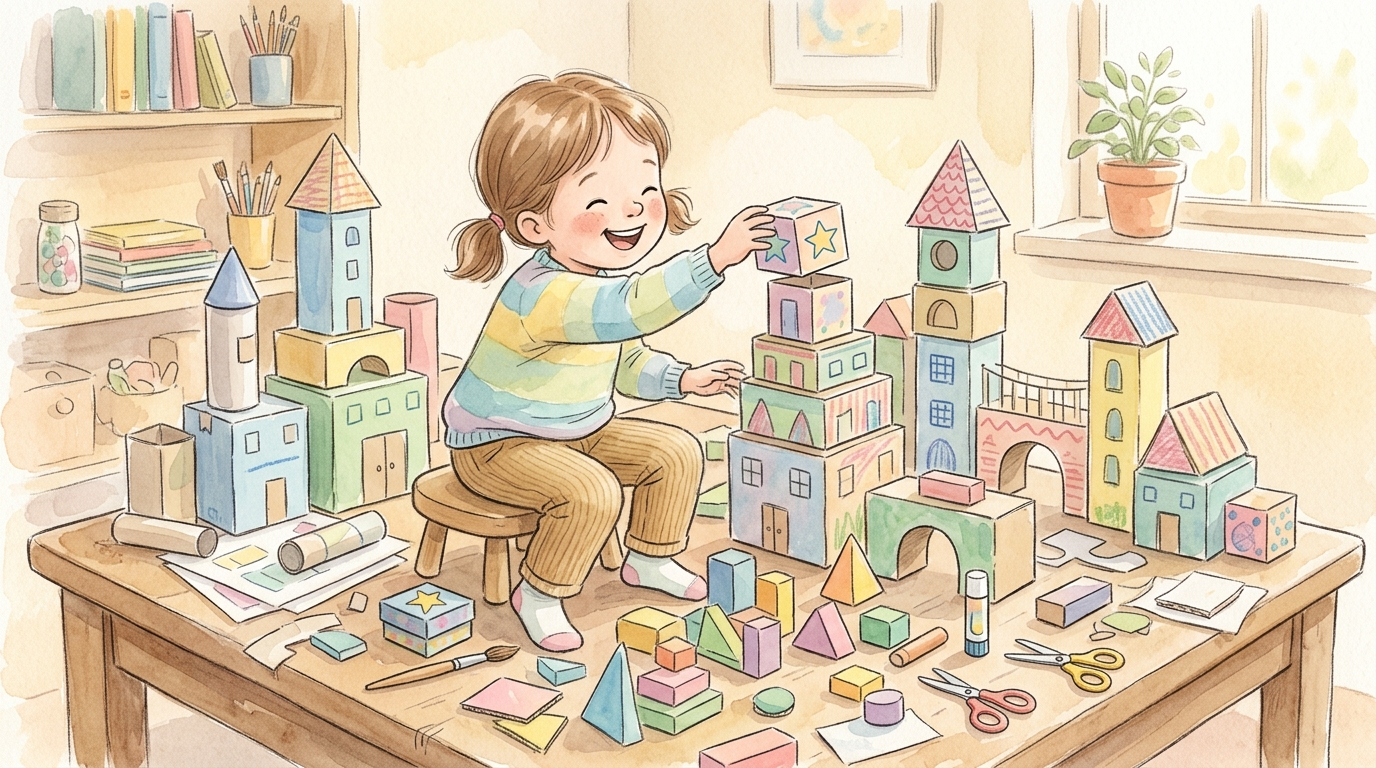
Collect different sizes and shapes of boxes — both cylinder and rectangular forms work beautifully. Help your child glue or tape the boxes together to build their favorite object. It can be a house, a building, a bridge, or an abstract sculpture!
- Make bricks from cartons
- Create columns from cylinders
- Fashion a turret roof from a circle cutout
🏠 For Younger Children: A Box Playhouse
Use a large box that your child can sit or walk into. Cut out windows and a door for them, then let them decorate their house or cabin with the geometric shapes they've made. This is a truly magical activity for little ones — they get to live inside their geometry lesson!
🧱 Construction Containers to Collect
- Shoe boxes
- Oatmeal cylinder boxes
- Cereal boxes
- Pasta boxes
- Salt boxes or cylinders
- Clean milk cartons (tape down the spout into a rectangular shape)
- Yogurt, margarine, or cheese tubs
Start collecting these a week or two before the lesson — you'll be surprised how quickly you gather a wonderful building supply! ♻️
🎤 Part 4: Speech Time — Show & Tell
Once your child's creation is complete, let them display their work and talk about it. Ask guiding questions:
- What shapes did you use?
- Why did you choose those shapes for that part of your building?
- What is your favorite part of your creation?
- Can you find similar shapes in our house or neighborhood?
This presentation practice builds confidence, vocabulary, and the ability to articulate ideas — all essential Montessori skills. 🌟
💡 Phonics Corner
B, b, b — the box sound "B" makes a box sound! As your child works with boxes, reinforce the letter B and its sound. Box, build, bridge, brick — so many wonderful B-words in this lesson!
🔗 Looking Back
This lesson builds beautifully on the geometry foundations from previous days:
- Lesson 11: Rectangles
- Lesson 12: Circles
- Lesson 13: Triangles
- Lesson 14: Fractions
By connecting shapes to architecture and art, your child sees that geometry isn't just something on paper — it's the language of the world around us. Happy building! 🏗️